You may feel your Texas family law case was handled unfairly, then discover that the appeal deadline has already passed. Perhaps you're a parent who just saw a final custody order in the clerk's portal, or a spouse who opened the mail and found a property division judgment signed without understanding its effect. The immediate reaction is usually the same: fear that the chance for review is gone.
The situation is serious, but the right response is not panic. It's deadline triage. The first hours and days after discovering the problem matter because a narrow filing window may still exist, and even after that window closes, a lawyer can evaluate other procedural remedies. This guide focuses on the difficult question behind the search for “appeal deadline missed what to do Texas,” including what remains possible after the ordinary deadline and the Rule 26.3 grace period have expired.
When the Deadline Slips Past You in a Texas Family Case
A parent in Houston checks the district clerk's portal after a final custody order was signed. The parent thought there was more time to appeal, but the portal now reflects a notice or dismissal-related filing. A spouse in San Antonio opens a letter and learns that a default divorce judgment has already divided property and assigned support obligations. Neither person intended to give up appellate review. Both may have relied on incomplete information, a misunderstanding about the order's finality, or an assumption that trial counsel was handling the next filing.
That moment is common in family litigation because orders can arrive after hearings, amended pleadings, post-judgment motions, or service problems. A custody order may also fall into an accelerated appeal category, which creates a shorter filing period than an ordinary divorce judgment. The legal system treats deadlines strictly, but the human error behind a missed deadline still deserves a careful review.
Practical rule: Don't spend the first day arguing that the judgment was unfair. First establish which date controls, whether the case is accelerated, and whether any filing already extended or changed the deadline.
Texas generally requires a notice of appeal within 30 days after the judgment is signed in an ordinary civil or family law appeal. A timely qualifying post-judgment motion can extend that period to 90 days, while an accelerated appeal generally requires filing within 20 days. These rules appear in Texas Rule of Appellate Procedure 26.
If the ordinary deadline has passed, Texas provides a limited 15-day extension window. The late notice and extension request must satisfy the appellate rules, and the motion must include a reasonable explanation for the delay. Once that window closes, an appellate court generally lacks jurisdiction to hear a conventional appeal. That doesn't mean every legal remedy disappears. It means the case needs a different procedural strategy.
Locking Down the Date That Actually Controls Your Appeal Clock
A reliable deadline calculation starts with the signed order, not the hearing date, the date you received a copy, or the day you decided to challenge the ruling. Obtain the file-stamped final judgment from the district clerk's records and identify the date the judge signed it. Then determine whether the order is final, modified, interlocutory, or subject to an accelerated appeal rule.
Start with the order and case classification
Read the title and decretal language carefully. A final divorce decree usually resolves the case, while a temporary custody order or another interlocutory order may follow a different appellate path. Some family matters, including parental-termination proceedings and other statutorily accelerated matters, can require faster action. In an accelerated appeal, the notice deadline is 20 days, not the ordinary 30-day period. Texas appellate materials describe the ordinary and accelerated timing rules and recognize special timing for certain juvenile adjudications under Texas Family Code section 56.01.
Next, inspect the docket for post-judgment filings. A timely motion for new trial, motion to modify, motion to reinstate, or qualifying request for findings can extend an ordinary appeal deadline to 90 days from the date the judgment was signed. The motion doesn't restart the clock from the date you filed it. It changes the applicable calculation under Rule 26.1.
Check notice problems under Rule 306a
Rule 306a can matter when a party didn't receive timely notice of the judgment or acquire actual knowledge of it. That relief isn't automatic. The party must make the required sworn showing, and the allegations must address timely notice and actual knowledge for both the party and every attorney whose notice matters. A lawyer should compare the clerk's certificate, service records, docket entries, and correspondence before relying on a delayed starting date.
| Case Type | Triggering Event | Deadline Length |
|---|---|---|
| Ordinary appeal | Judgment signed | 30 days |
| Ordinary appeal with a qualifying timely post-judgment motion | Judgment signed, with the motion affecting the appellate timetable | 90 days |
| Accelerated appeal | Judgment or order signed | 20 days |
| Rule 26.3 extension | Original deadline passes, with required filings inside the permitted window | 15-day extension window |
The appellate record also matters because the reviewing court generally considers what appears in the clerk's and reporter's records. The Appellate Record: Clerk's and Reporter's Records explains why the record determines what an appeals court can consider.
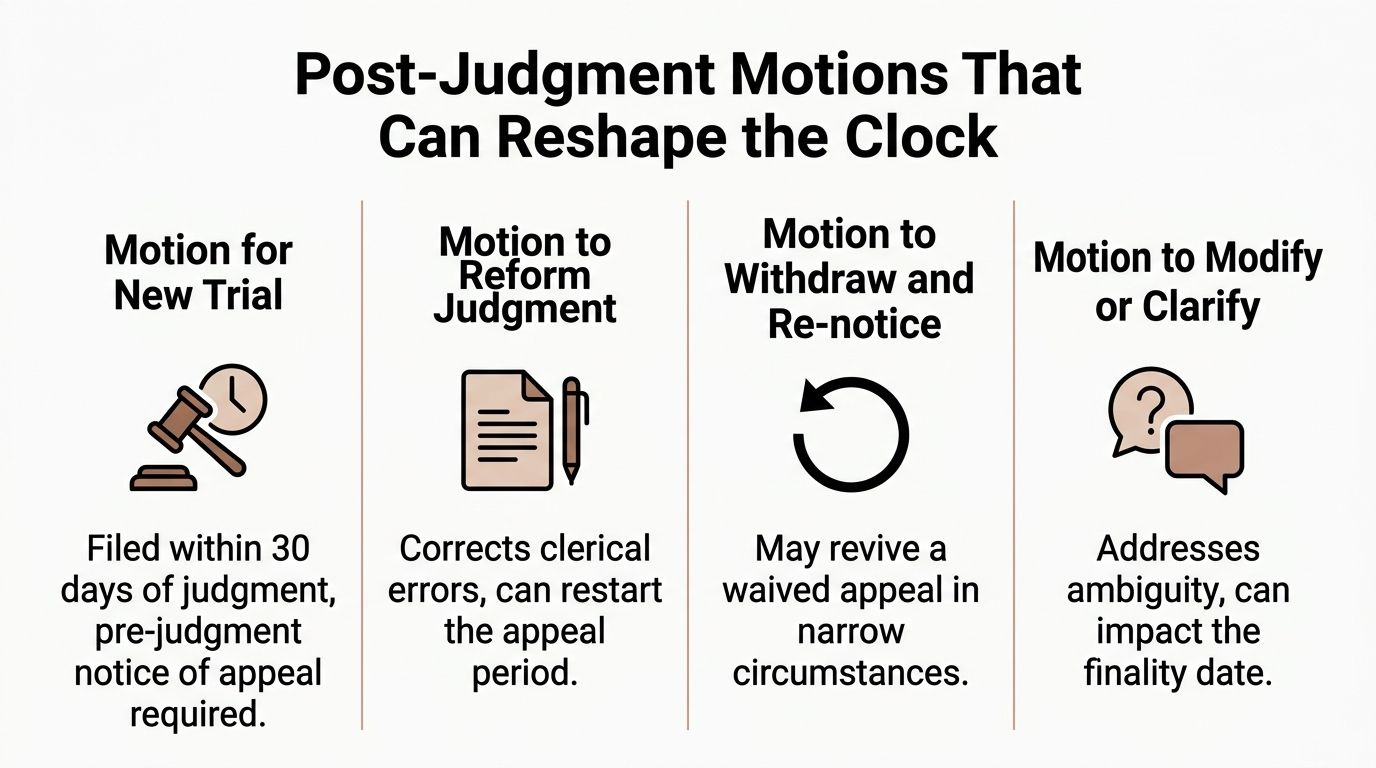
Post-Judgment Motions That Can Reshape the Clock
Post-judgment motions aren't interchangeable. A motion filed after the deadline usually won't create an appeal right by itself, and filing a document with the wrong title can leave the original timetable untouched. The key question is whether the motion was timely filed after the judgment and whether Rule 26.1 recognizes it as a deadline-extending filing.
Motion for new trial
A motion for new trial asks the trial judge to reconsider the outcome because of trial error, newly discovered evidence, or another recognized ground. In an ordinary case, a timely motion can extend the notice-of-appeal deadline from 30 days to 90 days under Rule 26.1. The filing must identify the grounds with enough detail to give the trial court a fair opportunity to address them.
A motion for new trial filed after the applicable deadline generally won't revive a lost appellate deadline. It may still have a role in a separate trial-court remedy, but it shouldn't be treated as a reset button. For a focused explanation of this device, review motion for new trial practice in Texas family law. The related resource Post-Trial Motions Before a Texas Appeal addresses how a motion for new trial can extend the appeal deadline.
Motion to modify, correct, or reform
A motion to modify, correct, or reform asks the trial court to change the judgment. It may address an incorrect provision in a divorce decree, a mistaken property description, or an error in the wording of a custody or support order. A timely motion can affect the ordinary appeal timetable, but the filing date and substance must satisfy the applicable rules.
Motion to reinstate
A motion to reinstate is most relevant when the court dismissed a case for want of prosecution or when a party needs the trial court to restore a case after a particular dismissal. It isn't a general method for extending every family law appeal. Its impact on appellate deadlines depends on the type of dismissal, when it was filed, and whether Rule 26.1 applies.
Findings of fact and conclusions of law
A qualifying request for findings can extend the deadline in an ordinary bench-trial matter when the rules permit it. The request should identify the need for findings and comply with the timing requirements. It doesn't help just because a party wants more time after the deadline has already passed.
The practical distinction is simple. A timely, qualifying motion may reshape the clock. A late motion usually cannot manufacture jurisdiction. A lawyer must review the docket and the actual filing, not rely on a party's memory of what was discussed at the final hearing.
Using the 15-Day Rule 26.3 Grace Window
Rule 26.3 offers a narrow opportunity after the original notice deadline has expired. It isn't an automatic grace period and it isn't a promise that the appellate court will accept every late filing. The party must act inside the permitted 15-day window, file the missing notice of appeal, and present a motion for extension with a reasonable explanation.

File both pieces in the correct places
The notice of appeal is filed in the trial court clerk's office. The extension motion belongs in the court of appeals with jurisdiction over the case. The motion should identify the judgment, explain the original deadline, state when the notice was filed or will be filed, and include the facts supporting the request. Affidavit evidence may be necessary when the explanation depends on a medical event, deployment, delivery problem, or communication breakdown.
A lawyer should also confirm the correct appellate court for the county. Filing in the wrong place can create another procedural problem while time continues to run. The Texas family law extension process provides a useful framework for understanding this filing sequence.
Explain the delay with facts, not conclusions
A reasonable explanation is specific. Counsel's documented miscommunication, a serious medical event supported by records, or a mail problem supported by delivery evidence may provide a foundation for relief. A parent who reasonably relied on the other party's attorney, a deployed service member who lacked access to case information, or a self-represented litigant in a rural county may have facts worth presenting.
That doesn't mean the court excuses every mistake. Ignorance of the law and simple oversight are weak explanations. The motion should also address prejudice to the other side and show that the late filing was made in good faith. Texas appellate courts decide whether to grant the extension or dismiss for lack of jurisdiction. Grounds for Appealing a Texas Family Law Ruling discusses the types of error that may support appellate review, but an extension motion first has to preserve access to that review.
What Still Works After the Grace Window Has Closed
When the Rule 26.3 window is gone, a conventional appeal is usually no longer available. The question becomes whether a different procedural vehicle fits the defect. These remedies are narrower than an ordinary appeal, and most require a precise factual foundation.
Rule 306a relief
If the party didn't receive timely notice or acquire actual knowledge of the judgment, Rule 306a may offer a path to establish a later starting point. The party must make the required sworn allegations and satisfy the rule's limits. The evidence must address notice to the party and the relevant attorneys. A vague statement that “I didn't know” won't carry the analysis.
Restricted appeal
A restricted appeal can apply when the judgment is final, the party didn't participate in the hearing that produced it, and the alleged error appears on the face of the record. It isn't a second trial and generally can't be used to add evidence that wasn't presented to the trial court. A default property judgment or a custody order entered without the required participation may justify investigation, but eligibility depends on the record.
Bill of review
A bill of review is an equitable proceeding used to challenge a final judgment when ordinary appellate remedies are no longer available and the party can establish a recognized basis such as extrinsic fraud or an off-the-record problem that prevented a meaningful opportunity to litigate. It requires more than showing that the trial judge weighed evidence incorrectly. The pleading and proof must connect the outside misconduct or procedural failure to the inability to obtain ordinary review.
Mandamus and other extraordinary relief
Mandamus is designed to correct a clear abuse of discretion or compel a ministerial duty when ordinary appeal is inadequate. It isn't a substitute for a late notice of appeal. In family cases, it may be considered for a discovery ruling, a refusal to perform a clear legal duty, or an order that creates harm ordinary appellate review can't repair.
Equitable tolling arguments, including those associated with Balanchine and later cases, are highly fact-dependent. A petition for review or certiorari may be relevant only after an appellate court has acted and when the issue meets the governing standards. Newly discovered evidence can matter, but it usually supports a separate trial-court remedy rather than reopening an expired appeal automatically.
| Remedy | Best Use Case | Likelihood of Success | Typical Cost |
|---|---|---|---|
| Rule 306a relief | Lack of timely notice or actual knowledge | Depends on sworn proof and rule compliance | Case-specific |
| Restricted appeal | Qualifying nonparticipation and error visible in the record | Narrow and fact-dependent | Case-specific |
| Bill of review | Extrinsic fraud or an off-the-record barrier to a fair challenge | Difficult and evidence-intensive | Case-specific |
| Mandamus | Clear legal duty or abuse of discretion with no adequate appellate remedy | Extraordinary and limited | Case-specific |
| Equitable tolling or higher-court review | Exceptional jurisdictional or procedural circumstances | Rare and highly fact-dependent | Case-specific |
A careful discussion of these options appears in restricted appeal and bill of review relief. The Notice of Appeal Deadline in Texas Family Cases also explains why the ordinary starting point is generally only 30 days after a signed judgment.
Why Calling an Appellate Attorney Right Now Matters
A missed deadline creates a records problem before it creates a briefing problem. An appellate attorney can pull the trial court docket, inspect the signed judgment, identify every post-judgment filing, and calculate the controlling date. That review may reveal a timely motion, a notice defect, an accelerated classification, or a filing that was sent to the wrong court.
Consider a father who notices a clerical error in a divorce decree within hours of signing. A prompt review may allow the trial court to address the wording before the dispute becomes a broader appellate issue. A mother may receive a final custody order containing findings she didn't understand. The immediate task is to obtain the full order, hearing record, and docket, then determine whether the findings affect preservation, appealability, or a possible post-judgment filing.
A service member deployed overseas during the original deadline may have facts relevant to notice, communication, or an extension request. Those facts need documentation. The court won't infer every circumstance from a general statement that the party was unavailable.
Appeals require a different type of legal work
An appeal isn't a do-over of the trial. The appellant must identify legal issues, explain the governing standard of review, support the argument with authority, and cite the record. Appellate courts don't search the record for missing support, and inadequate citations can leave an alleged error unreviewed, as explained in this overview of the Texas appeals process.
Common family law errors can include applying the wrong legal standard, abusing discretion in a custody or support ruling, excluding relevant evidence, entering a judgment inconsistent with the evidence, failing to follow required notice procedures, or making findings that don't support the relief granted. Reversible error means a legal error that harmed the outcome or affected important rights. Abuse of discretion generally means the trial court acted without reference to guiding rules or principles, or reached a decision outside the range of reasonable choices.
An early consultation is triage, not a commitment to pursue every possible filing. It can prevent collateral damage by identifying the narrowest viable remedy before more deadlines pass.
Your Next-Step Checklist and Where to Turn for Help
Treat the missed deadline like a document-and-date emergency. Gather the record first, then choose the remedy. Use this checklist:
- Pull the signed judgment. Record the date the judge signed it and obtain the file-stamped version.
- Identify post-judgment filings. Look for a motion for new trial, motion to modify, motion to reinstate, or qualifying request for findings.
- Calculate the original deadline. Apply Rule 26 based on whether the appeal is ordinary or accelerated.
- Check Rule 26.3 immediately. Determine whether the 15-day extension window remains open.
- Gather court correspondence. Save clerk notices, service documents, emails, portal entries, and proof of delivery.
- Consult a Texas family law appellate attorney. Ask for a jurisdiction and deadline review before filing a new motion.
- Review procedural details. Confirm the correct court of appeals, filing location, service requirements, and any local rules.
- Prepare a case timeline. Summarize the judgment, hearings, motions, notice dates, and the errors you believe affected the result.

Bring financial records when the dispute involves property division, spousal maintenance, or child support. For custody, possession, visitation, or protective-order matters, identify the evidence admitted at trial, the objections made, the findings entered, and any preservation issue. The appellate court reviews the record, not a new collection of facts assembled after judgment.
Frequently asked questions
Does a late appeal cost more?
It can require additional procedural work because counsel may need to evaluate jurisdiction, notice problems, extraordinary relief, or a bill of review. The actual cost depends on the record and the remedy. A consultation can identify whether a viable path exists before substantial work begins.
How time-sensitive is this?
Extremely time-sensitive. The ordinary deadline, any accelerated deadline, and the Rule 26.3 window operate on fixed rules. Contact counsel as soon as you discover the problem.
Can a new-trial motion help after the deadline?
A timely motion for new trial can extend an ordinary appeal deadline, but a late motion generally doesn't revive a closed appellate window. Whether it has another purpose depends on the judgment, notice history, and available trial-court remedies.
You can schedule a free 30-minute consultation to have a Texas appellate attorney review the timeline, judgment, docket, and possible remedies without pressure. The goal is a clear recommendation, whether that means filing immediately, pursuing a narrow post-window remedy, or recognizing that appellate jurisdiction is no longer available.
The Law Office of Bryan Fagan, PLLC evaluates missed Texas family law appeal deadlines, accelerated appeals, Rule 26.3 extensions, Rule 306a issues, restricted appeals, mandamus requests, and bills of review. Visit The Law Office of Bryan Fagan, PLLC to schedule a free 30-minute consultation and obtain a focused strategy for your custody, divorce, property, support, or protective-order matter.