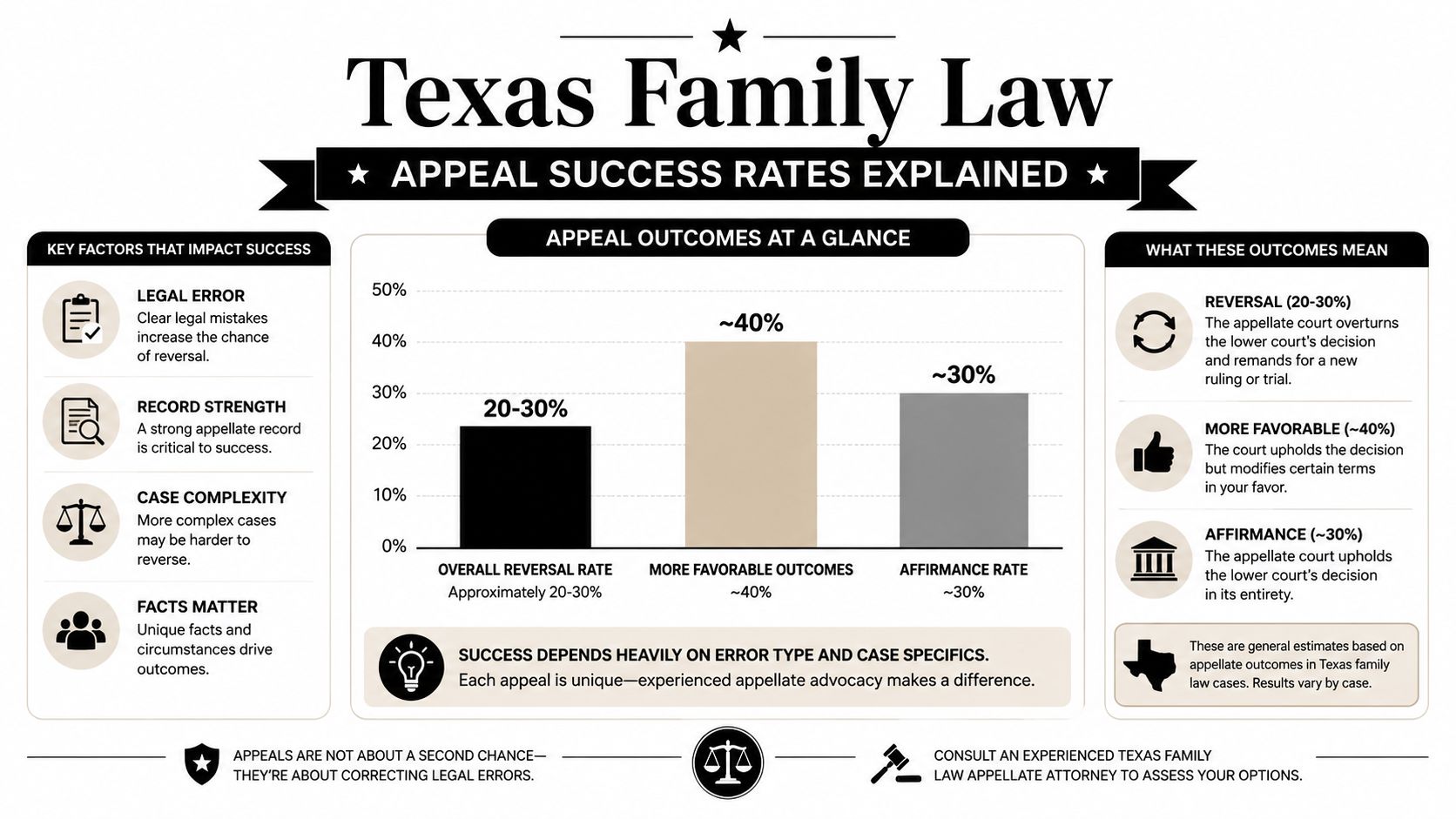
Texas family law appeals succeed between 21% and 32% of the time, depending on the study and the type of case. Child-support appeals and suits to modify the parent-child relationship show the highest reversal rates in the available Texas data.
You may feel your case was handled unfairly, especially after investing time, money, and emotional energy in a divorce, custody, support, or enforcement proceeding. An appeal can provide a path to correct a legal mistake, but it isn't a second trial and it won't succeed just because the result feels wrong.
The practical question isn't only, “How many family law appeals are successful in Texas?” It's whether your record contains a reviewable error, whether that error was preserved, and whether it affected the judgment. The statistics help set expectations, but the trial record and the standard of review usually decide whether an appeal is worth pursuing.
Texas Family Law Appeal Success Rates Explained
A statewide Houston Law Review study found that 21% of Texas family-law appeals were reversed, including 24% of divorce cases, 19% of suits to modify the parent-child relationship, and 23% of child-support cases. Those figures come from the Houston Law Review analysis of reversals in Texas courts of appeals.
A later benchmark study reported a 32% overall reversal rate for family matters. Its figures were 24% for divorce, 34% for parent-child modification cases, and 42% for child-support cases. The study also identified family-law cases as the largest group of appeals after bench trials and reported a 28% reversal rate for that category, as discussed in this Texas appellate reversal study.
Why the range matters
A reversal does not guarantee every result you requested. The appellate court may reverse only part of the judgment, remand an issue for further proceedings, or require the trial court to apply the law correctly without dictating the final outcome. Your appeal assessment must therefore focus on the order, the objections and arguments preserved at trial, and the evidence contained in the appellate record.
Another Texas analysis reported a 27% overall reversal rate for family cases, with divorce matters reversed 20% of the time and parent-child modification cases reversed 31% of the time. It also found that child-support matters were reversed more often than divorce matters, as explained in this Texas courts of appeals reversal analysis.
The practical conclusion is clear: appeal success is meaningful but remains the exception. Custody, divorce, and child-support cases do not carry identical prospects, so assess the specific issue rather than relying on one statewide figure. A focused legal error gives you a stronger starting point than dissatisfaction with the judge's factual conclusions. For broader context, review Texas appeal reversal percentages by case type, then have counsel test those figures against your actual record.
Understanding the Standard of Review in Family Appeals
Texas family appeals rarely succeed merely because a parent, spouse, or support recipient disagrees with the result. The governing standard of review determines how much authority the appellate court gives the trial judge and what kind of error can justify reversal.
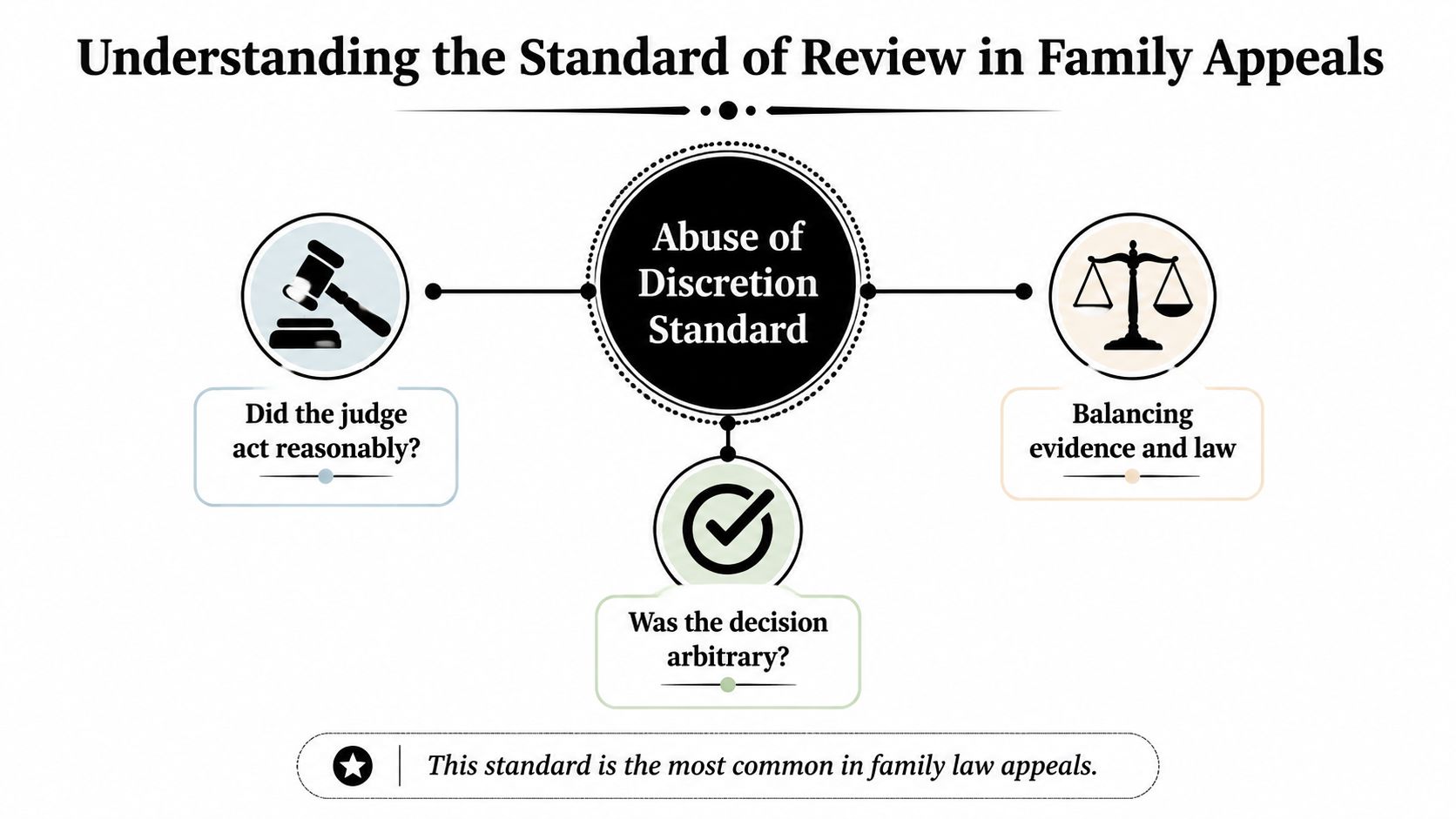
Custody, possession, and visitation rulings usually receive abuse of discretion review. The appellate court asks whether the trial judge acted arbitrarily or unreasonably, or failed to follow the governing legal rules and principles. It does not rehear the witnesses or choose the parent it personally prefers.
The appellate judges review the existing record, including the evidence and the trial court's ruling. Their task is to identify a legal mistake, an unreasonable decision, or a ruling without a proper connection to the law and evidence. The Texas Court of Appeals decision discussing abuse of discretion describes the inquiry in those terms. Trial judges have room to weigh conflicting evidence, but that discretion has limits.
Two questions guide the review
Texas family appeals generally require two related inquiries:
- Did the trial court have enough information to exercise its discretion? The appellate court examines whether the record contained evidence relevant to the decision.
- Did the trial court apply its discretion properly? The judge still had to follow the applicable statutes, legal standards, and guiding principles.
A failure on either point may support reversal if the error was harmful and properly presented. Reversible error is an error serious enough to justify changing the judgment or returning the issue to the trial court. A mistake that did not affect the outcome usually will not provide appellate relief.
Some issues receive de novo review. Under that standard, the appellate court independently decides a legal question rather than deferring to the trial judge's legal conclusion. Factual findings and discretionary choices, however, remain common in family cases. Read a breakdown of how abuse-of-discretion and de novo standards apply to custody, support, and property division rulings, along with the Standards of Review in Texas Family Appeals, before judging your appeal's prospects.
A persuasive brief ties the governing rule to specific pages in the clerk's record and reporter's record. Saying the judge was unfair is not enough. The brief must identify what the judge did, why the law required a different approach, and how the error affected the judgment. That record-based analysis, not dissatisfaction with the outcome, is what makes an appeal viable.
Reversal Rates by Family Law Case Type
A single statewide success rate can mislead you. The useful comparison separates divorce, custody modification, and child-support appeals, because each issue receives different appellate treatment and presents a different record.
| Case Type | Reversal Rate Range | Key Factors |
|---|---|---|
| Divorce, including enforcement or modification of existing decrees | 20% to 24% | Property division and related rulings often involve broad discretion and fact-intensive review |
| Suits to modify the parent-child relationship | 19% to 34% | Results depend on the record, the legal standard, and the challenged custody or possession ruling |
| Child-support cases | 23% to 42% | Narrower, rule-driven issues and a developed paper record may create clearer appellate complaints |
These ranges come from statewide studies discussed in the Houston Law Review study of family-law reversals and a later benchmark in this evaluation of Texas appeals by the numbers. Treat them as historical context, not as a prediction of your result.
Divorce and property division
Divorce appeals commonly challenge property characterization, valuation, division of the marital estate, enforcement, or other rulings tied to the decree. Trial courts weigh conflicting evidence and exercise substantial discretion in fact-sensitive matters. A complaint that the judge credited one witness over another usually does not establish reversible error.
A divorce appeal becomes more viable when the record shows a wrong legal standard, an unsupported finding, or failure to follow a required procedure. The Texas Family Law Appeals Lawyer resource addresses appellate representation for final family-law orders challenged on legal grounds.
Custody modification and child support
Custody modification appeals concern conservatorship, possession, visitation, or the legal requirements for changing an existing order. The appellate question is whether the evidence and governing law support the challenged ruling, not whether the trial judge reached a result you consider unfair.
Child-support appeals often involve narrower calculation or application issues. A developed written record can make the alleged mistake easier to isolate, but the order, admitted evidence, and preserved objections still control.
Use the ranges to frame the review, then examine your own record. The practical questions are whether the trial court made a legal mistake, whether you preserved the complaint, and whether the error affected the judgment. A higher historical reversal rate for one case type does not make an individual appeal strong.
Common Reversible Errors in Texas Family Courts
In Texas family appeals, a ruling becomes reversible only when a legal, procedural, or discretionary mistake was preserved and caused harmful error. A disappointing result, by itself, does not meet that standard.

Suppose a custody court applies a criminal-law standard instead of the family-law rule governing the requested relief. That may be a legal error. Your appeal must identify the controlling rule, show which standard the court applied, and explain how the mistake affected the ruling.
Evidence problems form another common category. The court may improperly exclude testimony or documents that were timely offered and legally admissible, or rely on material it should not have considered. Exclusion alone does not establish harm. You must show that the ruling was legally wrong and that the evidence could have affected the judgment.
Record-supported complaints
A judgment may also rest on findings unsupported by the record. Examples include findings about income, parenting conduct, or property value that the admitted testimony and exhibits do not support. Appellate counsel must connect the alleged defect to specific testimony, exhibits, objections, and findings.
Procedural failures can support reversal too. The court may skip a required process, deny a meaningful opportunity to present a position, or enter an order without addressing a controlling legal requirement. The appellate court reviews the official record, so later explanations about what happened will not repair an incomplete record.
Practical rule: An appellate complaint needs a legal rule, a record citation, and a clear explanation of harm.
What usually isn't enough
A strong appeal usually cannot rest on the judge believing the other witness, assigning different weight to competing evidence, or reaching a harsh result. Trial judges resolve conflicts in testimony and generally have room to evaluate credibility. The appellate court will not replace that assessment merely because it might have viewed the evidence differently.
The Texas family-case review framework emphasizes the connection between the information available to the trial court and the proper exercise of discretion. Focus your appeal on a legally recognizable defect, such as an incorrect standard, an unsupported finding, an evidentiary ruling, or a preserved procedural failure. Do not relitigate the entire family dispute without tying the complaint to harm shown in the record.
The Texas Family Law Appeal Timeline and Process
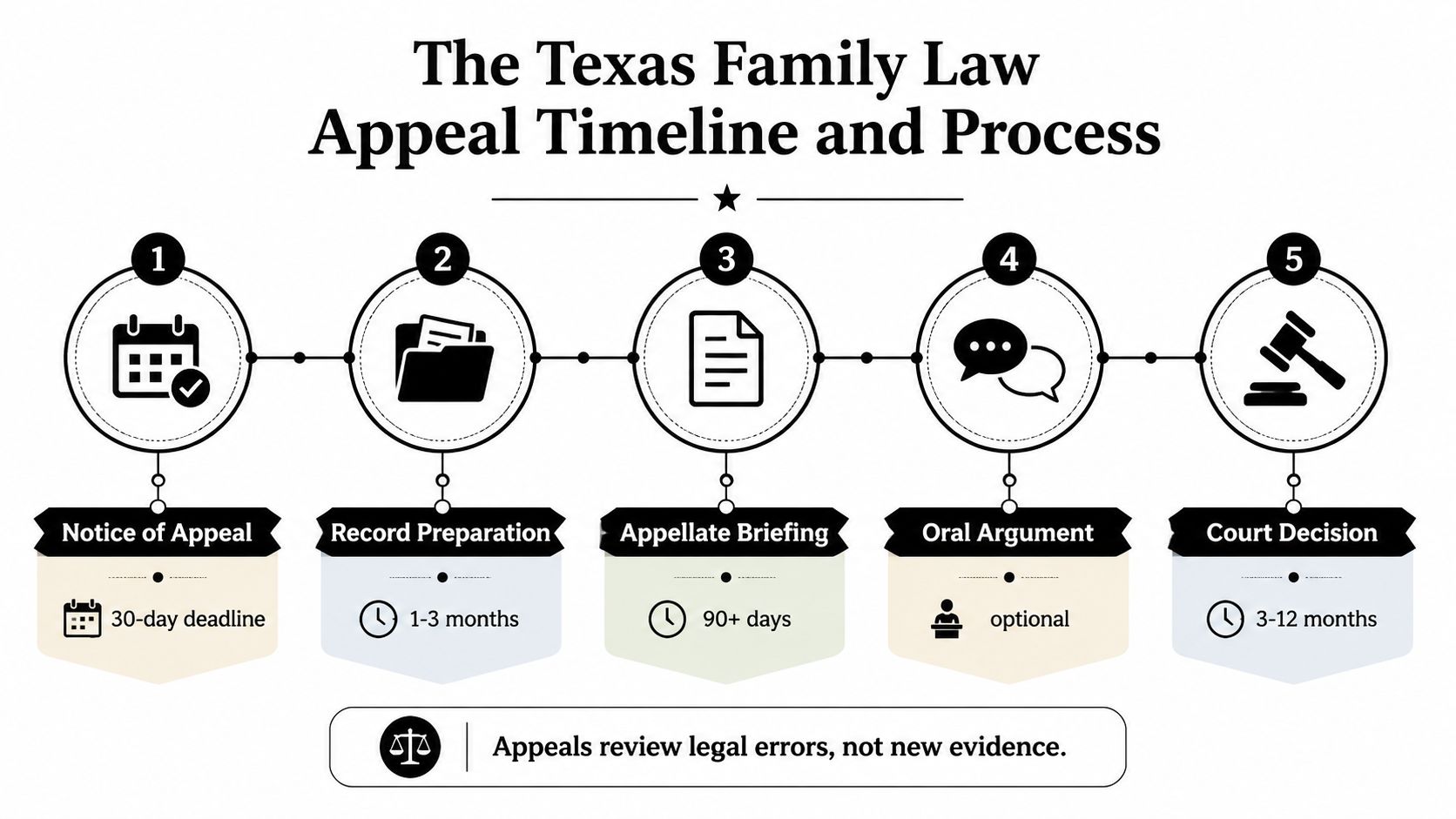
A Texas family appeal begins with timely action, but the appeal itself is built from the trial record. The appellate court doesn't conduct a new hearing with new witnesses or fresh exhibits. It reviews the clerk's record and reporter's record, then evaluates the legal arguments in the parties' briefs.
The process in practical order
- File the notice of appeal. This filing tells the trial court and the opposing party that you seek review. The deadline depends on the type of order and the applicable rules, so counsel should examine the signed judgment immediately.
- Prepare the record. The clerk's record contains filed documents and orders. The reporter's record generally contains the transcribed proceedings. If an important hearing wasn't recorded or a necessary item isn't included, the appellate court may not be able to consider the complaint.
- File the appellant's brief. Under Texas Rule of Appellate Procedure 38.6, the appellant's brief is due 30 days after the later of the clerk's record or reporter's record is filed. The Texas Rules of Appellate Procedure also provide that the appellee's brief is due 30 days after the appellant's brief, followed by a reply brief due 20 days after the appellee's brief.
- Address oral argument if scheduled. Oral argument may allow the judges to question counsel, but the written brief and record remain central.
- Receive the decision. The appellate court may affirm, reverse, or remand some or all of the judgment.
Briefing is written advocacy
Briefing is the written argument filed with the appellate court. A strong brief identifies the issue, states the governing law, explains the standard of review, cites the record, and demonstrates why the judgment should change.
The record controls the appeal. Rule 34 and Rule 38 make record preparation and briefing mechanics central, so missing a deadline or failing to include a necessary record component can weaken an otherwise serious complaint. Some family orders may also use accelerated procedures, making immediate legal review important.
Factors That Increase Your Chances of a Successful Appeal
A family-law appeal becomes viable when you can identify a specific legal or procedural error, show that the trial court had notice of it, and connect it to the judgment. A disappointing result alone is not an appellate issue.
Begin with the ruling and the evidence available at trial. Determine whether the objection, request, or legal argument appears in a motion, hearing transcript, admitted exhibit, finding of fact, or final order. The appellate court generally cannot rely on facts or documents that never entered the record.
Use this viability screen
- Preserved complaint: Did counsel object, request a ruling, or otherwise alert the trial judge to the alleged error?
- Governing rule: Can you identify the statute, rule, or legal standard the court allegedly misapplied?
- Record support: Can you point to the relevant page in the clerk's or reporter's record?
- Material effect: Did the error affect custody, property division, child support, or another disputed part of the judgment?
- Available remedy: Would reversal, partial reversal, or remand address the specific problem?
Case type should guide the review. Custody appeals often turn on evidentiary rulings, findings, or an unsupported exercise of discretion. Divorce appeals may focus on property characterization, division, or procedural fairness. Child-support appeals commonly require close review of the financial findings and the legal basis for the support order. Earlier reversal data can help set priorities, but those rates do not replace analysis of your record.
What will not improve the appeal
A new trial lawyer cannot give the appellate court new evidence. A new witness, a document created after trial, or an explanation that was never admitted cannot repair a missing trial record. The reviewing court examines what the trial court had before it and whether the court applied the law correctly.
Avoid turning the brief into a personal account of unfairness. Explain the ruling, identify the governing law, cite the record, and state the relief requested. That structure gives the court a legal reason to change the judgment.
An effective consultation should answer one precise question: What exact ruling should the appellate court change, and where does the record prove the legal error?
Your appellate lawyer should identify the strongest issue and explain its weaknesses. A candid assessment based on the record is more valuable than a confident prediction based only on the result you want.
Next Steps to Evaluate and Pursue Your Family Law Appeal
A successful appeal starts with the record, not a second trial. Act promptly after the judge signs the order. Preserve pleadings, exhibits, motions, objections, proposed orders, and hearing notices. Confirm what belongs in the clerk's record and reporter's record. The appellate court reviews the existing record, so a missing item can limit the issues you can raise.
Your evaluation should answer four questions:
- What order is being challenged?
- What deadline applies?
- What legal or procedural error does the record show?
- What relief could the appellate court grant?
Issue type should direct the review. Custody and visitation appeals often depend on evidentiary rulings, findings, or an unsupported exercise of discretion. Divorce appeals may involve property characterization, division, or procedural fairness. Child-support appeals require close examination of financial findings and the legal basis for the order. Broader reversal rates can provide context, but they cannot decide whether your record supports an appeal.
Read whether you need a different lawyer for a Texas appeal before assuming your trial lawyer should handle the appeal. Appellate counsel must review the record, research the governing law, and present a precise argument.
Do not expect new evidence to fix a weak record. Focus on the ruling, the legal error, the supporting record citations, and the requested relief. Your lawyer should identify the strongest issue and its weaknesses.
The Law Office of Bryan Fagan, PLLC evaluates Texas family-law appeals. Schedule a free 30-minute consultation through The Law Office of Bryan Fagan, PLLC for review of deadlines, the record, and potential reversible error.