You may feel your case was handled unfairly, yet the cost of another legal fight can seem impossible. After an adverse custody, support, property division, divorce, or protective-order ruling, many parents assume the courthouse is closed to them because they can't pay filing fees or the cost of preparing the appellate record.
That assumption is often wrong. Texas provides procedures that may allow a qualifying appellant to proceed without paying appellate costs upfront. The challenge is procedural: you must protect the deadline, preserve indigence correctly, request relief for the record, and identify an actual appellate error.
You Can Appeal Even When Funds Are Tight
A parent loses a custody ruling after presenting evidence the judge appears to have overlooked. The judgment changes possession, decision-making, and support, while the household budget is already committed to rent, transportation, and ordinary expenses. Filing costs may be difficult to pay, and transcripts or document preparation may seem impossible.
Texas procedure may still provide a path. Under the Texas Rules of Appellate Procedure, a person unable to afford appellate costs can file a Statement of Inability to Afford Payment of Court Costs. If the requirements are satisfied, fee relief can cover more than the notice-of-appeal charge. It may also address the clerk's record, reporter's record, motions, and other appellate costs.
The hidden risk is treating indigence as a one-time form. Preserve it carefully. File the correct statement or affidavit, monitor any challenge to indigence, and request relief for the record itself. A parent who obtains filing-cost relief but fails to address transcript or clerk-record costs can still lose the practical ability to present the appeal.
An appeal is not a second trial. The appellate court does not hear the case again, receive new evidence, or select the result it prefers. It reviews the existing record and written briefing for reversible error, a legally significant mistake that affected the judgment.
Practical rule: Money problems can often be addressed. A missed deadline, an unpreserved indigence claim, or an incomplete record can forfeit an appeal.
Start with four tasks:
- Protect the deadline: Confirm when the judgment or order was signed and whether an accelerated timetable applies.
- Preserve indigence: File the required statement or affidavit, then verify whether the trial court has established, challenged, or overruled indigence.
- Secure the record: Request the clerk's record and reporter's record separately, and ask for fee relief for each applicable cost.
- Screen the issues: Focus on legal error, abuse of discretion, evidentiary or procedural defects, and failures to apply controlling Texas Family Code requirements.
Your appellate lawyer must work from what the trial court filed, admitted, stated, and preserved. Acting promptly after judgment protects fee-waiver rights and record access before procedural options narrow.
Critical Deadlines You Cannot Miss
The notice of appeal starts the appellate process. An indigence affidavit or statement does something else: it asks the court to address court costs. Filing it doesn't itself perfect an appeal, as explained in the Texas appellate courts' practice guidance. Treat these as separate filings with separate consequences.
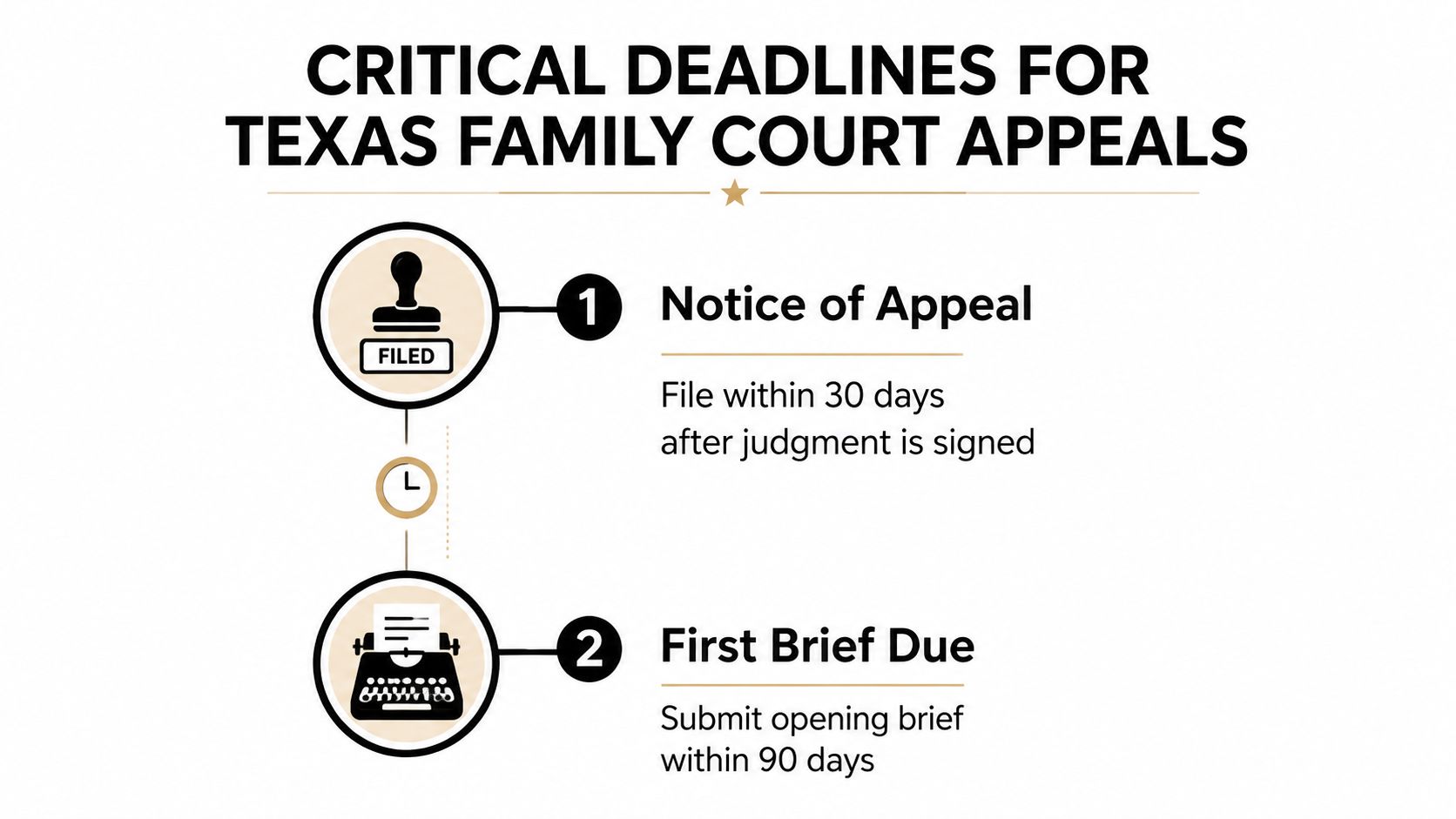
For most Texas civil and family-law appeals, the notice of appeal is generally due within 30 days after the judgment is signed. A timely motion for new trial, motion to modify the judgment, motion to reinstate, or qualifying request for findings can extend that deadline to 90 days, under the Texas Rules of Appellate Procedure. A post-trial filing changes the deadline only if it qualifies and was filed on time.
Accelerated family appeals need faster action
Some family matters use an accelerated timetable. In parental-rights termination cases, the notice of appeal and indigence materials may need to be filed within 20 days after the judgment or order, according to Handling Your First Child Welfare Appeal. Certain child-welfare proceedings also demand immediate action, so identify the case type before relying on the ordinary deadline.
Use this filing sequence:
- Identify the signing date: Read the final judgment or appealable order. Do not calculate from the day you received a copy.
- Classify the case: Determine whether it is an ordinary appeal or an accelerated appeal involving termination or another qualifying order.
- Check post-trial filings: Confirm that any motion or findings request qualifies and was timely filed.
- File the notice: Submit it even if the indigence process is still unresolved.
- File cost-relief papers: Submit the statement or affidavit under the applicable procedure, and preserve proof of filing.
- Confirm receipt: Keep file-stamped copies and evidence that the clerk received each document.
The Texas family-law notice-of-appeal deadline guide explains why you generally have only 30 days to begin a family-law appeal. The Notice of Appeal Deadline in Texas Family Cases offers a focused explanation of the same filing window.
A missed notice-of-appeal deadline can end the case before the appellate court reviews the merits. A fee waiver cannot revive an appeal that was never properly perfected. Filing the notice first, then confirming that the cost-relief papers and record requests are also protected, prevents the procedural trap that leaves an indigent parent with no practical appeal.
Establishing Indigence to Waive Court Costs
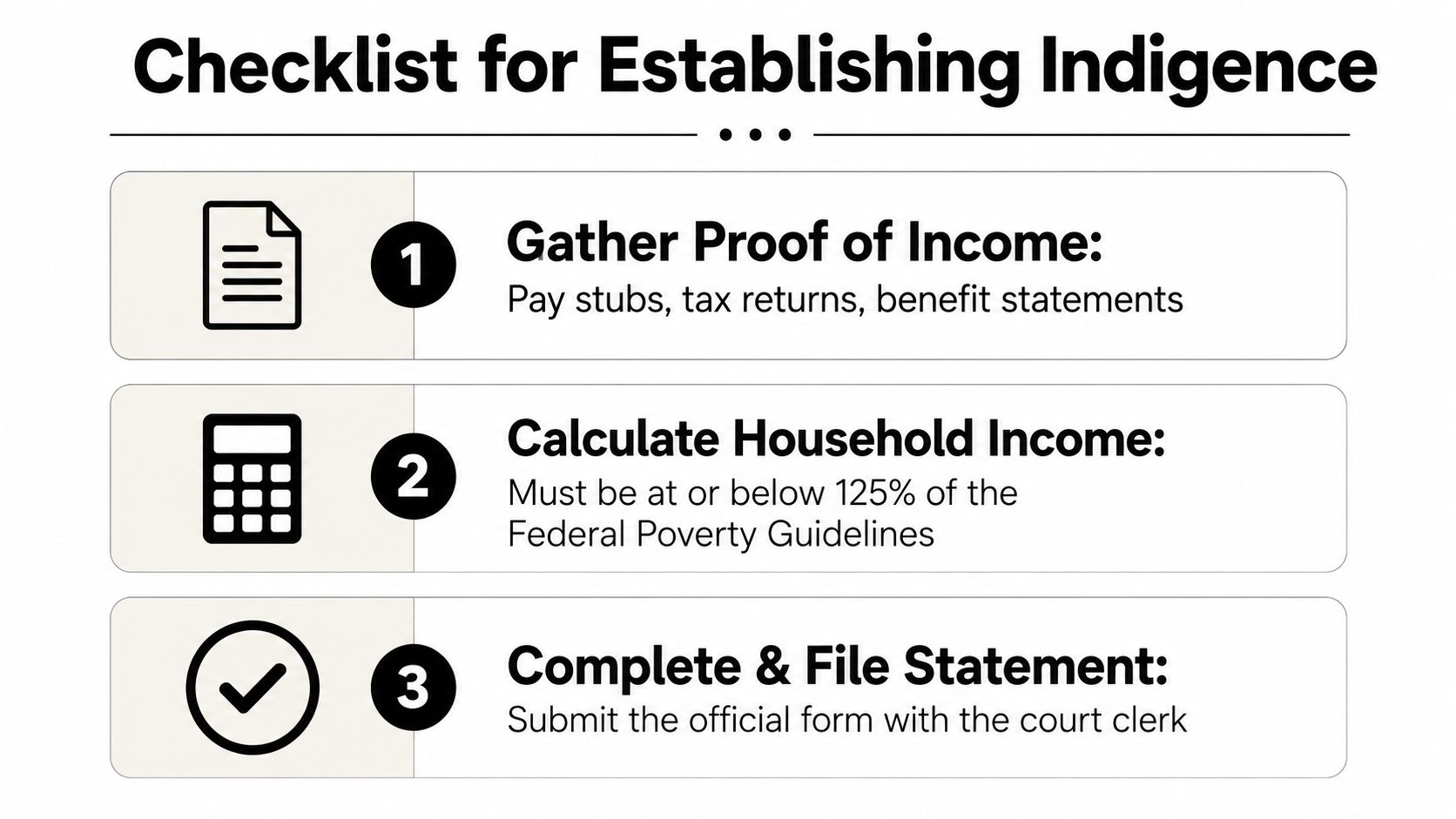
Texas uses a Statement of Inability to Afford Payment of Court Costs to address a person's inability to pay. The Texas affidavit form identifies several expenses that may be covered or waived for a qualifying appellant, including the $175 filing fee, the $10 or $15 fee for each motion, the trial clerk's charge for preparing the clerk's record, and the court reporter's charge for preparing the reporter's record. These specific costs appear in the Texas appellate materials linked above.
Texas defines indigent for this purpose as earning not more than 125% of the federal poverty guidelines, as stated in the Texas Rules of Appellate Procedure. That threshold isn't the only practical consideration. The statement also requires a truthful account of household finances and circumstances, so accuracy matters more than presenting a general claim that money is tight.
The trial-court trap
A party who filed a statement in the trial court is generally treated as indigent on appeal and isn't required to pay appellate costs unless the trial court overruled the indigence claim under Texas Rule of Civil Procedure 145. The key word is generally. You need to confirm what happened in your case.
If the trial court denied or overruled indigence, the appellant may seek relief in the appellate court by showing a material change in financial circumstances and filing a current statement there, as described in Texas Rule of Appellate Procedure 20. Poverty alone doesn't erase the procedural history of the case.
Avoid these mistakes:
- Filing only the affidavit: The affidavit doesn't replace the notice of appeal.
- Ignoring an earlier denial: A prior ruling under Rule 145 can affect the appeal.
- Using outdated information: If circumstances changed, explain the material change in a current filing.
- Leaving out record costs: Request relief for the clerk's record and reporter's record, not just the filing charge.
- Failing to keep proof: Preserve file-stamped copies, service records, and any order addressing indigence.
A truthful, complete statement gives the court a usable basis for deciding costs. A vague or incomplete filing creates avoidable questions at the moment your appeal needs clarity.
Securing the Appellate Record Without Funds
The record is the foundation of the appeal. The clerk's record contains filed pleadings, orders, judgments, exhibits, and other papers included in the trial court file. The reporter's record usually contains the court reporter's transcription of hearings or trial proceedings.
Without the necessary record, the appellate court may not be able to evaluate an argument that the trial judge ignored testimony, admitted improper evidence, applied the wrong legal rule, or failed to make a required finding. The issue may have mattered greatly to your family, but appellate judges generally must decide from the record transmitted under the appellate rules.
Request both records deliberately
When filing the notice of appeal and indigence materials, address record preparation directly:
- Designate the clerk's record: Identify the pleadings, orders, findings, exhibits, and other documents needed for the issues you intend to raise.
- Designate the reporter's record: Identify the hearings or trial portions that contain the testimony and rulings relevant to those issues.
- Request cost relief: Ask that qualifying clerk and reporter charges be waived under the indigence procedure.
- Contact the court reporter: Confirm the reporter received the designation and knows that a fee-waiver request is pending.
- Track omissions: Compare the record notices with the materials needed to prove each appellate issue.
- Address delays promptly: Notify the appellate court through the proper motion or filing if a record is incomplete or delayed.
TexasLawHelp explains that fee waivers can cover clerk and court-reporter charges for preparing the appellate record, not merely the notice-of-appeal fee. The State Bar appellate pamphlet also advises indigent parties to request waiver of reporter's-record costs in the trial court when filing the notice of appeal, as reflected in this Texas appellate guide.
For a practical explanation of designating these materials, review Designating and Paying for the Appellate Record. The exact portions needed depend on the issues. Requesting everything without a strategy may create unnecessary work, while requesting too little can leave the appellate court unable to review the claimed error.
A fee waiver is only useful if the record contains the evidence needed to prove the appeal.
Don't wait passively for the record to appear. Confirm designations, communicate with the clerk and reporter, and tell appellate counsel what occurred at each important hearing. Record preparation is part of appellate strategy, not clerical cleanup at the end.
Understanding What the Appellate Court Actually Reviews
An appeal asks a different question from a trial. A trial court decides disputed facts, evaluates witness credibility, receives evidence, and enters orders under the Texas Family Code. An appellate court reviews the written record and briefing to determine whether the trial court committed a legal or procedural error that warrants relief.
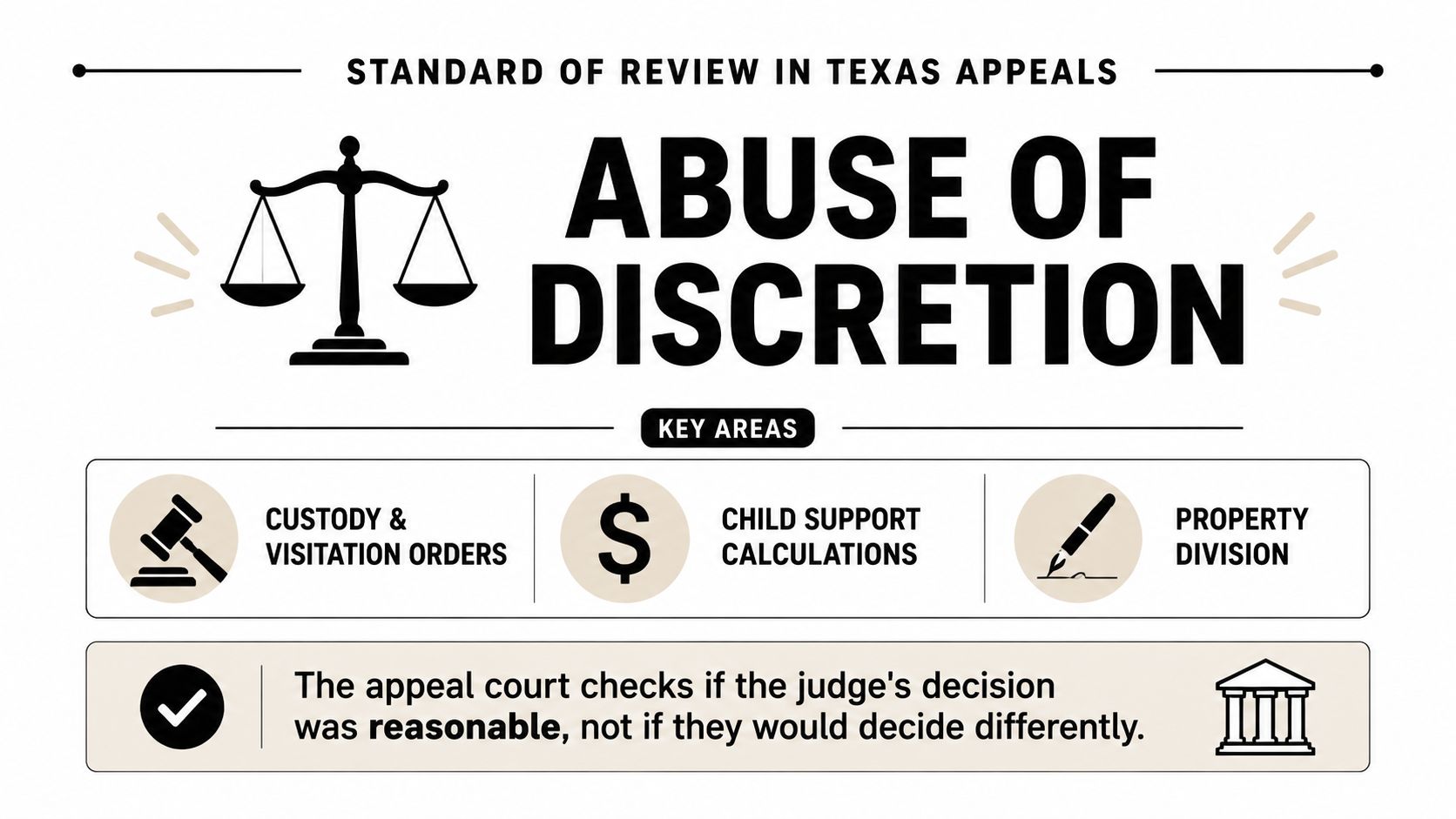
In many Texas family-law appeals, the central standard is abuse of discretion. In plain English, the appellate court asks whether the trial judge acted outside the range of reasonable choices, applied the wrong legal principles, or reached a decision without a sufficient evidentiary basis. The appellate court generally doesn't substitute its judgment because it might have weighed the evidence differently.
Appeal versus retrial
| Trial court | Appellate court |
|---|---|
| Receives live testimony and exhibits | Reviews the existing record |
| Decides disputed facts | Determines whether legal error is shown |
| Evaluates credibility firsthand | Usually defers to supported credibility decisions |
| Develops the evidence | Relies on preserved objections and filed materials |
| Enters the original judgment | May affirm, reverse, modify, or remand when appropriate |
A reversible error is more than an unfavorable result. It is a mistake that matters under the governing law and affected the judgment. Briefing is the written presentation of appellate issues, legal authorities, record citations, and requested relief. Strong briefing connects each complaint to the proper standard of review and shows exactly where the record supports it.
Legal and factual insufficiency usually aren't independent reversible errors in this setting. Instead, they help the appellate court decide whether the trial court abused its discretion, as explained in this Texas family-law appellate decision.
Issues that may justify review
Examples of potentially reversible errors include:
- Misapplying the Family Code: The court uses the wrong statutory rule for conservatorship, support, property division, maintenance, or protective relief.
- Ignoring mandatory limits: The court fails to apply a statutory restriction after making findings that trigger it. For example, Texas Family Code Section 153.004 can limit conservatorship decisions when the record establishes a history or pattern of family violence.
- Abusing discretion: The order lacks a reasonable evidentiary or legal basis.
- Failing to preserve due process: A party receives inadequate notice, a meaningful opportunity to be heard is denied, or a ruling rests on a procedure that prevented a fair presentation.
- Leaving the record incomplete: The materials needed to review the claimed error aren't properly included.
A statewide study reported an overall family-case reversal rate of about 32%, roughly matching the broader civil reversal rate of about one in three, according to Evaluating Appeals by the Numbers. That figure isn't a promise about your case. It supports a practical conclusion: family appeals aren't limited to hopeless matters, but the strongest ones target identifiable legal, procedural, or discretionary errors instead of repeating dissatisfaction with the facts.
Getting Legal Help and Taking the Next Step
Money concerns shouldn't prevent you from investigating your appellate options, but you need the right type of help. An appellate lawyer looks for preserved error, evaluates the standard of review, examines the clerk's and reporter's records, and determines whether the judgment can be challenged under the Texas Rules of Appellate Procedure and Texas Family Code.
In a parental-rights termination case, ask promptly whether appointed counsel may be available. Legal-aid organizations and pro bono programs may also assist qualifying applicants. Some lawyers may consider limited-scope work or another fee arrangement, but you should ask directly about the precise services covered, including deadline protection, record review, motion practice, and briefing.
A consultation before the notice deadline is ideal. Counsel can determine whether the order is appealable, identify any accelerated deadline, preserve indigence rights, and prevent a record-cost problem from developing. If you can't retain counsel for the full appeal, early advice can still help you avoid the procedural mistakes that are hardest to correct later. For background on self-representation, see Can I Appeal Without a Lawyer in Texas?
The Law Office of Bryan Fagan, PLLC handles Texas family-law appeals involving custody, visitation, property division, child support, spousal maintenance, divorce decrees, protective orders, contempt, and enforcement judgments. Its appellate team reviews the trial record, identifies potential reversible error, and prepares briefing grounded in the Texas Family Code and Texas appellate rules.
If you're researching how to appeal a family court ruling with no money in Texas, start by gathering the signed judgment, every post-trial motion, any indigence filing or ruling, and information about the hearings that shaped the decision. Bring those materials to an early consultation so counsel can give you a focused assessment rather than a guess.
The Law Office of Bryan Fagan, PLLC can evaluate your deadlines, indigence posture, record-cost needs, and potential appellate issues in a free consultation. Visit The Law Office of Bryan Fagan, PLLC to schedule that consultation and discuss a practical strategy for seeking a fair outcome.