You may be sitting with a final Texas family court order that feels wrong, unfair, or unsupported by the evidence. You may also believe you have a valid appeal but cannot afford the filing costs. That combination creates real pressure, especially when the order affects custody, support, property, visitation, or a protective order.
Texas provides a procedure for seeking relief from appellate filing costs. But the TRAP 20.1 statement of inability to afford appellate costs is not a simple fee-waiver checkbox, and a trial-court filing doesn't automatically solve the appellate problem. The procedure requires careful timing, complete financial disclosures, written communication with the appellate clerk, and attention to the separate rules governing the record.
Seeking Fairness After an Unjust Family Court Ruling
Suppose a family court entered an order limiting your possession of a child, assigning property in a way you believe ignores the evidence, or imposing support obligations based on an incorrect legal standard. You leave court feeling that the judge didn't address the facts that mattered most. An appeal may offer a path to review, but it won't give you a second trial.
Texas appellate courts review the existing record. They examine whether the trial court made a legal mistake, abused its discretion, failed to follow required procedures, or reached a decision that cannot stand under the applicable standard of review. The Texas Rules of Appellate Procedure control much of that process, while the Texas Family Code supplies the substantive rules governing issues such as conservatorship, possession, child support, and property rights.
What appellate terms mean in plain English
Abuse of discretion means the trial court acted without reference to guiding legal rules or made a decision that falls outside the range of reasonable choices supported by the circumstances. It doesn't mean the appellate judges would have handled the case differently. The question is whether the trial court's decision was legally or factually unreasonable in the way the law defines.
Reversible error is a mistake serious enough to justify changing or sending back the judgment. Texas appellate rules provide that a judgment may not be reversed for legal error unless the court of appeals concludes that the error probably caused an improper judgment or probably prevented the appellant from properly presenting the case. Texas appellate rules therefore require more than identifying a mistake. Your appeal must connect the mistake to the result or to a meaningful failure in presenting your case.
Briefing is the written argument filed with the appellate court. A brief identifies the issues, explains the governing law, cites the record, and shows why the alleged error requires relief. It isn't a personal statement about how unfair the hearing felt. It must give the court a legally supported reason to reverse or remand.
Practical rule: Financial hardship shouldn't decide whether the appellate court can review a family law judgment, but procedural accuracy determines whether fee relief remains available.
TRAP 20.1 helps an appellant seek relief from appellate filing costs when payment isn't possible. It protects access to appellate review, but it doesn't perfect the appeal by itself, extend every deadline, or pay every expense connected to preparing the appellate record. Those distinctions should be addressed immediately after judgment, not after a clerk questions the filing.
Required Elements of a TRAP 20.1 Financial Disclosure
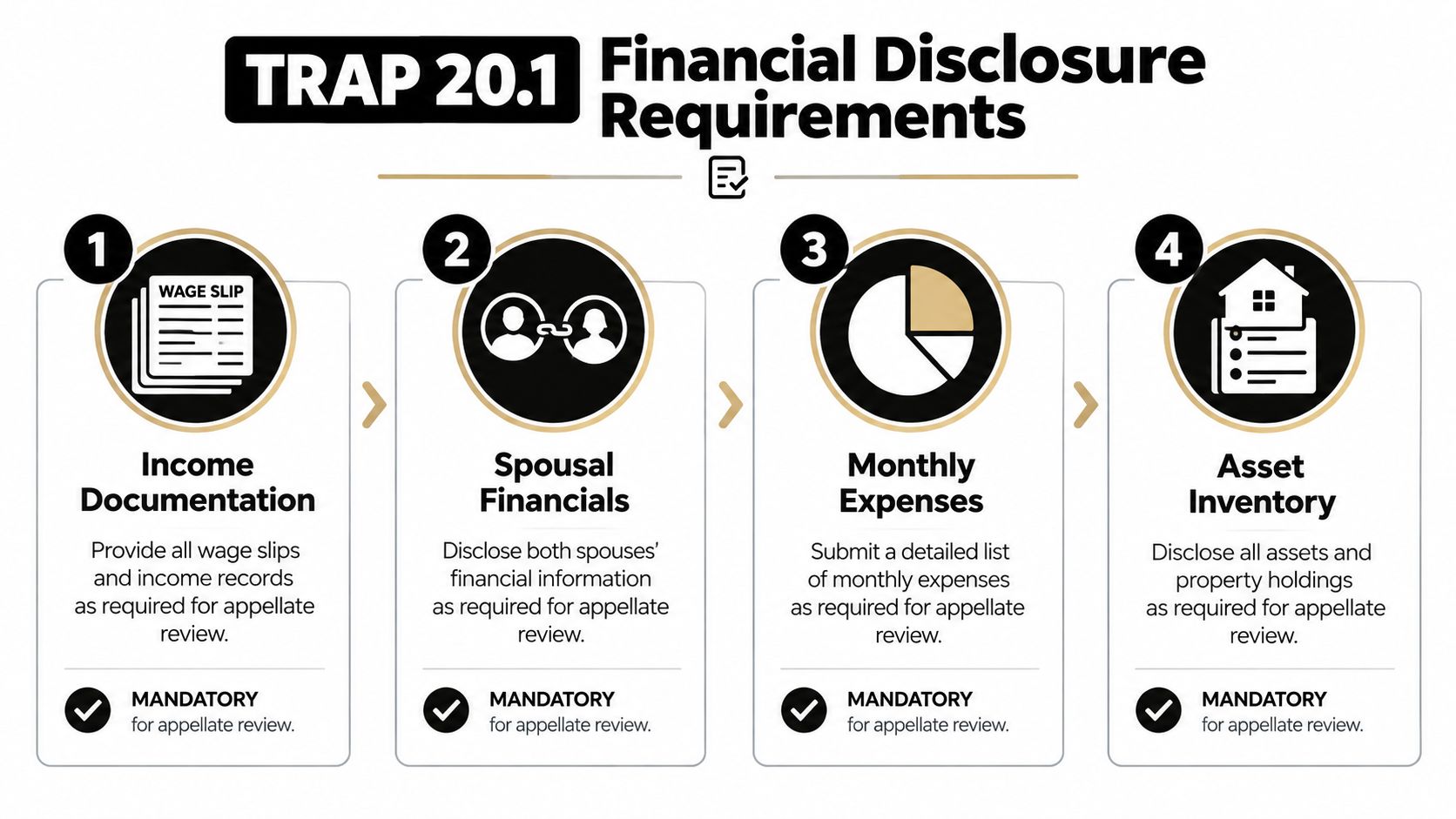
A trial-court fee waiver does not automatically protect you from appellate costs. If you file a TRAP 20.1 statement with missing categories, inconsistent answers, or unsupported claims, the court may question your indigent status and your appeal can face a procedural setback. File the statement with, or before, the notice of appeal, and treat it as a factual financial disclosure rather than a conclusory request. The court's analysis in Teague v. Southside Bank illustrates how an incomplete financial statement may be treated under the rule.
Build the statement as a complete financial snapshot
Your disclosure should address:
- Your income: Identify each source of income.
- Spousal income: Include your spouse's income when applicable.
- Property: List real property and other ownership interests.
- Cash on deposit: Disclose money held in bank and other accounts.
- Other assets: Identify assets outside the property and cash categories.
- Dependents: State who relies on your financial support.
- Debts: List outstanding obligations.
- Monthly expenses: Describe recurring household and personal costs realistically.
- Access to loans: Explain whether you can obtain credit or borrow money for court costs.
- Attorney-cost arrangements: State how attorney fees and related expenses are being paid.
The court or opposing party may compare the statement with information elsewhere in the record. Omitting a significant asset, understating income, or claiming no access to credit while describing available borrowing can damage your credibility. Completeness and internal consistency are the technical benchmarks.
Separate appellate filing costs from record expenses
TRAP 20.1 addresses costs as filing fees charged by the appellate court. Those costs differ from fees for preparing the appellate record. Record expenses, including clerk's-record and reporter's-record charges, are addressed through the applicable civil-cost procedure, including Texas Rule of Civil Procedure 145.
A TRAP 20.1 statement therefore does not automatically resolve every expense involved in an appeal. The record may determine whether the appellate court can evaluate your complaint, so handle any request involving record preparation separately and promptly.
Use a written checklist before filing. Confirm every financial category, reconcile all figures and descriptions, and identify any separate relief needed for record costs. For practical guidance on appealing a family court ruling without funds, review this guide to appealing a family court ruling with no money in Texas.
Why Trial Court Fee Waivers Do Not Automatically Transfer
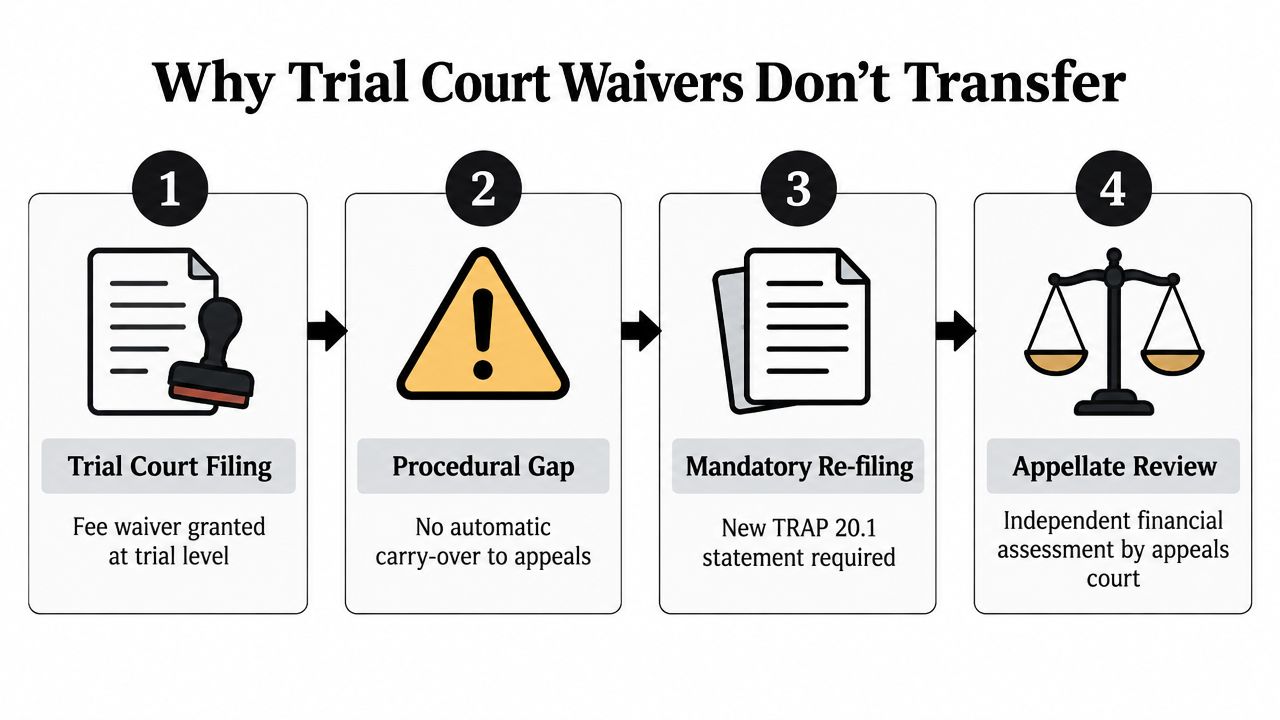
A trial-court fee waiver and appellate indigency status are related, but they aren't interchangeable. Many appellants assume that because they filed a Statement of Inability to Afford Payment of Court Costs in the trial court, the court of appeals will automatically recognize the same status. That assumption can lead to missed procedural steps.
TRAP 20.1 provides that a party who filed a trial-court statement generally doesn't have to pay appellate costs unless the trial court overruled the indigence claim in an order complying with Texas Rule of Civil Procedure 145. The rule also addresses trial-court orders requiring partial costs or installment payments. Those rulings can affect whether the appellant receives automatic protection from appellate costs.
The appellate clerk still needs written notice
The benefit isn't self-executing. If the trial-court ruling leaves you presumed indigent under the appellate rule, you must communicate that status in writing to the appellate clerk. Filing a notice of appeal alone doesn't communicate the required information, and filing a statement in the trial court alone doesn't complete the appellate step. Texas appellate practice guidance distinguishes the trial-court filing from the written communication needed in the appellate court.
The question many clients ask is direct: Do I need to refile the same form, or is my trial-court filing enough? The answer depends on the procedural history and current financial circumstances, but you shouldn't assume the old filing is enough. If your finances changed, or if the trial court rejected your indigence claim, the appellate court requires a new motion alleging a material change along with a current statement of inability.
A practical decision point
Review the trial-court order before deciding what to file:
- Determine whether the trial court accepted or rejected the indigence claim.
- Check whether the order complies with the applicable civil-cost rule.
- Determine whether the court ordered partial costs or installment payments.
- Notify the appellate clerk in writing when the rule requires that notice.
- File a new appellate motion and current statement if your circumstances changed or the earlier claim was rejected.
This is why the cost of a family law appeal in Texas must be analyzed by category rather than treated as one general expense. A Texas Family Law Appeals Lawyer provides appellate representation challenging final family law orders for legal error.
Navigating Contests and Protecting Your Indigent Status
A statement of inability can be challenged. When an opposing party files a contest, your financial allegations must be supported through the procedure established by the rule. If no contest is filed, the allegations are deemed true, and the appellant may proceed without advancing appellate costs. If a contest is filed, the claim must be sustained by written order.
That difference changes your task. You aren't merely submitting a form and waiting for approval. You need to preserve the documents and explanations that support each material statement, respond to a contest within the applicable process, and make sure the resulting order addresses the indigence claim.
Internal consistency matters more than conclusory language
A contest may focus on apparent contradictions. For example, the statement may list a vehicle as an asset but omit a loan, describe household expenses without identifying who pays them, or report attorney-cost arrangements in a way that conflicts with the fee agreement. Each unexplained inconsistency gives the opposing party an opening.
Before filing, compare the statement with:
- Recent income information
- Bank and account information
- Property and vehicle records
- Existing support obligations
- Household expenses
- Loan or credit access
- The written attorney-fee arrangement
Don't minimize information because you think it will make approval easier. A complete explanation is stronger than a selective disclosure. If an asset can't reasonably be converted to pay an appellate filing fee, explain why rather than leaving the asset out.
Understand the written-order requirement
When a contest is filed, the indigence claim must be sustained by written order. That order is important because it establishes the procedural basis for proceeding without advance payment of appellate costs. A verbal discussion at a hearing isn't a substitute for a written ruling that resolves the claim.
A trial court may also order partial costs or installment payments. Those orders don't fit neatly into an assumption that the appellant either qualifies for everything or qualifies for nothing. Read the order closely and communicate its terms to the appellate clerk. The appellate consequences depend on what the trial court ordered, not on a general belief that a fee waiver was granted.
A contest is a financial documentation issue, not a referendum on the merits of your family law appeal. Keep the response focused, supported, and consistent.
Fee relief also doesn't stay enforcement of a judgment. If the other side is pursuing collection or enforcement while the appeal proceeds, you need to address that issue through the proper procedure. The relationship between appellate costs and enforcement is discussed in supersedeas and staying enforcement pending appeal. Handle the indigency contest and any request to pause enforcement as separate procedural matters.
Connecting Fee Relief to the Appellate Record and Reversible Error
Obtaining relief from appellate filing fees only opens the courthouse door. It doesn't prove that the trial court made reversible error, and it doesn't create evidence that wasn't presented below. The appellant still carries the burden to provide a sufficient record showing why the judgment should be reversed or remanded.

Appeals review the record, not a new story
A trial includes testimony, exhibits, objections, and arguments presented to the judge. An appeal examines what happened through the existing record. That record commonly includes the reporter's record, exhibits, pleadings, and related filings. New evidence can't be added later because it would strengthen the appeal.
Texas appellate courts don't reweigh evidence as a new fact finder. In family cases involving custody, support, property division, or enforcement, the appellate judges review the legal framework and the record supporting the ruling. The Texas appellate record and reversible-error analysis show why the appellant must provide the materials needed to evaluate the complaint.
Consider the difference between these arguments:
- “The judge ignored my evidence.” This is too general.
- “The court excluded a properly offered exhibit, and the ruling affected the property division.” This identifies an event, a record location, and a connection to the result.
- “The ruling was unfair.” This expresses a conclusion without identifying the legal error.
- “The court applied the wrong legal standard to the requested modification.” This points toward a reviewable issue that must still be supported by the record and briefing.
Record preparation requires its own plan
Because TRAP 20.1 addresses appellate filing costs separately from record-preparation fees, you must identify what the clerk's record and reporter's record need to contain and determine how the governing cost procedures apply. A waiver of one category doesn't automatically eliminate the other.
A strong appellate plan connects four elements:
- The ruling: Identify the specific part of the final order being challenged.
- The preserved complaint: Show where the issue was raised and ruled on.
- The record: Provide the testimony, exhibit, pleading, or order needed to evaluate it.
- The harm: Explain why the error probably caused an improper judgment or prevented proper presentation of the case.
That connection is the difference between identifying a bad moment in court and presenting a viable appellate issue. A complete fee filing without a sufficient record leaves the court unable to reach the merits.
Securing Your Rights Through Strategic Appellate Advocacy
The hardest part of an appeal often begins before the appellate brief. Deadlines, notices, indigency filings, record requests, preservation rules, and enforcement concerns can develop at the same time. A person who misses the correct procedural vehicle may lose fee relief even when the financial hardship is genuine. A person who files a timely appeal but fails to provide the necessary record may also leave the appellate court unable to review the claimed error.
Protect the procedural foundation first
Start with the final order and the docket. Identify the deadline for the notice of appeal, determine whether a trial-court indigence ruling exists, and review whether that ruling accepted, rejected, or limited the request. Then communicate with the appellate clerk as required and address any current change in finances through the correct appellate motion and statement.
Your substantive review should examine issues such as:
- Whether the court applied the wrong legal standard
- Whether the court abused its discretion in a custody or visitation ruling
- Whether the property division rests on an improper legal assumption
- Whether support findings lack the required record support
- Whether the court denied a meaningful opportunity to present evidence
- Whether an evidentiary or procedural ruling probably affected the judgment
- Whether the record contains the materials necessary to prove the complaint
A careful appellate lawyer doesn't just repeat the trial argument. Counsel examines the record, identifies preserved and reviewable errors, selects the correct standard of review, and develops briefing that addresses the questions the court of appeals must decide. The Texas Rules of Appellate Procedure and Texas Family Code must work together in that analysis.
The Law Office of Bryan Fagan, PLLC handles Texas family law appeals involving custody, visitation, property division, support, divorce decrees, protective orders, contempt, and enforcement judgments. Its appellate division reviews trial records, evaluates potential reversible error, and prepares arguments directed to the appellate court's legal standards.
Your financial circumstances may explain why you need fee relief. Your record and legal arguments explain why the judgment should change. Both deserve careful attention.
If you believe the court made a mistake in your family law case, our appellate attorneys can help you seek a fair outcome. Contact The Law Office of Bryan Fagan today for a free consultation.
The Law Office of Bryan Fagan, PLLC can evaluate your TRAP 20.1 filing, appellate deadlines, record needs, and potential reversible error in a Texas family law judgment. Visit The Law Office of Bryan Fagan, PLLC to schedule a consultation and discuss a focused strategy for protecting your right to appellate review.