Skip to content
You may feel your Texas family law case was handled unfairly. A custody order may limit your time with your child, a divorce decree may divide property in a way that seems unsupported, or a protective order may affect your safety, reputation, and future. The appeal process can offer a path toward correction, but only if you protect that path from the beginning.
The first filing is usually the notice of appeal. Under Texas Rule of Appellate Procedure 25.1, that notice must identify the case and the judgment with enough precision for the clerk and appellate court to process the appeal. The central question is not whether you're unhappy with the result. It's whether the trial court made a legal error, abused its discretion, or committed another reversible error that can be shown through the appellate record.
Taking the First Step After an Unfair Family Court Ruling
Consider a parent who leaves a final custody hearing believing important evidence was ignored. The judge may have relied on an incorrect legal standard, limited the parent's opportunity to present evidence, or entered an order that doesn't match the findings made in open court. The parent wants a new hearing immediately, but an appeal doesn't work that way.
An appeal is not a retrial. The appellate court generally reviews what happened in the trial court through the existing record. It doesn't usually hear new witnesses, receive new exhibits, or decide credibility from the beginning. The appellate judges examine whether the trial court followed the law and whether the ruling can stand under the applicable standard of review.
Practical rule: Protect the appeal before arguing the merits. A strong appellate issue can't help if the notice of appeal wasn't timely filed.
Texas Rule of Appellate Procedure 25.1 is the gateway filing. It requires information that allows the clerk and court to identify the trial court, the case, the appealed judgment, the party appealing, and the appellate court involved. The rule also requires additional information for certain accelerated, restricted, indigency, and government-related matters. Review the Texas Rules of Appellate Procedure before filing, because the exact wording and case classification matter.
The notice doesn't need to contain the complete argument. That belongs in the appellate briefing. It does need to communicate a clear intent to appeal and identify the judgment or order under review. A notice that merely says “I appeal” without identifying the case or ruling creates avoidable risk.
For a parent, the first strategic task is to identify the signed order and determine the correct deadline. For trial counsel, it's to preserve the client's right to review while the team evaluates the record and develops appellate issues. Those jobs overlap, but they're not identical. The notice starts the process. The record and briefing determine whether the appeal has a persuasive legal foundation.
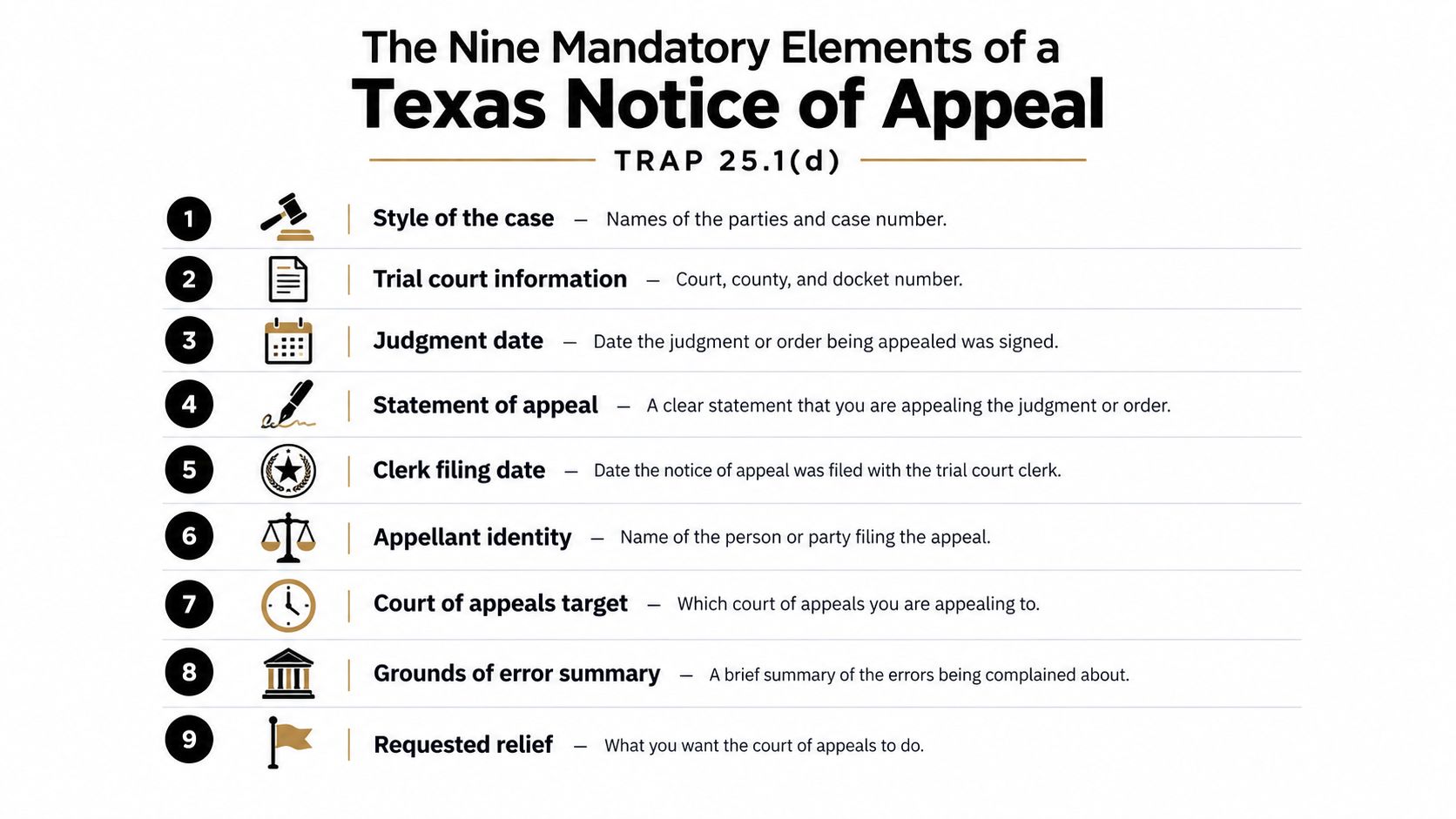
The Nine Mandatory Elements of a Texas Notice of Appeal
Rule 25.1(d) turns the notice into a checklist-style filing. The required details help the clerk route the appeal and help the appellate court determine whether special procedures or deadlines apply. The notice must do more than announce dissatisfaction with a judgment.
Use this checklist when reviewing a proposed filing:
- Trial court identity. State the trial court from which the appeal arises.
- Case number. Include the trial court's case number.
- Case style. Identify the parties using the case's style.
- Judgment or order date. State the date the appealed judgment or order was signed.
- Statement of intent. Clearly state that the filing party wants to appeal.
- Appellate court. Identify the court of appeals being used. Special language applies to appeals involving the First and Fourteenth Courts of Appeals.
- Filing party. Name each party filing the notice.
- Accelerated or restricted appeal statement. State whether the appeal is accelerated or restricted when that classification applies.
- Special status statements. Include required statements concerning indigency and certain government-related matters when applicable.
Why each detail matters
The trial court, case number, and case style connect the notice to the correct lawsuit. The judgment date allows the clerk and lawyers to calculate the applicable deadline. The statement of intent shows that the party seeks appellate review rather than merely objecting to the ruling.
The appellate court designation matters because the notice must identify where the appeal belongs. The First and Fourteenth Courts of Appeals have a special rule addressed in Rule 25.1. A filing that omits the proper appellate destination may require correction and should be reviewed carefully before submission.
The remaining statements identify procedural features that may change how the appeal proceeds. An accelerated appeal, restricted appeal, indigency request, or government-related matter can carry special requirements. The rule's structure reflects a practical reality: the clerk needs enough information to route the filing, and the court needs enough information to recognize the kind of appeal being initiated.
For general timing information, The Notice of Appeal Deadline in Texas Family Cases explains why you generally have only 30 days to start a family law appeal. That ordinary deadline isn't universal, so case classification must be confirmed before anyone relies on it.
A notice of appeal typically shouldn't contain a full merits brief. Don't use the filing to argue every factual dispute or explain why the trial judge was wrong in detail. Identify the required information accurately, file it on time, and reserve the legal analysis for the later appellate stages.
Curable Defects Versus Jurisdictionally Fatal Errors
A technical mistake and a jurisdictionally fatal failure aren't the same thing. That distinction is one of the most important points in Rule 25.1 practice.
Rule 25.1 requires specific information, but it also provides that filing a notice of appeal invokes appellate jurisdiction. Other defects generally don't destroy jurisdiction merely because the notice contains an error or omission. The Texas Bar's explanation of the rule describes this difference between invoking jurisdiction and complying with filing details in its discussion of Texas appellate notice requirements.
Mistakes that may be curable
A typographical error in a party's name, an incorrect label, or an omitted detail may be correctable when the timely filing clearly identifies the case and shows an intent to appeal. The right response is prompt review and correction, not panic. Counsel should compare the notice against the signed order, docket information, and Rule 25.1(d) before assuming a defect is fatal.
The filing must still communicate a genuine desire to seek appellate review. A document that clearly identifies the judgment and announces an appeal is materially different from a letter expressing frustration or a motion asking the trial judge to reconsider.
Failures that can end the appeal
The most serious problem is failure to file the notice within the applicable deadline. A late notice can prevent appellate review even when the underlying complaint appears strong. Misclassifying an accelerated case can create the same danger because a filer may wait for the ordinary deadline when a shorter period controls.
The correct approach is simple:
- File on time first. Don't delay the notice while perfecting the merits.
- Audit the details immediately. Compare every required item with the rule and the judgment.
- Correct defects quickly. Ask appellate counsel whether an amended notice or other filing is appropriate.
- Separate jurisdiction from form. A curable defect isn't the same as a missed deadline.
For additional context on the limited grace period that can apply in some circumstances, review TRAP 26.3 and the fifteen-day grace period to file a notice of appeal. Don't treat a grace period as a substitute for calculating the original deadline correctly.
The Hidden 20-Day Deadline Trap in Family Law Appeals
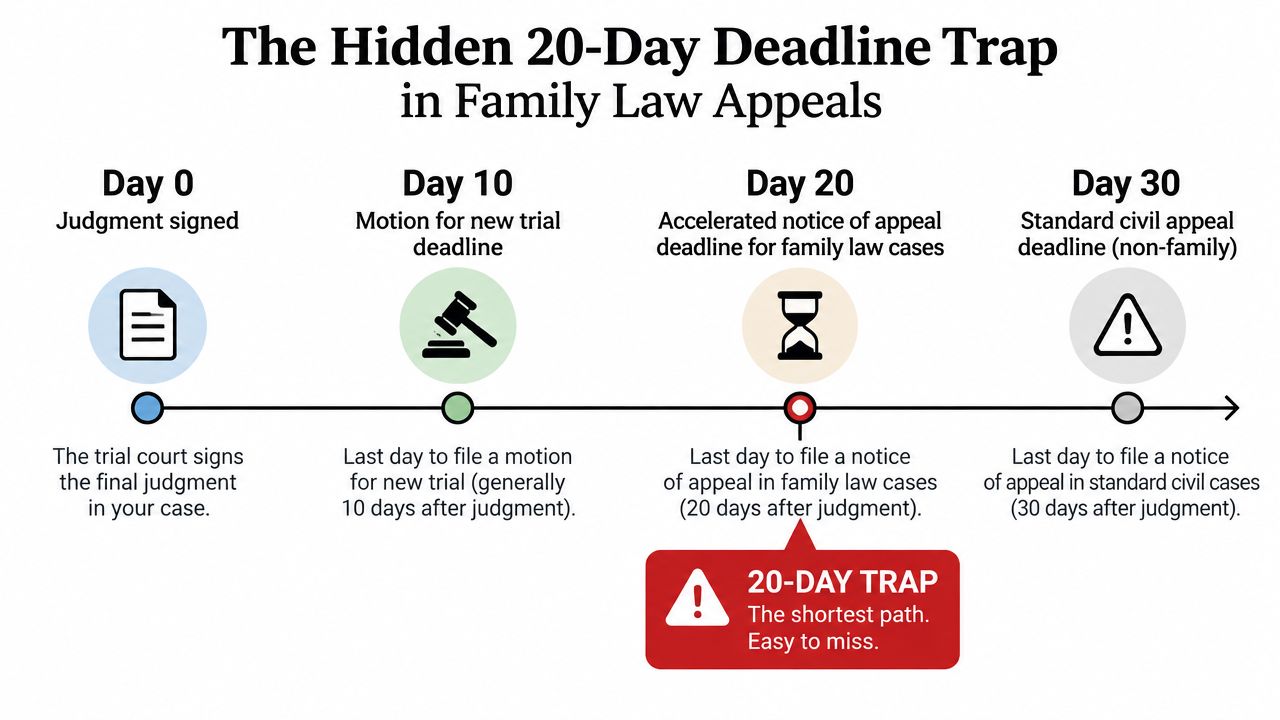
The assumption that every family law appeal allows 30 days is unsafe. Certain family cases proceed as accelerated appeals, and parental-termination and child-protection cases require the notice of appeal to be filed within 20 days of the signed order. A 2025 opinion from the First Court of Appeals reiterated that the 20-day deadline applies in accelerated appeals, including parental-termination proceedings. Read the decision in In re J.W..
The ordinary rule isn't the family-law answer
In an ordinary civil appeal, the deadline is 30 days. It can extend to 90 days when a timely motion for new trial or another qualifying post-judgment motion is filed. Those ordinary calculations don't eliminate the need to classify the family case correctly.
Texas court materials explain that certain family matters, including parental-termination cases, require filing within 20 days of the signed judgment. The same materials discuss the ordinary civil deadlines and the importance of identifying whether the appeal is accelerated. Review the Texas appellate deadline materials when calculating the filing date.
Why the classification matters
Termination and child-protection cases receive accelerated treatment because parental rights and child safety require prompt review. The notice should state when the appeal is accelerated and whether it involves a termination or child-protection case. That information helps the court apply the correct procedures from the start.
Missing the 20-day deadline can end appellate review before briefing begins. The merits of the parent's complaint won't cure a late filing. The court may never reach allegations that the trial judge ignored evidence, applied the wrong legal standard, or violated due process.
A parent should give appellate counsel the signed order immediately. Trial counsel should record the signing date, identify the case type, calculate the deadline independently, and confirm filing before relying on an electronic submission. Treat the shortest possible deadline as the controlling risk until the case has been classified.
How Appeals Differ from Trials and the Standard of Review
At trial, the judge receives evidence and makes decisions about facts, credibility, and the relief requested. On appeal, the court examines the record created below. The appellate judges aren't ordinarily deciding which witness they personally find more believable.
That difference changes the entire strategy. A parent who wants to introduce a new text message, offer new testimony, or explain events that never entered the record may be disappointed. The appellate court generally evaluates whether the trial court made a legally significant mistake based on the evidence and arguments preserved in the record.
Three terms every client should understand
Abuse of discretion means the trial court acted without reference to guiding legal rules or made a decision that falls outside the range of reasonable choices supported by the record. Family courts often exercise broad discretion, especially in custody and conservatorship matters, so the appellant must identify more than a disagreement with the result.
Reversible error means a legal error serious enough to justify changing the judgment or ordering further proceedings. Not every mistake requires reversal. The appellant must connect the error to the challenged ruling and explain why the record supports relief.
Briefing is the written legal argument submitted to the appellate court. The brief identifies the issues, cites the record, explains the governing law, and shows how the trial court's error affected the judgment.
The appellate record carries the evidence and proceedings the court can review. The appellant must ensure the record is filed, and the briefing must focus on legal error in that record rather than re-arguing the case as if it were a new trial. Issues such as abuse of discretion, reversible error, and legally sufficient evidence often become central to that analysis, as explained in this civil appeals guide.
Errors that may support appellate relief
Common examples in Texas family cases include applying the wrong legal standard, excluding evidence through an incorrect evidentiary ruling, failing to make findings required for the order, entering relief beyond what the pleadings support, or issuing a custody decision without a legally adequate basis in the record. Whether an error is reversible depends on the order, preservation, record, and governing law.
A successful appeal doesn't ask the appellate court to substitute personal preferences for the trial judge's judgment. It shows a specific legal problem and explains why that problem affected the outcome.
A Practical Filing Checklist for Trial Attorneys and Parents
Use a written filing protocol. Relying on memory is especially dangerous when a case may be accelerated.
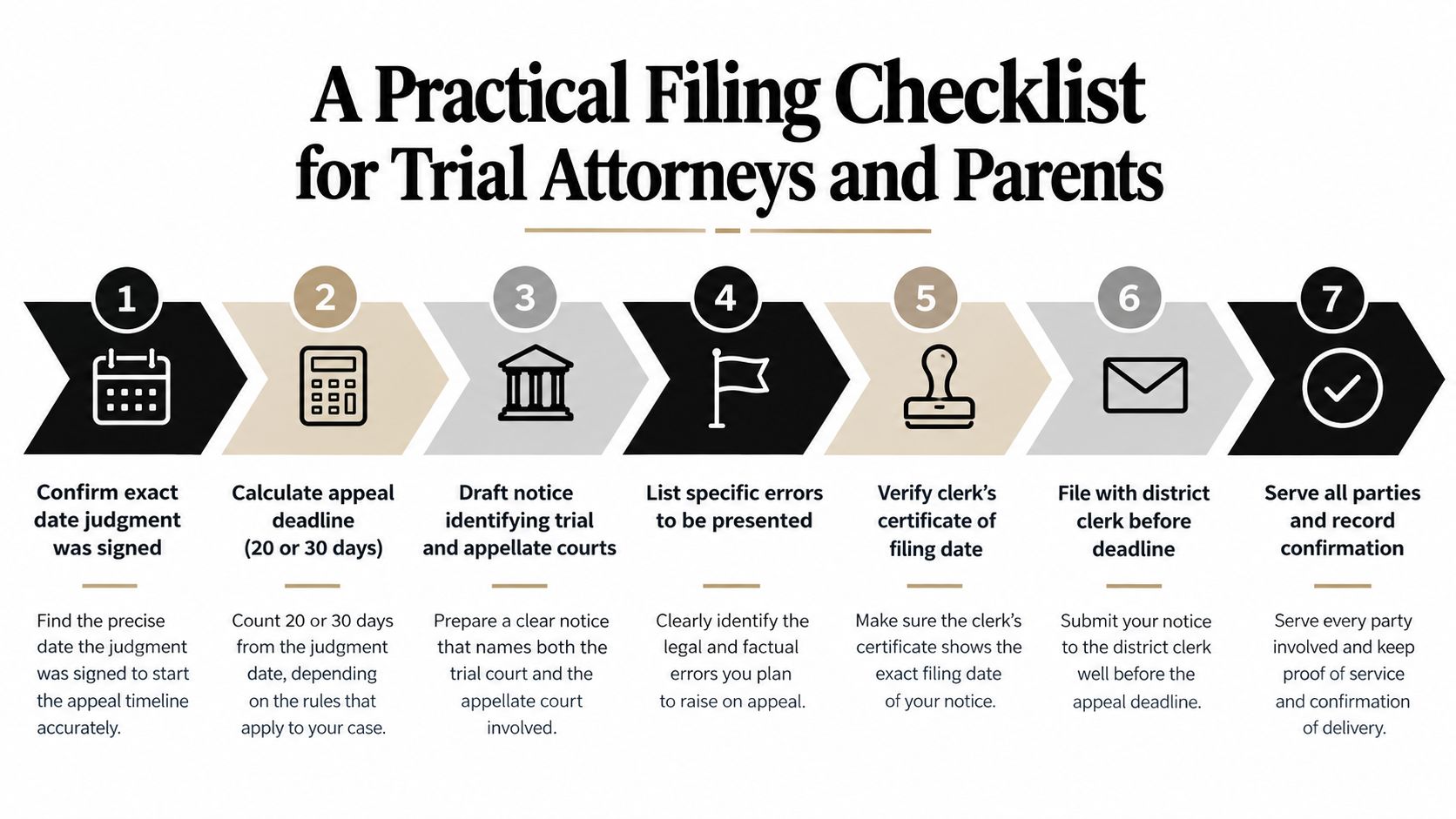
- Confirm the signed order. Obtain the exact judgment or order and verify the date it was signed. Don't calculate from the hearing date unless the rules make that date controlling.
- Classify the case. Decide whether the appeal is ordinary, accelerated, restricted, indigency-related, or connected to another special category.
- Calculate the deadline. Use the case classification and applicable post-judgment filings. Ordinary civil appeals generally use 30 days, while certain accelerated family cases use 20 days. A qualifying post-judgment motion may affect an ordinary civil deadline, which can extend to 90 days.
- Draft the notice. Identify the trial court, case number, style, order date, intent to appeal, appellate court, and filing parties. Add every special statement required by Rule 25.1(d).
- Review the requested designation. Make sure the notice identifies the correct appellate court, including any special language required for the First and Fourteenth Courts of Appeals.
- File with the district clerk. Confirm the clerk accepted the filing and preserve the file-stamped copy or electronic confirmation.
- Serve the parties and monitor the record. Confirm service and track the appellate record, docketing requirements, and briefing deadlines.
Sample language should be adapted, not copied blindly
A basic notice might state that the named party appeals the identified final judgment signed on the stated date from the identified trial court to the identified court of appeals. It should identify whether the matter is accelerated and include any required indigency or restricted-appeal statements. The language must match the actual case, not a generic form.
Filing discipline: Keep the signed order, deadline calculation, notice, proof of filing, and service confirmation in one appellate file.
A docketing statement is separate from the notice and serves a different purpose. Before filing, review what a docketing statement is so the team doesn't confuse the two documents or overlook a separate appellate requirement.
Parents representing themselves should seek advice before filing whenever possible. A notice can preserve the appellate path, but it won't identify every issue, assemble the record, or write the brief. Trial attorneys who don't regularly handle appeals should involve appellate counsel early, especially when the judgment affects parental rights, property division, spousal maintenance, support, or a protective order.
Securing Your Future Through Strategic Appellate Advocacy
A notice of appeal is a procedural beginning, not the full case. It preserves the opportunity to ask an appellate court to review the judgment, but the later work requires careful record examination, issue selection, standards-of-review analysis, and focused briefing.
The strongest appellate strategy starts by separating disappointment from legal error. An unfair result may reflect a wrong legal standard, a failure to consider required evidence, an unsupported exercise of discretion, or a procedural ruling that prevented a meaningful presentation. The record must show what happened, and the brief must explain why the mistake matters.
What careful appellate preparation accomplishes
A focused review can identify whether the notice was timely, whether the record contains the necessary materials, and whether the claimed error was preserved. It can also clarify the relief available, which may include a new hearing, modification of part of the judgment, or another remedy authorized by law.
The Law Office of Bryan Fagan, PLLC handles Texas family law appeals involving custody, visitation, property division, spousal maintenance, child support, divorce decrees, protective orders, contempt, and enforcement judgments. Its appellate team examines the record, identifies potential reversible error, and prepares briefs grounded in the Texas Family Code and Texas Rules of Appellate Procedure.
Don't wait until briefing is nearly due to investigate whether the appeal is viable. If the order is recent, give counsel the signed judgment, the notice of hearing, the major filings, and any filing confirmations. Early review allows the attorney to address the deadline, record, and legal issues in the right order.
If you believe the court made a mistake in your family law case, our appellate attorneys can help you seek a fair outcome. Contact The Law Office of Bryan Fagan today for a free consultation.
The Law Office of Bryan Fagan, PLLC offers appellate review of Texas family law judgments, including deadline analysis, record examination, and briefing strategy for potential reversible error. Visit The Law Office of Bryan Fagan, PLLC to schedule a consultation and discuss how to protect your appellate rights.