You may feel your case was handled unfairly when a Texas court issued a protective order against you, or refused to grant one when you needed it most. That kind of ruling can affect your parenting time, your home, your work, and your reputation, so it's normal to want a careful second look.
A protective-order appeal is not a do-over of the hearing. It's a focused review of whether the trial court followed the law, had enough evidence, and made a reversible mistake. In Texas family law, that distinction matters because appeals are governed by the Texas Rules of Appellate Procedure and the Texas Family Code, not by the same live witness combat that happens at trial.
The protective-order appeals pillar matters because these cases often overlap with divorce, custody, support, and enforcement issues. Texas courts issued an estimated 162,497 temporary and final protective orders from 2021 through 2023, and 74% of final protective orders were tied to family violence, which shows how common these disputes are in family court Texas Courts protective-order report. When a case reaches the court of appeals, the fight changes from “what happened” to “did the judge legally get it right?”
Introduction to Protective-Order Appeals
A parent walks out of a hearing thinking the judge believed the wrong side, or failed to hear the whole story. A spouse may leave court with a no-contact order in place and no clear idea whether the ruling can be challenged. Those reactions are understandable, because protective-order hearings can move quickly and the consequences can feel immediate.
Appeals bring structure back into that process. The appellate court reads the record, checks the law, and asks whether the trial court's decision can stand under the proper legal standard. That kind of review is especially important in family cases, where protective orders often sit alongside custody, visitation, property, and divorce issues.
One useful way to think about an appeal is this, the trial is about building the facts, while the appeal is about checking the framework the judge used to decide them. A client can feel certain the judge “got it wrong,” but the appellate court needs a legal reason to reverse. That is where reversible error, abuse of discretion, and briefing come in, and those terms make much more sense once they're translated into plain English.
The appellate court is not a second jury. It is a legal review panel that asks whether the trial court had a proper basis for the order.
Texas appellate strategy also depends on timing, because some protective orders can be appealed right away while others wait for a final divorce or custody order. The rest of this guide breaks those rules down step by step so you can see where appeal rights begin, where they pause, and where they can be lost if the procedure goes off track.
When You Can Appeal Protective Orders
A protective-order ruling can feel final the moment the judge signs it, especially when it changes where someone lives, who can call whom, or whether children are involved in handoffs. The appeal question is narrower than that feeling. Texas law asks a different question, whether this order can be reviewed now or whether appellate review must wait for the larger family case to end.
Start with the type of case
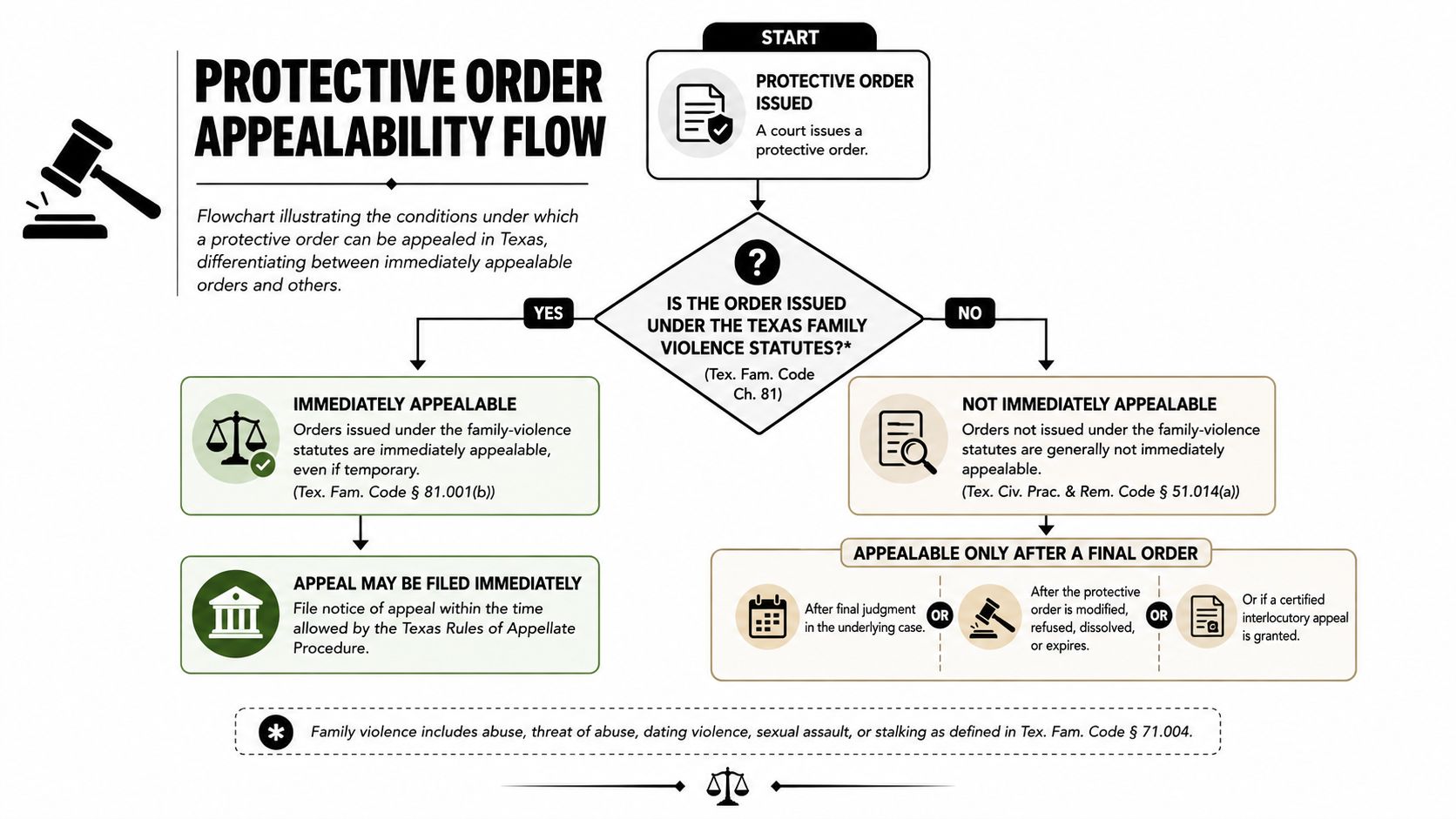
A stand-alone family-violence protective order is generally treated as a final, appealable order when there is no other pending litigation between the parties. In that setting, the appeal path is usually open right away. When the protective order is entered inside a divorce case or a suit affecting the parent-child relationship, the timing changes. Texas law often postpones review until the final divorce decree or the final support, conservatorship, or access order becomes appealable Texas appeal timing rule.
That sequence keeps one issue from pulling the rest of the case into the court of appeals too early. The practical effect is easy to miss. A parent or spouse may be looking at the order that hurts the most, while Texas appellate procedure is looking for the order that ends the case.
A protective order can also outlive the immediate dispute. Texas Law Help explains that these orders often last for a limited period, but some can last for life, and sexual assault and stalking protective orders can also last for life Texas Law Help protective order fact sheet. That matters because an order may expire before the appeal is decided, yet the right to appeal can still remain viable. The case does not disappear just because the order's calendar life is shorter than the appellate process.
Count the deadline carefully
The deadline begins with the correct order, not with the order a client thinks should control. In Texas, the notice of appeal deadline is often 30 days after the final, appealable order. If a post-judgment motion extends that deadline, the timing can change, but the first job is still the same: identify the right final order before filing. A notice filed from the wrong order, or filed before the case is appealable, can create avoidable jurisdiction problems.
That is why appellate counsel starts by sorting the lawsuit structure, then the order, then the deadline. A paper caption that says “protective order” is not enough by itself. The lawyer has to ask whether the order stands alone or sits inside broader family litigation. If the posture is unclear, the appeal strategy changes immediately.
A practical reference point is Standards of Review in Texas Family Appeals, because the standard of review often decides whether a challenge has real traction. A timely notice alone does not guarantee meaningful review. The appellate court still measures the complaint through the legal lens that applies to family cases.
Practical rule: do not guess at appealability from the title of the order. Read the whole case posture, then identify the final judgment that actually triggers review.
Texas appellate courts have also recognized that a family-violence protective order can be treated as a final, appealable order when it is not tied to pending litigation, as reflected in a Texas appellate decision on that issue Texas appellate case on final, appealable family-violence protective orders. That is the key distinction. One path allows an immediate appeal, while the other requires the lawyer to wait for the larger family case to finish before the appellate clock really starts.
Preserving the Record and Key Timelines
A protective-order appeal is built on the paper trail. If the appellate court cannot see a ruling, an exhibit, or a hearing exchange in the record, it usually cannot consider it. That is why the clerk's record, the reporter's record, the exhibits, and every filing that may matter have to be preserved on time.
What has to be requested
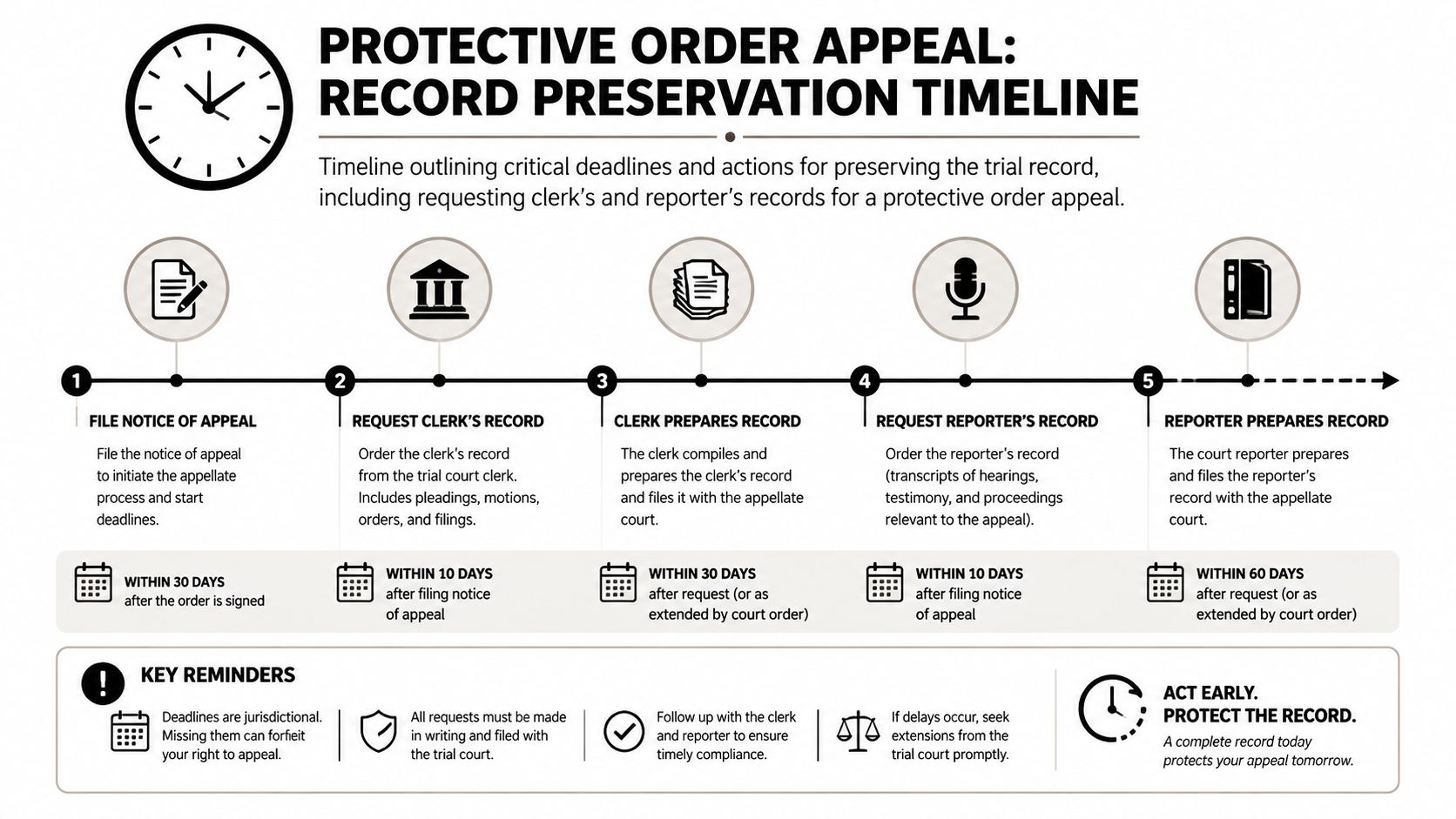
The clerk's record holds the pleadings, orders, and core filings from the trial court. The reporter's record contains the hearing transcript, which is often where the appeal is won or lost. If exhibits were admitted, they also need to be included, because appellate judges do not recreate the hearing from memory.
A careful filing plan keeps the record moving before the deadline passes. It also leaves room to spot missing items early, ask for supplementation if needed, or seek extra time when the rules allow it. When the case involved emergency relief, fast hearings, or short notice, that attention matters even more.
A transcript deadline is not a housekeeping detail. It often determines whether the court can review the exact words that supported, or undermined, the order.
A basic filing sequence
- File the notice of appeal. This starts the appellate case and tells the court that review is being sought.
- Request the clerk's record. The trial-court file needs to follow the appeal.
- Request the reporter's record. If the hearing matters, the transcript matters too.
- Review the record for gaps. Missing exhibits or omitted filings should be addressed early.
- Track the briefing schedule. The appellant's brief comes next, followed by the appellee's brief and any reply brief.
The timeline can become harder to manage when the protective order may end before review is finished. Some orders remain in effect long enough for the appeal to run its course, while others may expire before the court of appeals finishes its work. That is one reason appellate lawyers treat the record and the timeline as one strategy, not two separate tasks. For a plain-English overview of the mechanics, see designating and paying for the appellate record.
Standards of Review and Common Reversible Errors
A protective-order appeal does not start with the question, “Who sounded more convincing?” The court of appeals looks at a different issue. It asks whether the trial judge had a lawful basis to act, whether the ruling fits the record, and whether the error, if any, mattered enough to change the result.
Plain-English definitions
Abuse of discretion means the trial judge stepped outside the range of reasonable choices. If the judge had enough evidence and used the right law, the appellate court usually will not replace that decision just because it might have reached a different conclusion.
Reversible error means a legal mistake that is serious enough to affect the outcome. Small mistakes do not automatically lead to reversal. The error has to matter to the ruling itself.
Briefing is the written argument filed in the court of appeals. It explains what went wrong, points the judges to the record, and shows why the law calls for reversal or modification. For a clean explanation of how different rulings line up with different review standards, see standards of review mapped to ruling type.
How appellate courts look at the case
Texas appellate courts focus on whether the trial court had enough evidence and applied the law correctly. If the order is not supported by the record or does not satisfy the statutory requirements, the court of appeals can set it aside Texas appellate review of protective orders. That matters because protective-order appeals usually turn on proof, procedure, and legal reasoning, not on fresh testimony.
The seriousness of these cases also shows up in protective-order research. One protective order study found that protective orders were not violated for half of the women in the sample during follow-up, and that even when violations occurred, many still saw meaningful reductions in abuse and violence protective order study. Another longitudinal study reported lower incident rates for women seeking protective orders than for a matched comparison group before the order. Those findings help explain why appellate courts examine the record carefully. The record often reflects real danger before the order was entered.
Common reversible errors in Texas protective-order appeals
- No legally required proof: If the court enters or continues an order without the proof the statute requires, the order may not stand.
- Wrong legal standard: If the judge applies the wrong rule for family violence or another protected category, the appellate court can correct that mistake.
- Unsupported findings: If the record does not support the findings the order depends on, the ruling is vulnerable on appeal.
- Procedure problems: If the court skips required steps or rules in a way that violates due process, that can become a reversible issue.
A Texas appeals case described family violence as conduct intended to cause physical harm or a threat that reasonably places a family member in fear of imminent harm, and it showed why the trial court's factual basis mattered before the order was issued Texas appellate review of protective orders. That is the kind of legal framing an appellate brief has to address directly.
A protective-order appeal is stronger when it identifies a specific legal mistake, not just a general belief that the judge got it wrong.
Interlocutory Versus Final Judgment Issues
A protective-order appeal can feel straightforward until the order is only one piece of a larger family case. Then the question is not just whether the judge got it right, but whether review is available now or only after the rest of the case reaches a final stage.
Why timing changes the path
A stand-alone protective order is usually treated as a final order that can be appealed in the ordinary way. The Texas appellate courts have recognized that kind of order as final and appealable when it resolves the protective-order dispute by itself. When the order is part of a divorce case or a suit affecting the parent-child relationship, the appeal usually waits until the final decree or the final conservatorship, support, or access order becomes appealable. The rule is designed to keep the court of appeals from being asked to review pieces of the same family case one by one while the underlying case is still open.
That timing difference matters because the wrong filing can stall the case before the appellate court ever reaches the merits. A spouse may want immediate review of the protective order, but the statute may require waiting until the broader case is finished. Filing too early can waste time and money, and filing from the wrong order can create a jurisdiction problem that has nothing to do with the strength of the arguments.
How related cases affect strategy
Lawyers have to look at the whole docket, not just the protective-order hearing, because divorce, custody, property division, and support can all affect when appellate review begins. The appeal clock does not always start when the protective order is signed. It starts when the correct order becomes final and appealable.
That is why the sequencing matters so much in Texas family law. A protective-order issue may sit inside a larger case, while other issues move on a different track. A useful guide to that difference is interlocutory appeals and temporary-order tracks, which helps show how some orders move quickly and others wait for a final judgment.
The practical lesson is simple. Before filing, identify the exact order the court of appeals will recognize as final. That step helps avoid a dismissal based on jurisdiction, which says nothing about the merits and everything about timing. Even after a protective order expires, appellate review can still matter if the appeal was taken from a final order that carries continuing legal consequences.
Practical Checklists and Sample Appellate Arguments
After a protective-order hearing, a client usually wants two answers right away, what happens next, and what can still be fixed on appeal. The answer starts with the record. If the issue was not preserved, or if the wrong order is being challenged, even a strong argument may never reach the merits.
A useful way to approach the appeal is to work from the order itself, then move outward to timing, finality, and consequences. A protective order can sit inside a larger family-law case, and that matters because Texas appellate review does not always begin at the same moment for every order. Some issues travel on an interlocutory path, while others wait for a final judgment, and that sequence can determine whether the court of appeals will hear the case at all.
Appellate Preparation Checklist
| Checklist Item | Action Steps |
|---|---|
| Identify the order | Confirm whether it is a stand-alone protective order, or part of a divorce or SAPCR case. |
| Check finality | Determine whether the order is immediately appealable or delayed until another final order. |
| Count deadlines | Mark the notice of appeal deadline and any record or briefing dates. |
| Preserve the record | Request the clerk's record, reporter's record, and admitted exhibits. |
| Review for error | Find the exact ruling, finding, or omission that may support reversal. |
| Plan the brief | Organize issues, authorities, and record citations before drafting. |
| Think about consequences | Consider whether the order's effects continue after expiration, especially if collateral disabilities remain. |
An appellate point gets stronger when it is narrowed to one clean error. If the complaint is lack of proof, the brief should identify what element the record does not support. If the complaint is legal error, the brief should show the judge's wording and explain why that wording does not fit the statute.
The same method applies when the order may already have expired. An expired order is not automatically dead for appellate purposes. If the order still carries collateral consequences, such as licensing effects or other legal disabilities, the appeal can still matter even after the protection period ends.
Sample argument directions
- Insufficient evidence: “The record does not contain the proof needed to support the findings required for the order, so the ruling should be reversed or modified.”
- Wrong legal definition: “The court applied an incorrect understanding of family violence, which led to a result the statute does not allow.”
- Expired order with ongoing harm: “Even though the order expired, collateral consequences remain, so the appeal is not moot.”
A practical issue sometimes missed is that an appeal can remain live after expiration if the order still affects the client in the actual world. That point was noted in the expired-order appellate discussion, and the underlying idea is simple. An order can stop operating on paper while still leaving legal consequences in place.
If your case needs a careful record review and a clean appellate theory, The Law Office of Bryan Fagan, PLLC is one option for Texas family-law appellate work, including protective orders, custody, and divorce-related appeals. The firm's role is to examine the record, identify reversible error, and build a brief that speaks to the judges' legal questions, not just the client's frustration.
When to bring in appellate help
Bring in appellate counsel when the order is final, the deadline is close, the record is incomplete, or the case is tied up with other family-law issues. Those are the cases where strategy matters most, because a small procedural mistake can end the appeal before it starts. A focused review early can prevent a jurisdiction problem later.
Frequently Asked Questions
Can you appeal an expired protective order? Yes, in some cases you still can. An expired order may leave collateral consequences in place, such as licensing effects or other legal disabilities, so the appeal can remain live even after the order itself has ended.
What if you need relief while the appeal is pending? Counsel can examine emergency options based on the record and the posture of the case, but the first question is whether the appeal is properly before the court. If jurisdiction is shaky, emergency requests may not cure the larger problem.
What if the transcript deadline was missed? Act quickly. The record can sometimes be corrected or supplemented, but delay makes it harder to preserve the issue and explain the omission. The right response depends on what was missed and why.
Why do some protective-order appeals feel harder than trial cases? Because the court of appeals reviews legal error, not the case from scratch. The written record, the standard of review, and the exact wording of the order can matter more than a client expects. Interlocutory appeals and final appeals can also affect the sequence, so the timing question deserves careful attention before anyone assumes the case has reached its last stop.
Next Steps and Call to Action
If you think a Texas court made a mistake in your protective-order case, the next move is a focused appellate review, not another round of guesswork. A careful lawyer can tell you whether the order is final, whether the record supports reversal, and whether the issue belongs in a broader custody or divorce appeal.
If you're ready to protect your rights, talk with an appellate team that handles protective orders, custody, divorce, and property division issues with the Texas Rules of Appellate Procedure in mind. Internal review, record analysis, and clear briefing can make the difference between a dismissed complaint and a meaningful appellate challenge.
If you believe the court made a mistake in your family law case, our appellate attorneys can help you seek a fair outcome. Contact The Law Office of Bryan Fagan today for a free consultation. Visit The Law Office of Bryan Fagan, PLLC to schedule a case evaluation and get help assessing your protective-order appeal.