You may feel like the judge saw only one side of the story. You sat through a custody trial, listened to accusations about alienation, and walked out with an order that felt disconnected from the evidence you thought mattered most.
That feeling is real. But a Texas appeal does not ask whether you were a good parent in the abstract. It asks whether the trial court made a legal mistake, whether the record supports the ruling, and whether that mistake was serious enough to change the outcome.
A parental-alienation appeals pillar gives you the appellate lens, not a second custody trial. That distinction matters. Appellate courts look for reversible error, which means an error that affected the judgment, not just a ruling you dislike. They also review the case through standards like abuse of discretion and legal sufficiency, which shape what the court can fix and what it must leave alone.
In Texas family law, alienation arguments often become central because they can alter conservatorship, possession, and parenting time. But the appellate question is narrower than the trial question. The issue is whether the court properly identified alienating conduct, correctly ruled out lawful alternative explanations, and built its judgment on a record that can withstand review.
This guide stays on that appellate path. It covers what can be appealed, how Texas appellate procedure works under the Texas Rules of Appellate Procedure and the Texas Family Code, what reversible errors usually appear in alienation cases, and how to preserve the record before the appeal starts. If you're trying to decide whether your case is a hard-fought loss or a true legal error, the sections below will help you sort that out.
When a Custody Ruling Feels Unjust in Texas
A parent often leaves the courthouse with a specific kind of shock. The trial court accepted the other side's alienation story, or blamed them for alienation without addressing the child's actual history, the communication record, or the possibility that something else drove the refusal.
That moment is usually when people start looking for a do-over. Appellate work doesn't give them one. It gives them a way to test whether the ruling rests on a legal foundation strong enough to stand.
A hard result is not the same thing as a reversible one.
The parental-alienation appeals pillar is for Texas parents who need a straight answer about whether the court got the law wrong. It is also for parents who sense that the judge accepted a label too quickly, skipped over alternative causes, or relied on conclusions that the record never really supported. That's the right frame for an appeal, because appellate courts care about error, preservation, and the written record.
This guide won't re-argue your entire custody fight. It won't promise that every unfair result can be fixed. It will show how Texas appellate courts look at alienation findings, how legal error shows up in a judgment, and how a record can either support or sink an appeal.
For parents trying to compare custody and appellate issues, Appealing a Child Custody Order in Texas addresses how appellate courts review conservatorship and possession rulings. For a more detailed example of alienation issues in practice, the overview at https://familylawcourtappeals.com/examples-of-parental-alienation/ can help you see how those claims are usually framed in family court.
What to watch for first
- Was the court focused on causation? Alienation turns on why the child resisted contact, not just whether conflict existed.
- Did the order address alternatives? A strong appellate record usually shows the trial court considered other explanations and explained why they were rejected.
- Is the complaint about law or facts? Appeals are strongest when the issue is a legal mistake, not just disappointment with credibility calls.
If those questions matter in your case, the next step is usually to inspect the judgment, the findings, and the reporter's record with an appellate eye.
What Courts Mean by Parental Alienation
Texas parents often use “alienation” to describe the whole pattern, constant conflict, blocked visits, poor communication, and a child who seems pulled away. Courts use the term more carefully. The legal question is whether the child's resistance was unjustified and caused by the other parent's conduct, not whether the parents' relationship was ugly.
The 2024 Family and Divorce Research Journal article describes parental alienation as a mental condition in high-conflict separation or divorce where a child aligns strongly with one parent and rejects the other without legitimate justification. The English appellate guidance in Re S (Parental Alienation: Cult) says the process can matter even if the parent did not act with malicious intent, because “the process that matters, not the motive” Re S (Parental Alienation: Cult). That point matters on appeal, because a trial court can err if it focuses on blameful intent instead of the effect shown in the record.
The legal elements matter more than the label
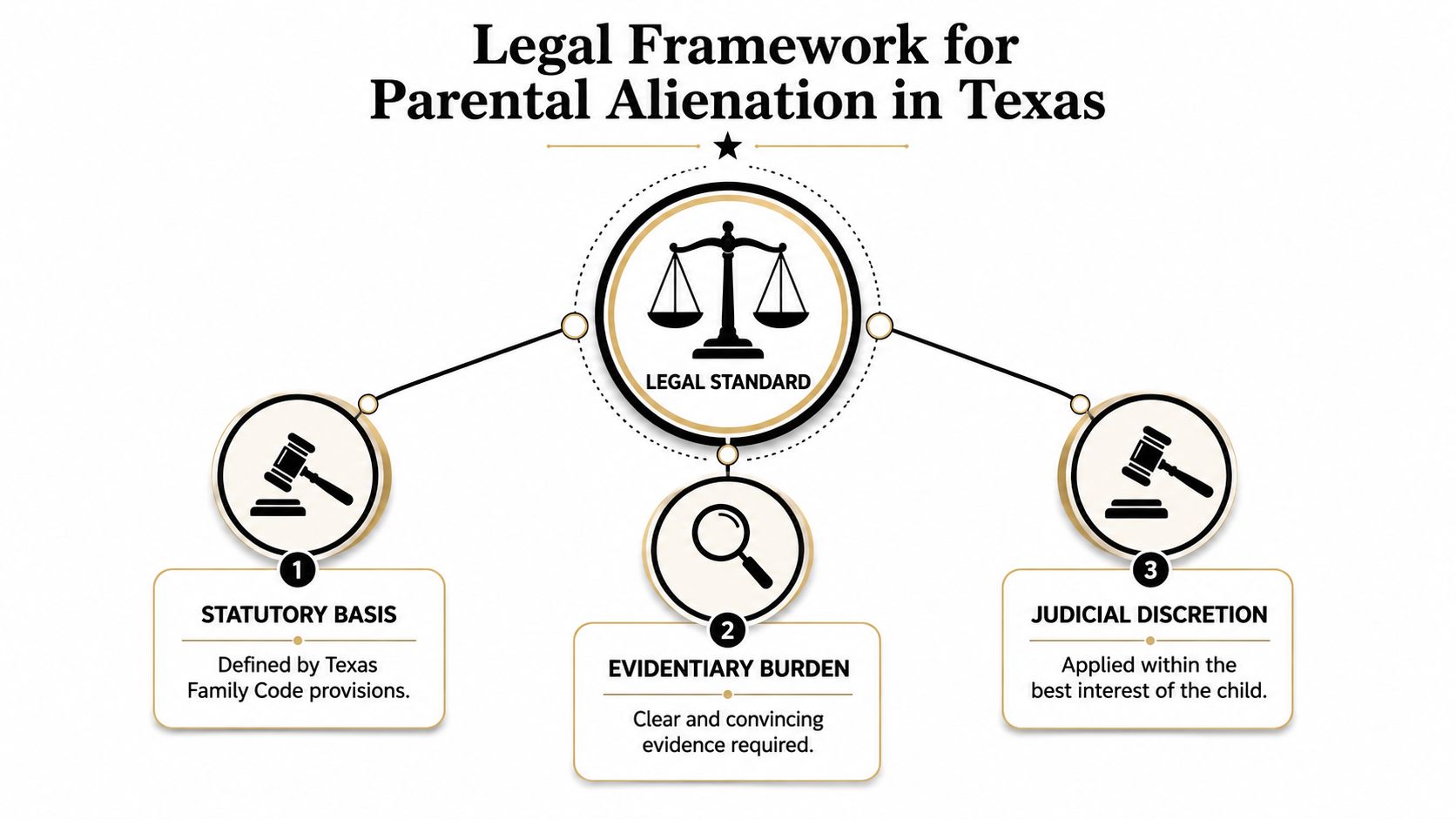
The 2024 Family Justice Council guidance says alienation requires proof of three things, the child resists contact, that resistance is not caused by the rejected parent or another legitimate factor, and the other parent engaged in conduct that directly or indirectly caused the refusal Family Justice Council guidance. That structure helps in Texas appellate work because it forces the court to ask whether the record ruled out other causes before making the finding.
Johnston's model is more useful in practice. It treats alienation as a multi-factor phenomenon, with negative scripts, restrictive gatekeeping, inadequate or pathogenic parenting, and the child's own vulnerability or resilience interacting together Johnston article. A serious appellate record should connect specific communications or gatekeeping conduct to specific child symptoms, then address competing explanations in the same record.
Practical rule: an alienation finding is strongest when the evidence shows a causal chain, not just a general atmosphere of hostility.
When the record is thin, the label can outpace the proof. Appeals matter in that setting because the appellate court can test whether the trial court identified the right legal elements and supported them with evidence that answers the causation question.
For a custody order challenge built around the same review lens, Appealing a Child Custody Order in Texas tracks how appellate courts review conservatorship and possession rulings.
Why An Appeal Is Not a Second Chance at Trial
An appeal is a review of what already happened, not a rerun. That is the biggest adjustment parents have to make. The appellate court usually reads the clerk's record and reporter's record, not new family photos, new texts, or fresh explanations that weren't presented correctly below.
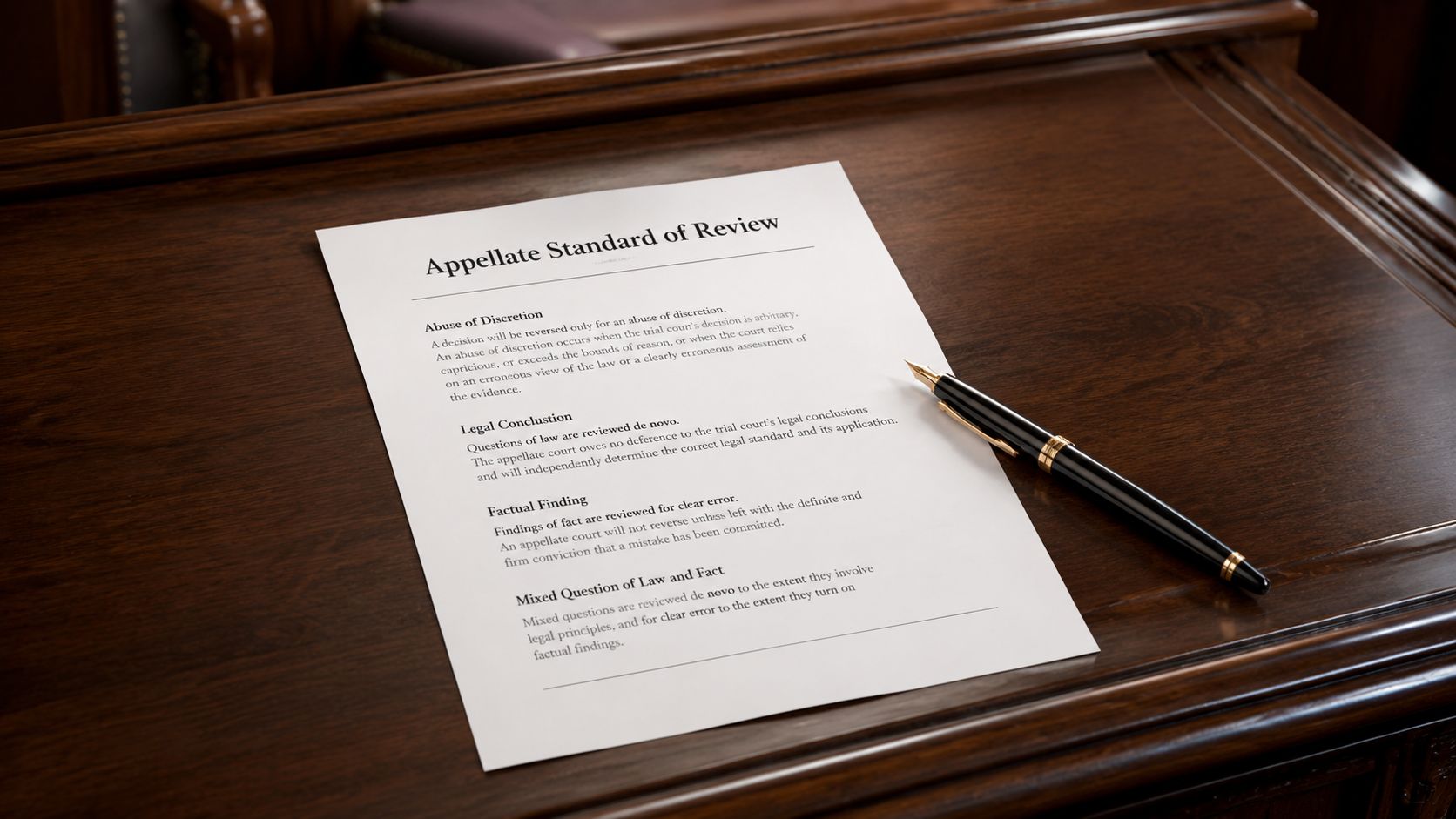
The key standards of review shape everything. Abuse of discretion asks whether the trial court acted without reference to guiding rules or principles. Legal sufficiency asks whether the evidence legally supports the finding. Factual sufficiency asks whether the finding is so against the great weight of the evidence that it can't stand. Legal questions, by contrast, are reviewed de novo, which means the appellate court decides them for itself.
A trial judge can weigh credibility in a way the court of appeals won't redo. That's why many alienation appeals fail when the complaint is really, “the judge believed them and not me.” Appeals work better when the issue is, “the judge accepted alienation without enough evidence, or without applying the right causation analysis.”
What the appellate court can and can't do
The court can reverse, remand, or modify when the record shows legal error. It generally can't hear new evidence just because the old record feels incomplete. That's why the distinction between a strong story and a strong appeal matters so much.
The timeline matters too. The Texas Rules of Appellate Procedure control the steps after judgment, and a late notice of appeal can end the case before the court ever reaches the merits. The internal guide on standards of review, Standards of Review Mapped to Ruling Type, helps match the complaint to the correct review standard.
After the briefing starts, the case becomes a paper-driven argument. Oral argument may happen, but the written brief usually does the heavy lifting.
If the trial court made a legal mistake, the appeal is the place to show it. If the issue is only that the evidence was close, the appellate odds are much narrower.
Reversible Errors That Undermine Alienation Findings
Alienation appeals often turn on record problems that looked small at trial but became legal problems on review. A trial judge can reach the right emotional impression and still commit reversible error if the findings do not support the result.
The errors that matter most
A recurring mistake is ignoring alternative explanations for the child's refusal. Alienation findings still have to account for whether the resistance came from the rejected parent's conduct, another legitimate cause, or something else in the family dynamic. If the findings never address that causation question, the appellate record may reveal a gap the court of appeals cannot ignore.
Another problem is overreliance on a single expert without a strong foundation. Expert testimony carries more weight when it connects specific conduct to specific child behavior and addresses other possible causes rather than relying on a label alone. That kind of record is much harder to defend on appeal.
The third common issue is legally insufficient findings. If the order says alienation happened, but the record does not show who did what, how the conduct affected the child, and why the court rejected competing explanations, the appellate court may have little to work with. Trial courts can make broad pronouncements. Appellate courts need a record that supports them.
What those errors look like in a real record
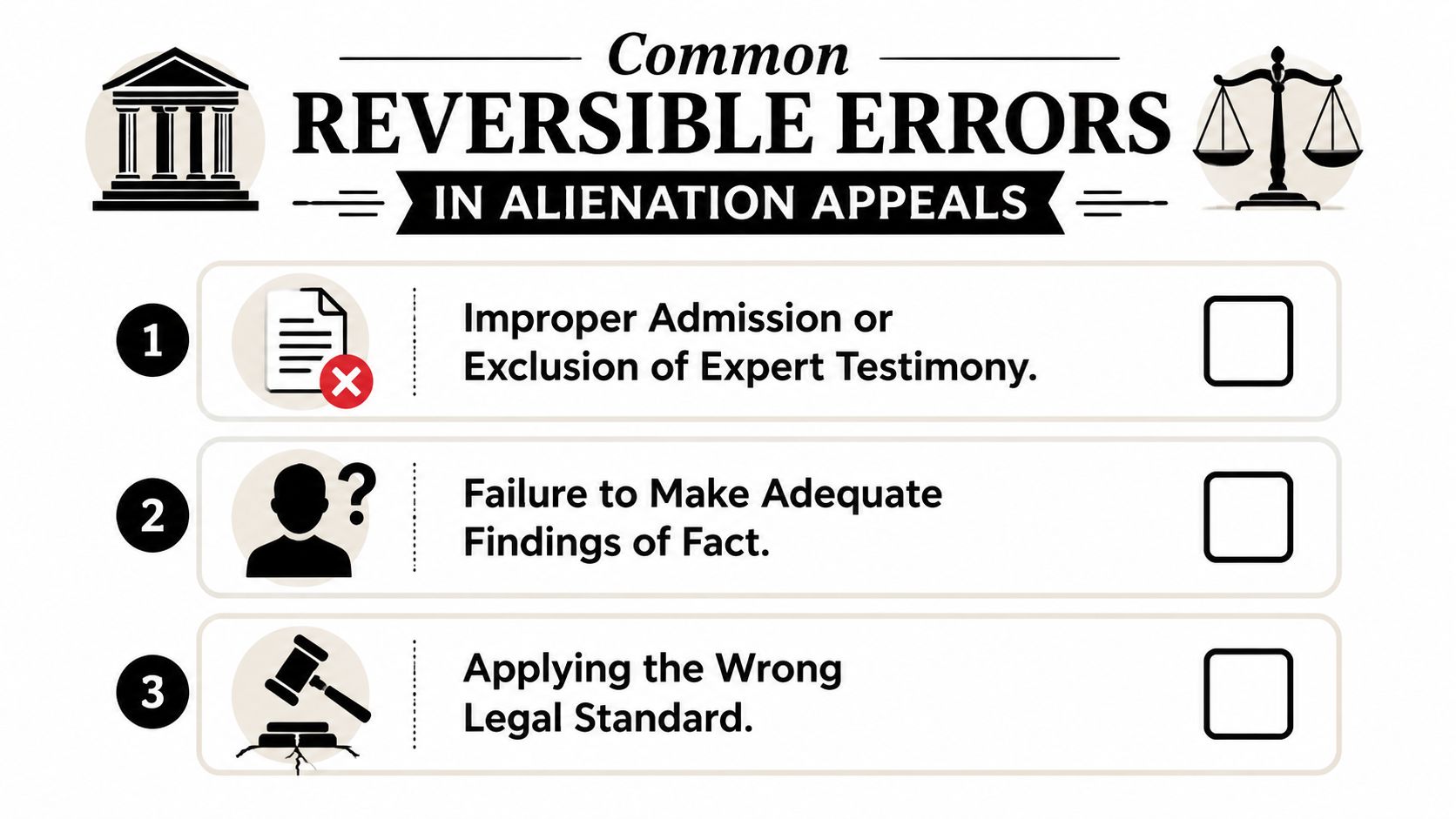
- Improper admission or exclusion of expert testimony. The court allows opinions without a solid link to the child's actual behavior, or blocks testimony that would have given a non-alienation explanation.
- Failure to make adequate findings of fact. The judgment says the parent alienated the child, but the written record never explains the pathway from conduct to refusal.
- Applying the wrong legal standard. The court treats intent as the whole issue, even though earlier guidance says the process matters, not motive Re S (Parental Alienation: Cult).
The appellate court can only review what is in the record, so missing material often matters as much as a bad ruling. The chapter on The Appellate Record: Clerk's and Reporter's Records explains why the clerk's and reporter's records control what the court can see.
If the judgment skips causation, the appeal usually starts with that omission.
The fastest way to spot reversible error is to read the findings against the live testimony, the exhibits, and the objections. If the trial court never had to confront the hard questions, the appeal has to show that failure line by line.
Preserving the Record for an Effective Appeal
A custody ruling can feel plainly wrong and still be hard to overturn. On appeal, the fight is usually not over who made the better parenting choice, it is over whether the trial court committed reversible error and whether the record is good enough to prove it.
Preservation starts before the final hearing ends. If evidence comes in over objection, the objection has to be made on the record, and the ground has to be clear enough for the trial court to rule on it. If the court excludes testimony or documents, make an offer of proof so the appellate court can see what was kept out. In a case tried to the court, request written findings of fact and conclusions of law so the court's reasoning is not left to guesswork. If a jury is involved, the charge has to be shaped so it tracks the alienation theory or the defense to it.
Practical rule: if the trial court never had a clean chance to rule on the issue, the court of appeals may not save it for you.
Parents also lose issues by being vague at the moment they object. “I object” is often too thin to preserve anything useful if the reason is never stated. Waiting until the final judgment to complain usually comes too late, because the trial court needed a chance to correct the problem while the evidence was still fresh and the ruling could still be changed.
The record has to be prepared with the same care. Once the notice of appeal is filed, the clerk's record and reporter's record must be designated and paid for so the appellate court can review what happened below. The practical roadmap for that stage is covered in Designating and Paying for the Appellate Record, because an appeal lives or dies on what the record contains, not on what a parent remembers from the hearing.
A parent who believes the trial court got it wrong still needs to prove the error from the paper trail and the transcript. In a custody or alienation case, the next step is usually a careful review of what was admitted, what was excluded, what was requested, and what the court ruled on. That is the point where a record issue becomes an appellate issue.
Texas Appellate Procedure and Timelines at a Glance
Texas appeals move on deadlines, not feelings. The first major step usually happens after the judgment is signed, when post-judgment motions can affect the deadline to appeal. Then the notice of appeal must be filed on time, or the appellate court may never reach the merits.
After that, counsel designates the clerk's record and reporter's record and makes sure they're paid for. Those records are what the appellate court reads. The brief comes next, and it needs to tie the facts to the standard of review with record citations that let the court verify every major point.
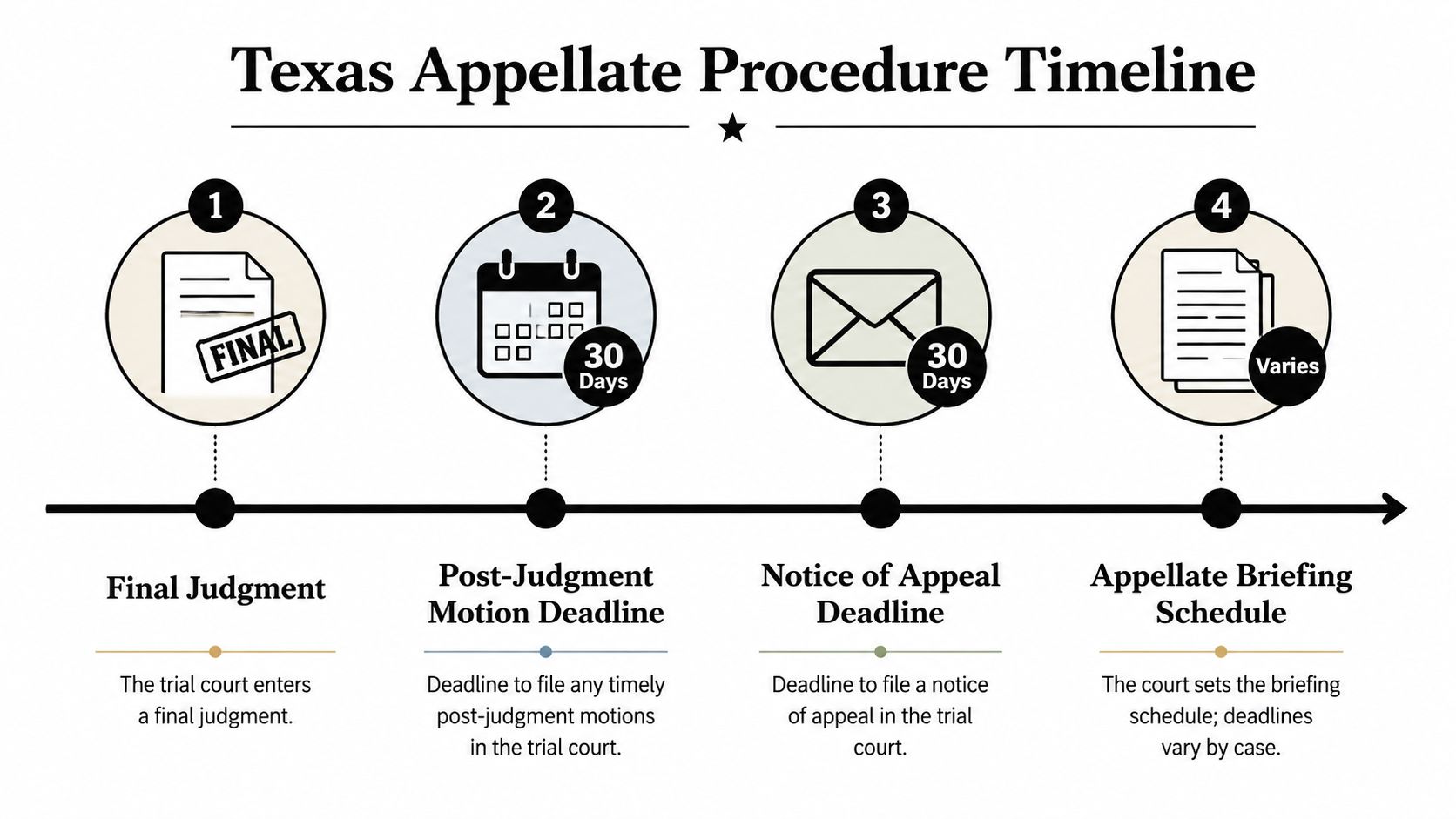
The milestones that matter
- Final Judgment. The signed order starts the clock on the next phase.
- Post-Judgment Motion Deadline. This can affect the timing of the appeal.
- Notice of Appeal Deadline. Missing this deadline can end the case.
- Appellate Briefing Schedule. The court sets the briefing pace, and the case becomes argument on paper.
Temporary orders and final judgments don't always follow the same path, so custody fights can move on different tracks depending on what was signed. That's one reason the first read of the order matters so much.
A persuasive alienation brief usually follows a steady structure. It identifies the alienation issue, states the standard of review, walks the court through the record, and then explains why the trial court's causation analysis was legally flawed. The strongest briefs don't repeat the trial argument. They show why the court's legal reasoning can't stand.
A good brief makes the judge's work easier by showing exactly where the error lives in the record.
That is the difference between advocacy and replay. The appeal is a written case about legal error, not a rehash of the family conflict.
Building a Persuasive Appellate Argument
A brief has a rhythm. It starts with the case background, then the issues presented, facts, standard of review, summary of the argument, argument, and prayer. In an alienation appeal, each part should do one job only, which is to move the court toward a reversible-error analysis.
The statement of facts should not read like a diary of hurt. It should point the court to the parts of the record that matter, the child's refusal, the alleged conduct, the expert testimony, the alternative explanations, and the findings the trial court made or failed to make. The argument then shows how the law applies to those facts.
A simple skeleton looks like this, with the citations filled in from the record:
Issue Presented: The trial court erred by finding parental alienation without legally sufficient evidence that the child's refusal was unjustified and caused by the other parent's conduct.
Argument: The reporter's record at [citation] and the findings at [citation] do not establish all required elements. The court did not rule out alternative causes for the child's resistance, including [record-supported alternative]. Under [controlling Texas authority], that omission is reversible because the finding rests on an incomplete causation analysis.
Prayer: The court should reverse and remand for further proceedings, or render the proper disposition if the record allows it.
The true skill lies in restraint. A brief that attacks every line of the judgment often loses focus. A brief that isolates one or two genuine legal errors usually has a better chance.
That same discipline is what makes an appeal worth filing in the first place. If the record has no clean error, the better choice may be to stop and reassess instead of forcing a weak appeal.
Frequently Asked Questions About Texas Parental-Alienation Appeals
A parent usually reaches the appellate stage after the trial court has already entered an order that feels wrong and the hearing is over. At that point, the core question is not whether the parenting relationship broke down in a broad, emotional sense. The question is whether the trial court made a legal mistake that can be corrected on appeal.
How long does an appeal take? It depends on the court's schedule, the record, and whether the case is accelerated. Family-law appeals often take months, not weeks, because the clerk's record, reporter's record, and briefing all have to be prepared and reviewed before the court can decide anything.
Can custody change while the appeal is pending? Sometimes, yes, depending on the order and the posture of the case. Some orders remain in place while the appeal moves forward, while others may be affected by post-judgment motions or emergency requests. Timing matters because a parent who waits too long may lose practical options that were available earlier.
What can an appeal fix? A successful appeal can reverse, remand, or sometimes modify an order if the record supports that remedy. It does not usually give you a fresh trial with new witnesses, new documents, or a second chance to redo the case from the ground up. The appellate court works from the record that was made below.
What happens in the consultation? A Texas appellate lawyer usually starts with the judgment, the key hearing record, and the deadlines. From there, the lawyer looks for reversible error, whether the judge applied the wrong legal standard, whether the evidence supports the alienation finding, and whether anything important was preserved in the trial court. The goal is to tell you, plainly, whether the case has a real appellate issue or whether the order is likely to stand.
If you believe the court made a mistake in your family law case, our appellate attorneys can help you seek a fair outcome. Contact The Law Office of Bryan Fagan today for a free consultation. Visit The Law Office of Bryan Fagan, PLLC to schedule a consultation and have an appellate attorney review whether your parental-alienation case has a real path forward.