You may feel your case was handled unfairly. A judge made a custody ruling you didn't expect, signed a divorce decree that seems one-sided, or entered an order that changed your life in ways you still can't accept.
That feeling matters. But in Texas family law, an appeal isn't a second trial. It's a focused legal review of whether the trial court made a meaningful legal mistake. If you're thinking about a frivolous appeal in Texas family law, the key question isn't whether you're upset. It's whether your appeal raises a real legal issue that an appellate court can review.
That distinction can protect you. It can also keep you from filing an appeal that exposes you to fees, costs, or a fast procedural setback. A careful appeal can help restore fairness. A poorly framed one can make a difficult case even harder.
Understanding Frivolous Appeals In Texas Family Law
A father leaves a custody hearing convinced the judge missed what mattered. He remembers the witness who stumbled, the document he thinks should have carried more weight, and the moment the ruling landed. By the time he reaches the parking lot, the idea feels obvious. Appeal everything.
That reaction is human. Family law orders affect where a child lives, how property is divided, when support must be paid, and whether conflict finally settles down or keeps going. An appeal, however, is a limited review of the trial court's work. It is closer to checking whether the rules of the game were followed than replaying the entire game from the opening whistle.
What "frivolous" means in this setting
A frivolous appeal in Texas family law is an appeal that does not present a real, arguable basis to change the result under the law or the record already made in the trial court. The problem is usually not that the person lost. The problem is that the issues raised do not give the appellate court a legitimate legal question to decide.
That can happen in several familiar ways. A party may ask the appellate court to re-weigh credibility, even though trial judges are usually the ones who decide which witness to believe. A party may complain in broad terms that the result was unfair without identifying a ruling that violated a legal standard. A party may also file to delay enforcement, buy time, or keep pressure on the other side after the trial court has already decided the dispute.
A weak appeal and a frivolous appeal are not always the same thing. Some appeals lose even though they raise honest, debatable legal issues. Frivolous appeals cross a different line. They ask the court to spend time on arguments that do not have legal footing.
A useful checkpoint: “I disagree with the judge” is a feeling. “The judge applied the wrong legal standard, and the record shows it” is the beginning of an appellate issue.
Why this is easy to misunderstand
Clients often hear the word "appeal" and picture a second chance to tell the full story to a new judge. Texas appeals do not work that way. The appellate court studies the paper trail, the reporter's record, the clerk's record, and the legal arguments tied to that record.
The difference is easier to see side by side:
| Trial court | Appellate court |
|---|---|
| Hears live testimony | Reviews the written and transcribed record |
| Decides disputed facts | Reviews whether legal error occurred |
| May consider new exhibits offered at trial | Does not accept new evidence |
| Weighs witness credibility | Usually defers to the trial court on credibility calls |
That distinction creates one of the hidden procedural risks in family-law appeals. A parent may spend money briefing facts that feel important emotionally but do not match the narrow issues an appellate court can review. By the time that mismatch becomes clear, deadlines have passed, fees have grown, and the appeal may be exposed to a frivolousness argument.
The overlooked costs are not only legal
Families often focus on the filing fee, transcript cost, or attorney time. Those matter. The emotional cost matters too.
A weak appeal can keep co-parenting conflict active for months. It can delay closure after a divorce decree. It can create false hope for the person appealing and fresh stress for the person trying to rely on the final order. In high-conflict cases, the appeal itself can become another tool of pressure, even when the legal issues are thin.
That is why careful appellate review at the start matters so much. A sound strategy asks narrow questions early. What exact ruling is being challenged? Was the issue preserved in the trial court? Does the record support the complaint? If the answer is unclear, the danger is not only losing the appeal. The danger is spending time, money, and emotional energy on a process that was never built to fix the problem being described.
A practical way to spot trouble early
One helpful comparison is this: a family-law appeal works like an error-checking process, not a reset button. If the complaint is "the judge should have believed me," the appeal may be headed toward trouble. If the complaint is "the judge excluded evidence under the wrong rule, I objected, and the record shows the ruling affected the outcome," that is a different kind of argument.
This guide pays close attention to those fault lines because they are easy to miss. Hidden procedural traps, the emotional drag of a low-merit appeal, and the mechanics of sanctions practice often get less attention than they deserve. Sample motions, timelines, and real case examples become useful only after one basic point is clear. A frivolous appeal is not defined by how upset someone feels about the judgment. It is defined by the absence of a real appellate issue the law recognizes.
Statutory And Case Law Foundations
Texas law gives courts a framework for deciding when an appeal crosses the line from weak to frivolous. The language matters because it tells judges what to look for and tells families what they must show.
The core legal definition
In Texas family law, an appeal is legally defined as frivolous when it lacks an arguable basis either in law or in fact, a standard explicitly codified in Texas Family Code § 263.405(d)(3) for termination of parental rights cases and reinforced by Civil Practice and Remedies Code § 13.003(b), as discussed in Lumpkin v. Department of Family & Protective Services.
That same authority explains an important point. The trial court decides frivolousness by asking whether the appellant has presented a substantial question for appellate review. If the court finds the appeal frivolous, it has necessarily decided that every issue identified in the appellant's statement of points lacks a substantial basis in law or fact.
Why the statement of points matters
The statement of points is more than a complaint list. It tells the court what errors you're asking the appellate court to review. If those points are vague, unsupported, or legally irrelevant, the appeal becomes vulnerable very quickly.
A helpful way to think about it is this:
- Strong point: "The trial court applied the wrong legal standard."
- Weak point: "The judge didn't believe me."
- Strong point: "The court excluded evidence based on an incorrect rule."
- Weak point: "The other side lied, and the judge sided with them."
The first type can raise an appellate issue. The second type often asks the appellate court to reweigh facts, which usually isn't its role.
Why challenging a frivolousness finding is hard
Texas precedent also makes these findings difficult to overturn. The court in Lumpkin confirmed that a frivolousness determination is reviewed under an abuse of discretion standard. That means the appellate court gives substantial deference to the trial court's decision.
Once a trial court decides the appeal lacks a substantial legal or factual basis, the reviewing court usually asks whether that decision itself was unreasonable, not whether the underlying case result feels harsh.
There's another consequence many families don't expect. When the trial court makes a frivolousness finding in this setting, the appellate court's review becomes limited to that finding itself. It does not move on to review the full merits of the underlying termination order or other judgment.
That is why careful issue selection matters so much at the start. In appellate work, the legal framing can determine whether the court ever reaches the deeper issues at all.
Appeal Process And Standards Of Review
Texas appellate procedure has deadlines that come fast, especially when you're still dealing with the stress of the trial court's judgment. Missing a step can hurt even a strong appeal.
The basic path from judgment to decision
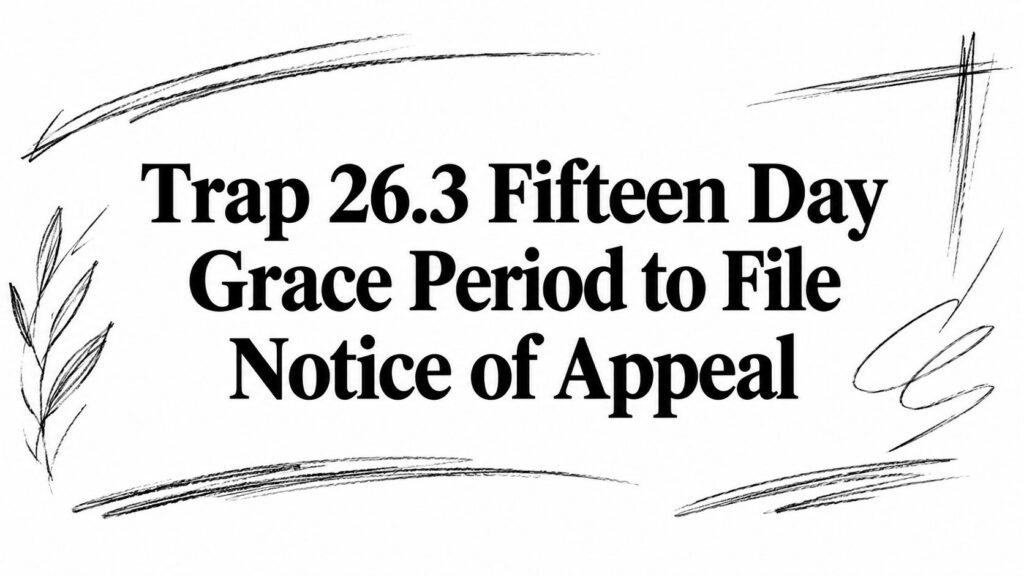
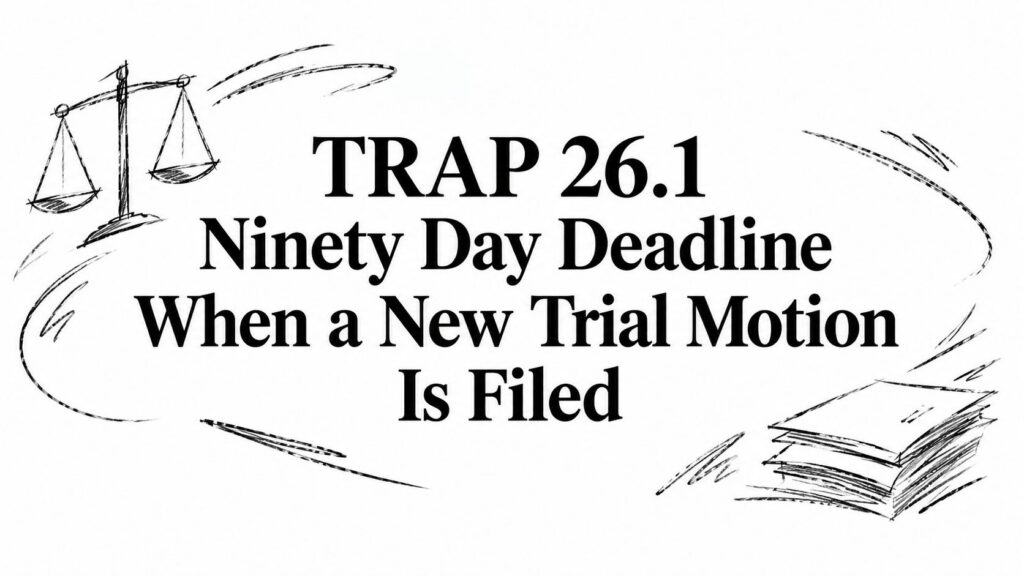
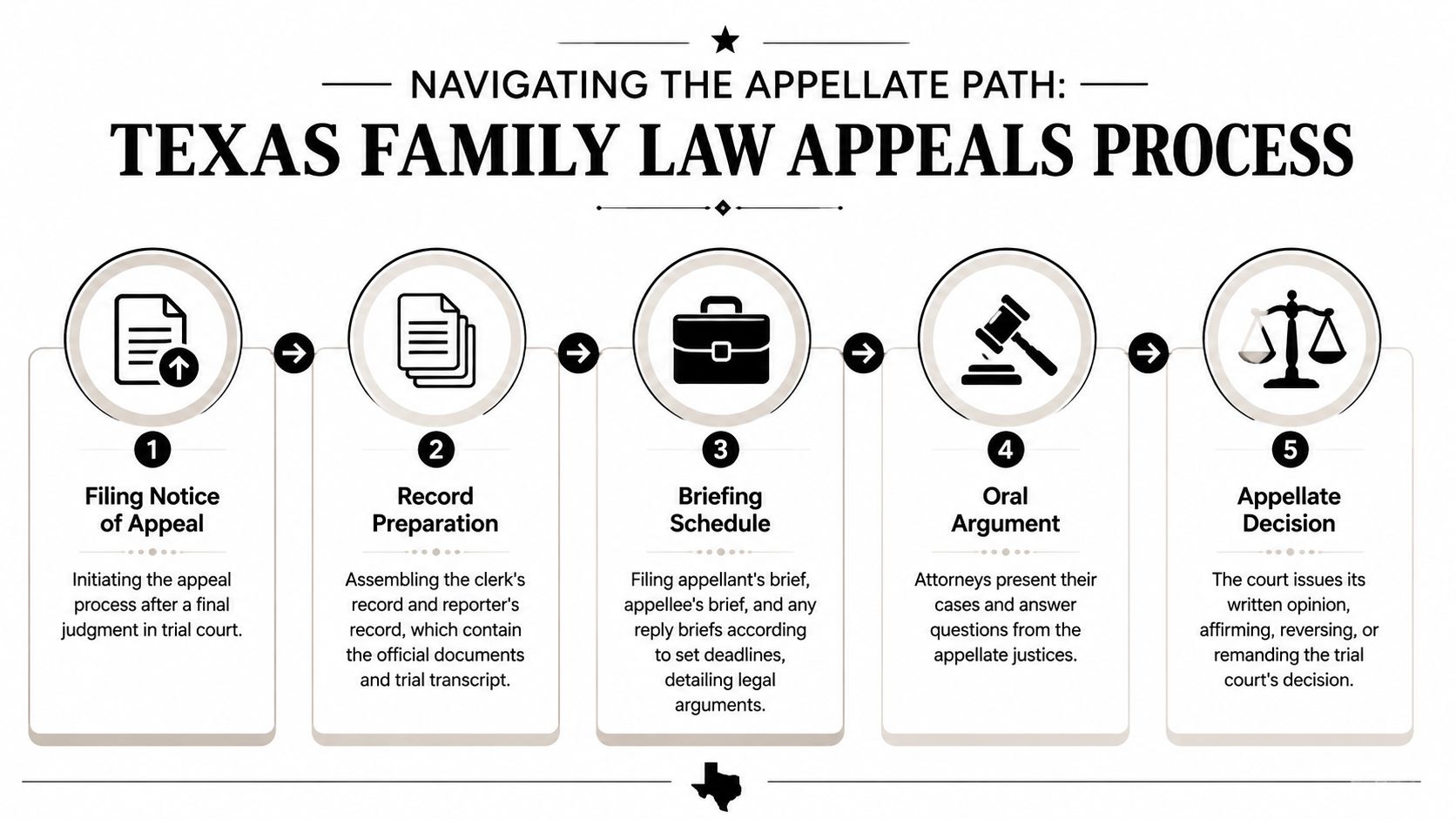
In a typical Texas family law appeal, a party has 30 days from the date the final judgment is signed to file a Notice of Appeal, though certain post-judgment filings can extend that deadline to 90 days, as explained in this overview of Texas family law appeals deadlines and procedure. The Notice of Appeal is the short document that tells the trial court and the opposing party that you're appealing, and it must be served on the opposing party immediately after filing.
After that, the appellate record must be prepared. This usually includes the clerk's record and the reporter's record. The Appellate Record: Clerk's and Reporter's Records explains the central point well: the record determines what the appeals court can consider.
Then comes briefing. In plain English, briefing is the written legal argument filed by each side. The appellant explains the claimed errors. The appellee answers. Sometimes the appellant files a reply.
Oral argument may happen, but it isn't automatic. It must be requested on the front cover of the moving party's brief under the same procedural overview linked above.
Key legal terms in plain English
Here are three terms clients often hear but don't always get clear explanations for:
- Abuse of discretion: A trial judge abuses discretion when the judge acts "unreasonably, arbitrarily, or without any reference to the applicable rules and legal principles," and an appellate court won't reverse if "adequate evidence" supported the exercise of discretion and the decision stayed within the "zone of reasonable disagreement," as explained in this discussion of Texas family law appeal standards.
- Reversible error: A legal mistake serious enough to justify changing the result. This article on reversible error in Texas family law gives a useful issue-focused explanation.
- Briefing: The written argument that tells the appellate court what happened, what law applies, and why the judgment should be affirmed, reversed, or remanded.
Common reversible errors in family court
Some appeals fail because they challenge the wrong thing. Others succeed because they identify a legal error the appellate court can review.
Examples can include:
- Wrong legal standard used: The judge applied the wrong rule in a custody or support decision.
- Evidence ruling that affected the result: The court wrongly excluded or admitted evidence.
- Failure to follow required procedure: The court skipped a required step under the Texas Family Code or Texas Rules of Appellate Procedure.
- Judgment outside the pleadings: The signed order grants relief that wasn't properly before the court.
A strong appeal usually starts with a disciplined question: not "Was the result unfair?" but "What legal error does the record show?"
Examples Of Frivolous Appeal Cases In Family Law
The line between a difficult appeal and a frivolous one becomes easier to see through examples. The situations below are simplified, but they reflect common patterns Texas courts look at closely.
Custody dispute with no real appellate issue
A father loses a modification case. On appeal, he argues that the judge should have believed his testimony over the other parent's testimony. His brief focuses on why he thinks the trial judge made the wrong credibility call.
That kind of argument is usually weak on appeal because appellate courts don't typically re-decide who seemed more believable at trial. If he can't point to a legal error, such as the use of the wrong standard or exclusion of critical evidence, the appeal may look like an attempt to relitigate facts rather than review law.
Property division challenge based on frustration alone
A spouse receives a property division that feels very unfair. She files an appeal stating that the judge "ignored everything" and that the division should be redone because she disagrees with the outcome.
That still may not create a viable appellate issue. If the record shows the court heard evidence, considered the marital estate, and acted within its discretion, the appeal may fail. If the brief doesn't identify a genuine legal defect, it can begin to resemble a frivolous filing.
A hard result and a reversible error aren't the same thing. Appellate courts look for legal mistakes, not simply painful outcomes.
Protective order appeal used to prolong conflict
A respondent appeals a protective order but raises arguments that are unsupported by the record and repeats issues already settled by the trial court without showing any legal flaw. The practical effect is delay.
Courts are alert to that pattern. In family law, delay can itself cause harm, especially where safety, parenting schedules, or enforcement issues are involved. An appeal filed only to postpone consequences can invite a harsh response.
Modification appeal that ignores controlling law
A parent files an appeal after a denied modification request. The brief doesn't confront the governing legal standard and doesn't explain how the trial court misapplied it. Instead, the parent argues only that the court should have "seen things differently."
That kind of briefing creates trouble because the court isn't required to build the argument for the appellant. If the brief lacks real legal analysis, the court may see no substantial question at all.
What these examples have in common
These appeals often share the same warning signs:
- They attack the result, not the legal reasoning
- They rely on emotion without record-based argument
- They ignore the standard of review
- They ask the appellate court to retry facts
- They fail to connect the issue to Texas law
Those patterns don't just weaken an appeal. They can support a finding that it never had a proper appellate basis in the first place.
Consequences And Sanctions For Frivolous Appeals
A parent files an appeal hoping to buy time after a painful custody ruling. Months later, the result is not just an affirmance. The parent also faces an order to pay the other side's appellate fees and costs. In family law, that surprise can hit as hard as the original judgment because it strains money, co-parenting, and the ability to keep litigating issues that do matter.
Attorney's fees and costs
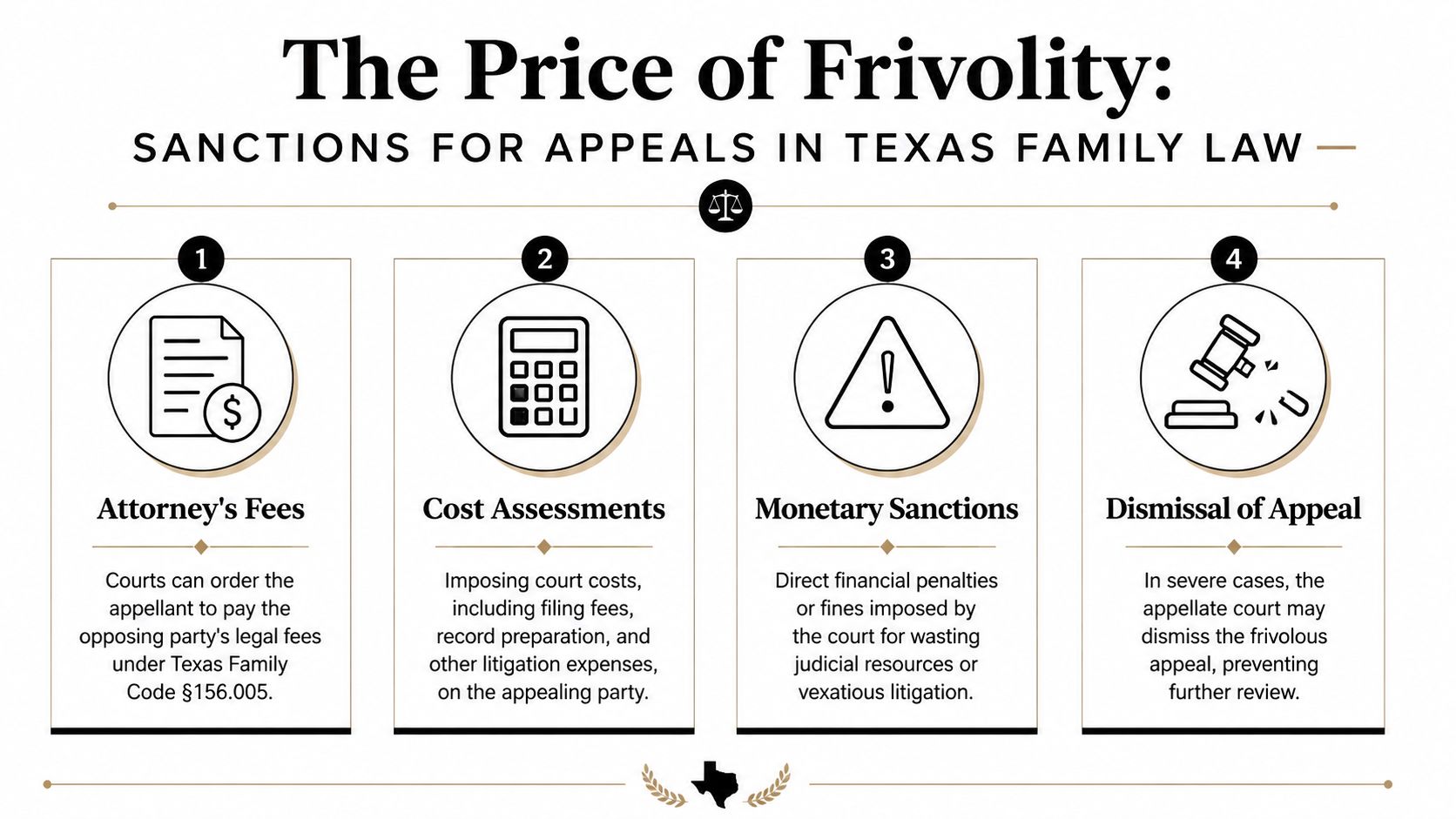
Texas courts have tools to respond when an appeal crosses the line from weak to frivolous. In some family law settings, including certain modification disputes, Texas Family Code § 156.005 allows the court to assess attorney's fees as costs if the suit or appeal was filed frivolously or to harass. Texas appellate courts also have sanction authority under the appellate rules, including the power to award just damages in an appropriate case after giving the parties a chance to respond.
That distinction matters. A losing appeal and a sanctionable appeal are not the same thing. Courts know family cases are emotional and fact-heavy, and many appellants lose for ordinary legal reasons. Sanctions usually come into focus when the record, the briefing, or the procedural history suggests the appeal had no reasonable basis or was used as a delaying device.
The financial risk can grow fast. Filing fees, clerk's records, reporter's records, and briefing costs are only the starting point. If sanctions are imposed, the appellant may also be ordered to cover the other side's appellate attorney's fees or additional costs. For a family already managing support obligations, counseling expenses, or separate households, that extra layer can change settlement decisions and post-judgment strategy.
Other sanctions the court may impose
Money is the sanction clients notice first, but it is not the only consequence. An appellate court may award single or double costs in a proper case. A sanctions finding can also damage credibility for the rest of the appeal, which matters if related disputes return to court later for enforcement, modification, or fee requests.
Procedural missteps can make the risk worse. An appellant who omits the reporter's record, ignores preservation problems, or files a brief that never connects the complaint to a reviewable legal error gives the court a poor picture from the outset. Those hidden procedural risks are easy to miss in the stress of a family case, especially if the appeal is driven by frustration rather than disciplined issue selection. A short review of objections required to preserve appeal in Texas shows why a party can feel wronged and still have no issue the appellate court can properly decide.
Courts also look at context. If a sanctions motion shows the appellant repeated arguments already rejected without addressing the governing law, misrepresented the record, or used the appeal to stall compliance, the request for sanctions becomes more concrete and more persuasive.
A result that surprises many clients
Clients often assume sanctions follow only outrageous conduct. The true danger is narrower and more common. An appeal can look sincere from the client's point of view and still appear objectively groundless on paper.
The appellate record works like a closed file cabinet. If the needed objection, exhibit, or testimony is not inside that cabinet, the court usually cannot supply it. That is why sanctions issues often turn on details that feel technical but carry real emotional weight. A parent may spend a year waiting on an appeal, miss chances to stabilize a parenting schedule, and then learn the court viewed the case as lacking any serious appellate basis.
This is also why lawyers sometimes prepare a sanctions response with exhibits, a timeline, and a fee affidavit that reads almost like a second mini-appeal. A well-supported motion can show not only that the appellant should lose, but that the appeal imposed avoidable expense and prolonged conflict. In family law, that prolonged conflict often hurts children and co-parents long before a sanctions order is signed.
Defenses And Avoidance Strategies
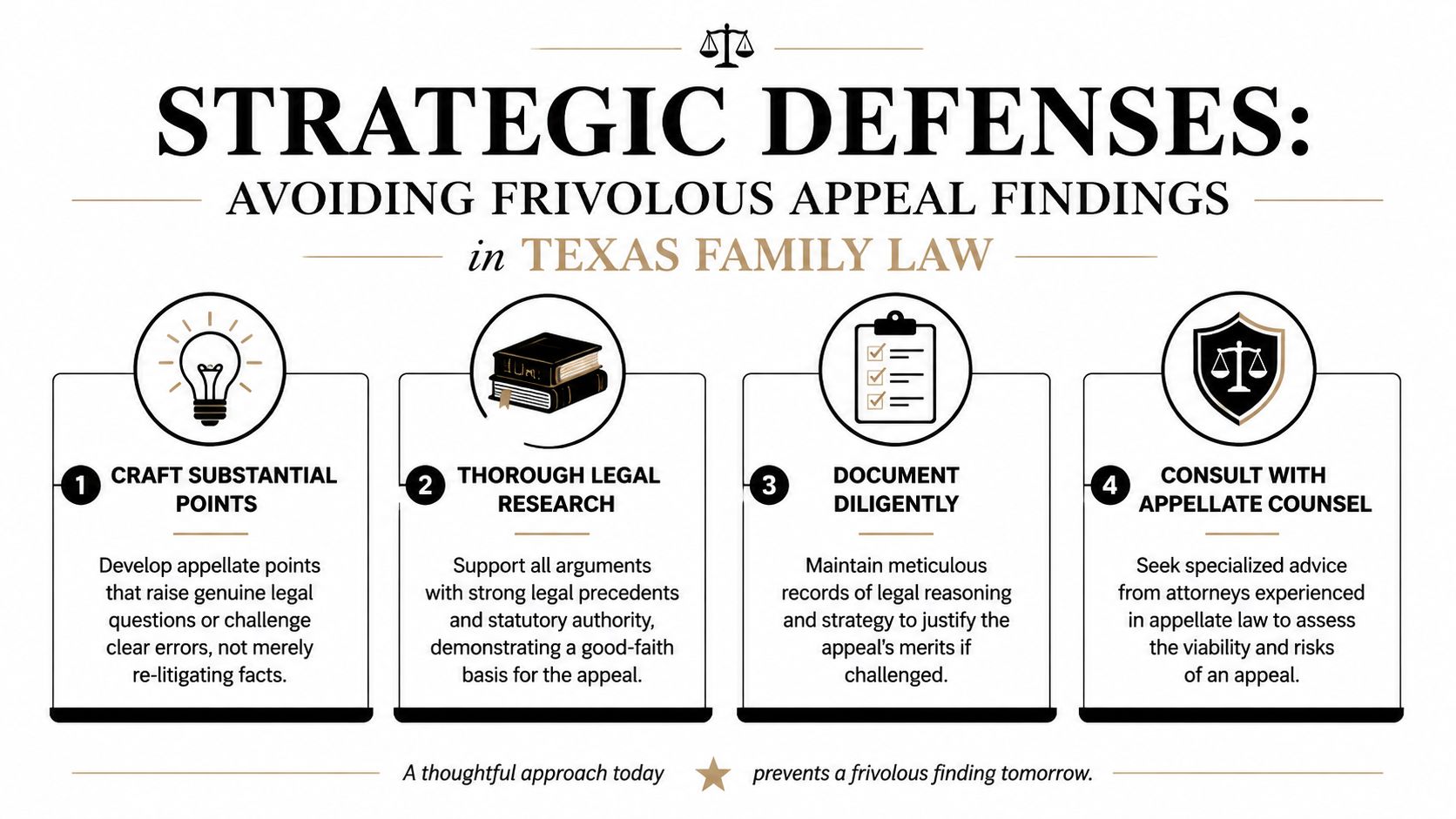
The best defense against a frivolousness finding is disciplined appellate preparation. A careful lawyer doesn't start with outrage. The lawyer starts with the record, the governing law, and the standard of review.
How to build a non-frivolous appeal
Think of an appeal like building a case for a decision-maker who wasn't in the courtroom. You need a clean theory, supporting proof in the record, and legal authority that connects the error to a real appellate remedy.
- Start with preserved error: If trial counsel didn't object when required, some issues may be lost. This guide on objections required to preserve appeal in Texas helps explain why preservation often decides what can be reviewed.
- Frame the issue as a legal question: "The court applied the wrong statute" is stronger than "The judge didn't listen."
- Match the issue to the standard of review: If the issue is abuse of discretion, explain why the ruling fell outside the zone of reasonable disagreement.
- Use the full record carefully: A missing transcript or omitted exhibit can cripple an otherwise solid argument.
- Avoid overclaiming: If only one ruling is validly appealable, don't crowd the brief with weak side issues.
Client-focused advice: A narrower appeal with one strong issue is often safer than a sprawling appeal with six weak ones.
The following video offers a practical overview that many clients find helpful as they sort through next steps.
Reasonable grounds matter
Texas appellate courts require proof of reasonable grounds to believe reversal was possible before imposing frivolous appeal sanctions. That means a mere loss doesn't automatically justify penalties, as explained in this article on stopping frivolous appeals in Texas.
That point eases a common fear. Many parents avoid appealing because they think any unsuccessful appeal will bring punishment. That's not the rule. The question is whether there were objectively reasonable grounds for reversal.
Practical tools before filing
Before a notice of appeal is filed, a party may benefit from a structured review:
- Pull the final order, docket sheet, and key motions.
- Identify what the judge ruled, not what you expected.
- Compare those rulings to the governing statute and preserved objections.
- Check deadlines immediately.
- Get an appellate review of the record.
For families who need focused review of final family law orders for legal error, a Texas Family Law Appeals Lawyer can evaluate whether the case presents a real appellate issue.
Procedural Steps For Sanctions Hearings
When a court questions whether an appeal is frivolous, procedure becomes just as important as substance. Families often think the only issue is whether their argument is strong. In reality, the hearing process and deadlines can decide the outcome.

The timeline in child custody and termination settings
Texas Family Code § 263.405(d) requires the trial court to hold a hearing within thirty days to determine whether a child custody appeal would be frivolous, and subsection (f) allows sixty days for filing the complete appellate record after that determination, as described in this Texas Supreme Court materials page on Family Code section 263.405 procedure.
That timeline is tight. If the court finds the appeal frivolous or denies indigence, the appellant must file the reporter's record and clerk's record with the appellate court not later than the 10th day after the date the court makes the decision under the same authority.
What usually happens at the hearing
A sanctions or frivolousness hearing often follows a practical sequence:
| Stage | What happens |
|---|---|
| Motion or concern raised | A party or the court identifies why the appeal may lack merit |
| Response | The appellant explains the legal basis for appeal and why reversal was reasonably possible |
| Hearing | The court reviews the statement of points, the record posture, and the legal basis asserted |
| Order | The court signs a written ruling on frivolousness, sanctions, or both |
The exact mechanics can vary by case posture, but the strategic task is consistent. The appellant must show that the appeal presents a real legal question.
Sample arguments and motion language
You don't need theatrical language. You need precision.
Examples of useful themes include:
- Issue-based framing: "Appellant raises a substantial question for appellate review regarding whether the court applied the correct legal standard."
- Record-based framing: "The challenged ruling appears in the reporter's record and was preserved by timely objection."
- Good-faith framing: "The appeal is not filed for delay or harassment but to seek review of a specific legal ruling."
Poor motion language usually sounds broad and emotional. Strong motion practice stays tied to the order, the record, and the statute.
The court is looking for an arguable basis in law or fact. Give the judge that basis clearly and early.
Why speed matters
These hearings move quickly because family law cases, especially those involving children, are not supposed to linger unnecessarily. Delay can affect placement, stability, visitation, and finality.
That is why litigants should gather the order, identify appellate points, secure the record, and prepare a focused response as soon as a frivolousness challenge appears.
Next Steps And Counsel Consultation
If you're reading this after an unfair divorce ruling, custody loss, support order, or protective order, you're probably balancing two thoughts at once. One is emotional: "I can't let this stand." The other is practical: "I don't want to make things worse."
Both thoughts are reasonable.
When appellate help becomes especially important
Some cases call for appellate counsel sooner rather than later:
- High-stakes custody rulings: Especially when the order affects long-term parenting rights
- Complex property issues: Business ownership, valuation disputes, or unusual decree language
- Protective orders and enforcement matters: Where the record and legal standards are tightly contested
- Possible frivolousness challenges: When the trial court or opposing party claims your appeal lacks merit
An appellate lawyer can review whether the issue is preserved, whether the record supports it, and whether the standard of review gives you a realistic path forward. If you need that kind of focused review, a family law appeal attorney can assess whether the judgment presents a viable legal challenge.
A grounded way to evaluate your case
A useful consultation usually begins with four documents: the final order, any post-judgment motions, the notice of appeal if already filed, and whatever record materials are available. From there, the lawyer can ask the right questions:
- What exactly did the court decide?
- What legal rule governed that decision?
- Was the issue preserved in the record?
- Is there a realistic argument for reversal or remand?
That's the right lens for fairness in appellate practice. Not hope alone. Not anger alone. A disciplined legal review.
The Law Office of Bryan Fagan, PLLC handles appellate representation in Texas family law matters involving final orders and legal error. For many clients, that kind of focused review is the point where uncertainty starts turning into a strategy.
If you believe the court made a mistake, don't assume your case is doomed and don't assume any appeal will be labeled frivolous. The answer depends on the record, the law, and the precision of the issues raised.
If you believe the court made a mistake in your family law case, our appellate attorneys can help you seek a fair outcome. Contact The Law Office of Bryan Fagan, PLLC today for a free consultation.