Skip to content
You may feel like the court ignored the facts, the paperwork was complete, and the denial still landed anyway. That kind of ruling hits hard because a name change is personal, practical, and often tied to identity, safety, and everyday records.
In Texas, appealing a name change denial is not about asking a higher court to start over from scratch. It is about showing that the trial court misapplied the law, ignored required evidence, or ruled beyond what the pleadings and record allowed. That distinction matters, because the appellate court looks at the paper trail, not a fresh sense of fairness.
When a Denial Feels Unjust
A Texas resident can do everything right on paper, show up for the hearing, and still leave with a denial. That result is especially hard to swallow in an adult name-change case, because the court is working from verified petitions, residence rules, identity proof, and fingerprint materials, not from loose explanations or a sympathetic story.
The frustration is real. On appeal, it does not carry the issue. The appellate court asks a narrower question, whether the judge had a legal basis to deny the petition and whether the record supports that ruling.
Practical rule: If the denial turned on a statutory defect, a missing filing, or a finding tied to fraud or criminal history, the appeal rises or falls on the record, not on how unfair the result felt in the courtroom.
That is why appealing a name change denial Texas calls for a different strategy than the original hearing. A trial asks the judge to weigh the evidence. An appeal asks whether the judge stayed within the law and the evidence already in the file.
If the denial involved a child, the analysis changes again. Texas materials treat best interest as the controlling issue in child name-change cases, so the record has to show more than a parent's preference or frustration Texas Tech family law form guide. For adults, the statutory prerequisites come first, and the notice deadline must be watched closely, as explained in Texas appellate deadline guidance.
Determining Your Appellate Path and Meeting Deadlines
Start with the remedy that fits the error. If the judge made a mistake that can still be corrected in the trial court, a motion for new trial is often the better move because it gives the court a chance to fix the ruling and can preserve appellate deadlines. If the problem is already locked into the signed order and the record is ready, a direct appeal is the cleaner path.
That choice matters most when the denial rests on something the judge may have overlooked, not a dispute about how the evidence felt in the room. If the court denied the petition because a filing was missing, an exhibit was never offered, or the order relied on a legal misunderstanding, a motion for new trial can be the fastest way to force the court to confront the mistake while the case is still fresh. If the judge has already made a firm ruling after hearing everything, a direct appeal usually makes more sense because you are asking a higher court to review the completed record, not to relitigate the hearing.
Texas law sets the basic requirements for adult name-change petitions. The filer must be at least 18, provide a fingerprint card, and usually pay filing fees of about $200, though the amount varies by county and can be waived with a Statement of Inability to Afford Court Costs Texas Law Help name-change article. For adults with felony history, Texas requires at least two years to have passed after discharge from prison or probation unless pardoned Texas Law Help name-change article.
The deadline trap to avoid
The worst mistake is waiting to decide. Once the court signs the denial, the clock starts, and the choice between a post-trial motion and a direct appeal has to be made quickly.
A motion for new trial is the better choice when you need to correct the trial court's own record. Use it if the judge denied the petition because a document was not presented, a witness was not heard, or the court applied the wrong legal standard and may be willing to fix that error without an appeal. A direct appeal is the better choice when the order is already complete, the key facts are in the file, and you need an appellate court to review whether the denial had a lawful basis.
That distinction is practical, not theoretical. If the court denied the petition because a required filing was missing or the proof did not match the statute, you should focus on rebuilding the record immediately. If the court denied relief even though the paperwork was complete and the legal rule was wrong, the stronger move is to preserve the issue in writing and prepare for appeal.
Use the filing window to make a deliberate choice, not to guess. For a clear explanation of the notice-of-appeal deadline in Texas, review What Is the Deadline for Filing a Notice of Appeal in Texas.
Direct advice: If the denial turns on a missing filing, a service defect, or a statutory disqualification, get the papers organized immediately. If the judge applied the wrong rule, put that error in writing before the deadline runs.
Preserving the Record and Assembling Court Documents
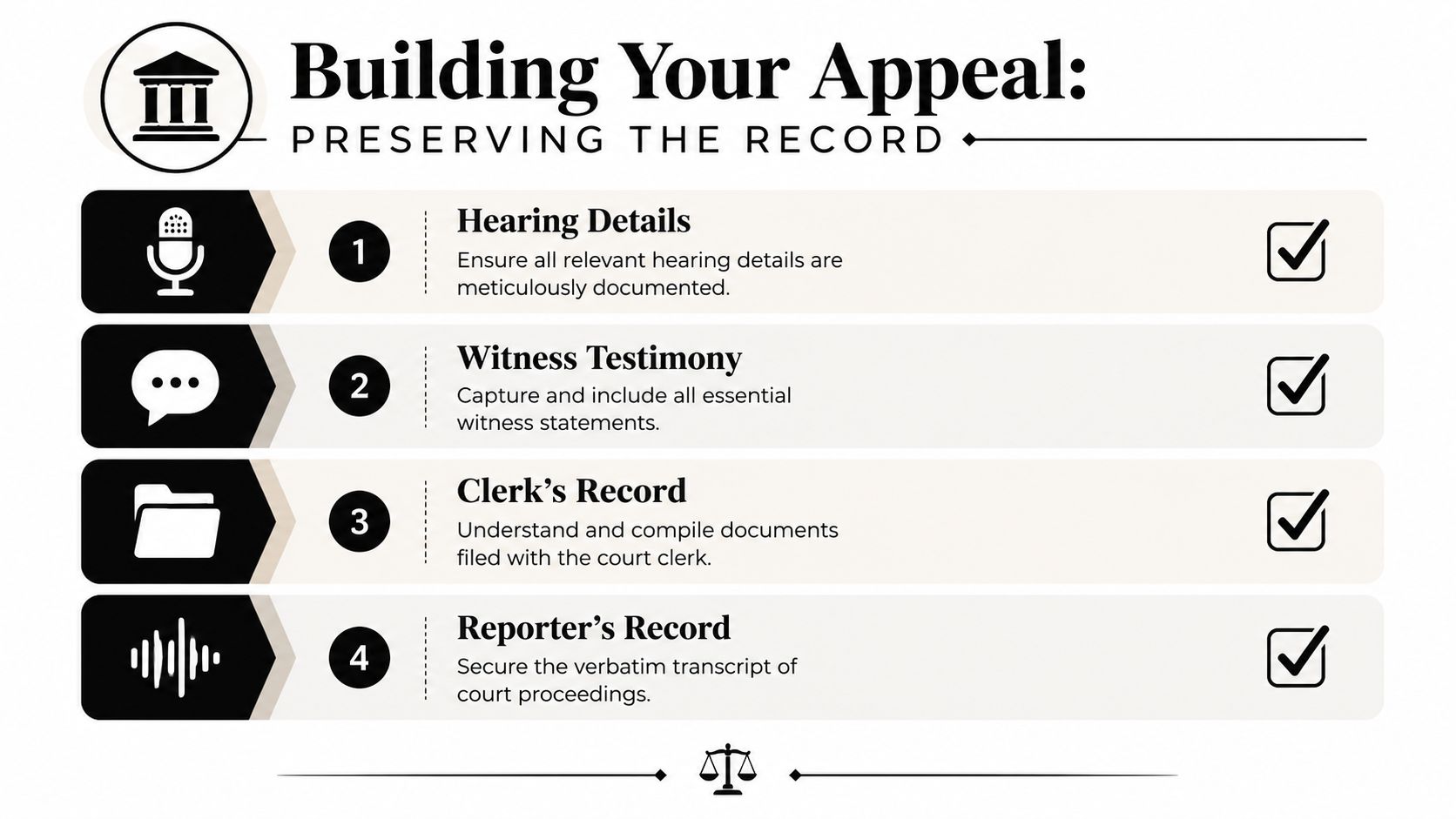
A name-change appeal lives or dies on the record. The appellate court does not retry the case from memory or sympathy, it reviews the papers, sworn filings, and hearing testimony the trial judge had before the court. Preserve that material from the start, because gaps in the file usually become fatal later.
What belongs in the clerk's record
The clerk's record contains the filed materials the court clerk keeps in the case file, including the petition, orders, proof of service, exhibits, and other submitted documents. For a plain-English breakdown of that package, see The Clerk's Record in a Texas Appeal. If a document never made it into the official file, the appellate court will not treat it as part of the case.
What belongs in the reporter's record
The reporter's record is the transcript of the hearing. It matters when the judge asked questions, heard sworn testimony, or explained the denial on the record. If the ruling turned on something said in open court, or even during a sidebar that affected the outcome, that exchange needs to be captured.
A complete file should include:
- Verified petition: The sworn pleading that begins the case.
- Proof of identity and fingerprint materials: The documents Texas guidance treats as part of the standard package.
- Service documents: Especially important in child cases where the other parent must be served and given the full response period.
- Hearing transcript: Needed if the court's reasoning matters to the appeal.
- Signed order: The judgment you are challenging.
The appellate record controls what the court can review, and The Appellate Record, Clerk's and Reporter's Records explains why that separation matters in practice. If it is not in the record, the appellate court usually acts as if it never happened.
The safest approach is direct. Order the clerk's record, order the reporter's record, and verify that the denial order, petition, exhibits, and hearing transcript all match the issues you plan to raise.
Drafting and Filing the Notice of Appeal and Appellate Brief
The notice of appeal is the filing that tells the court you are challenging the denial. It should identify the party appealing, the order being challenged, and the court that signed it. Keep it exact, because appellate clerks read these documents for jurisdictional clarity, not for narrative.
The brief is where the substantive work happens. A strong appellate brief does three things well. It states the issue clearly, explains the record in plain English, and matches the legal argument to the correct standard of review.
What makes an issue persuasive
In Texas family appeals, the standard of review controls how much deference the appellate court gives the trial judge. For a fuller explanation, see Standards of Review in Texas Family Appeals. If the judge had discretion, your brief must show that the ruling fell outside the bounds of reasonable decision-making.
A useful definition helps here. Abuse of discretion means the judge made a ruling that no reasonable court should have made, or applied the wrong law to the facts. Reversible error means the mistake mattered enough that the appellate court can undo the ruling.
Texas appellate decisions also stress that a trial court's judgment must match the pleadings and that relief has to track what was requested, unless an issue was tried by consent. A Texas appellate decision summarized by McClure Law Group explains that point and discusses a name-change dispute involving whether a hyphenated children's-name change was properly supported by the pleadings and evidence McClure Law Group summary of Texas appellate decision. That rule gives you a strong appellate argument when the order goes beyond what the case asked for.
The Appellate Brief in a Texas Family Appeal is the filing that usually decides the outcome. The brief matters because it turns the record into a legal argument the court can act on.
Use these drafting habits:
- State one main error first: Do not bury the issue under background facts.
- Tie every argument to the record: If the transcript or clerk's record does not support it, leave it out.
- Use plain English: Judges value clarity more than dramatic phrasing.
- Ask for the exact relief you want: Reversal, rendition, or remand should match the legal theory.
Considering Mandamus and Rehearing Options
A denied name change does not always belong on a straight appeal path. If the trial court entered an order that needs correction before the case is over, a mandamus petition can be the faster route. A rehearing request does something different. It asks the same judge to look again at the denial and fix the ruling without immediate appellate action.

How to choose between them
Choose mandamus only when the order is plainly outside the law and waiting for a normal appeal would leave you without a real remedy. It is a demanding remedy, and you should treat it that way. For a focused explanation of that route in family court, review the writ of mandamus in Texas family law.
Rehearing is narrower and usually the first move when the judge missed a fact, misunderstood a document, or overlooked a point already in the record. It keeps the issue in the trial court and gives that court a chance to correct its own ruling before you spend time and money on a higher court.
Common reasons for denial in name-change cases include fraud concerns, felony-history issues, and, in cases involving children, a failure to prove the requested change serves the child's best interest. If your petition ran into one of those problems, a rehearing request should target the exact proof the court overlooked or misread. Do not reargue the whole case. Focus on the missing fact, the mistaken assumption, or the document that clears up the record.
A mandamus petition and a rehearing request serve different purposes. Use rehearing when the problem is a mistaken denial that the trial court can still fix. Use mandamus when the order itself has no legal support and you need a higher court to step in now.
Estimating Costs Outcomes and Consulting Appellate Counsel
A denial can become expensive fast, so treat the cost side as part of the strategy from the start. In Travis County adult name-change practice, the district clerk charges a $350 filing fee unless the applicant files a Statement of Inability to Afford Court Costs Travis County Law Library adult name-change guide. That same guide explains that approval can take one to six weeks, and certified copies must be ordered separately to update records.

Appeals work the same way. Someone has to assemble the record, draft the brief, and track every deadline without missing a step. If the case turns on a messy transcript, a disputed service issue, or an order that reached beyond the pleadings, appellate counsel should be involved early.
When to call an appellate lawyer
Get legal help if:
- The record is incomplete: Missing transcripts or exhibits can sink the appeal.
- The ruling seems legally off: The judge may have used the wrong standard or granted relief that was never requested.
- The deadline is close: There is no room for guesswork.
- The case involves a child: Best-interest rulings need careful record analysis.
The job is not to reargue the hearing. It is to identify the legal error and build a record-based argument the appellate court can resolve.
For clients who want a focused appellate review, The Law Office of Bryan Fagan, PLLC handles Texas family-law appeals and record analysis, including name-change denials, custody disputes, and other post-judgment matters. If you are deciding whether the denial is worth challenging, that kind of targeted review can save time and sharpen the legal strategy.
Next Steps and Call to Action
Your next move is simple. Check the deadline, secure the clerk's record and reporter's record, and decide whether a motion for new trial, rehearing, or direct appeal best protects your rights. If the judge made a legal mistake, the appellate process is there to correct it.
A name-change denial can feel personal, but the appeal has to be built on law and record. The sooner you get that structure in place, the better your odds of presenting a clean, persuasive challenge to the order.
If you believe the court made a mistake in your family law case, our appellate attorneys can help you seek a fair outcome. Contact The Law Office of Bryan Fagan, PLLC today for a free consultation.