Under Texas Family Code § 109.002, an appeal does not suspend a custody order unless the trial court or appellate court orders a suspension. That means a parent usually must keep following the current custody, possession, or conservatorship order during the appeal, even while the case moves through deadlines that can stretch for many months.
You may feel your case was handled unfairly. You may believe the judge got the facts wrong, applied the wrong legal standard, or entered an order that disrupts your child's routine. Those concerns can be real, and an appeal may be the right tool to address them. But one of the hardest parts for parents to hear is this: filing the appeal usually does not pause the custody order.
That point confuses many people because they assume an appeal works like a reset button. In Texas custody cases, it usually doesn't. The law takes a stability-first approach. Courts generally keep the existing order in place unless a judge signs a separate order suspending it.
If you're trying to understand what happens next, the key is to separate two different ideas. An appeal asks a higher court to review whether the trial court made a legal mistake. A suspension request, sometimes called a stay request, asks a court to temporarily pause enforcement while the appeal is pending. Those are related, but they are not the same thing.
What Family Code 109.002 Means for Your Custody Order During Appeal
A common scenario looks like this. A parent leaves trial convinced the result was wrong. The possession schedule changed, decision-making rights shifted, or a child's living arrangement was altered. The parent files a notice of appeal and assumes the old routine or some neutral middle ground will apply until the appellate court rules.
That assumption can create serious problems.
Under Texas Family Code § 109.002, a final order is not suspended by appeal, whether or not the appellant posts a supersedeas bond, unless the trial court orders suspension. The appellate court may also permit suspension on a proper showing, except in termination cases brought by the state or a political subdivision. Texas appellate procedure also reinforces that filing a notice of appeal does not itself suspend enforcement of the judgment.
What that means in daily life
If the order says exchanges happen on certain days, those exchanges still need to happen.
If the order gives one parent the right to decide school enrollment, that authority remains in place unless a court changes it.
If the order restricts where the child lives, that restriction still applies during appeal.
Practical rule: Until a judge orders otherwise, treat the signed custody order as fully in effect.
Many parents ask whether they can wait for the appeal because they believe the ruling is unfair. The safer answer is no. Violating the order can expose a parent to enforcement problems and can distract from the legal errors that belong at the center of the appeal.
Why Texas handles custody this way
Texas doesn't treat custody orders like ordinary judgments. The rule reflects a policy choice. Children need continuity while litigation continues. Appeals take time, and the law generally favors preserving an existing court-ordered structure rather than creating an automatic pause every time a parent seeks review.
That doesn't mean you're powerless. It means the strategy has to be precise.
A parent who wants relief during appeal usually needs to do two things at once:
- Keep complying: Follow the signed order unless a court suspends it.
- Ask for targeted relief: File a separate request that explains why interim enforcement creates child-centered problems.
Appeals are not retrials
This is another place where people get tripped up. An appeal isn't a second trial with new witnesses and a fresh fact decision. It's a review of the trial court record for legal error.
Common issues on appeal can include:
- Abuse of discretion: This means the trial court made a decision outside the range the law allows.
- Reversible error: This means a legal mistake likely affected the outcome.
- Procedural error: This can include rulings that kept important evidence out or applied the wrong process.
Understanding the Plain Language of Texas Family Code 109.002
The statute sounds technical, but its message is direct. A custody order keeps operating unless a court says it doesn't.
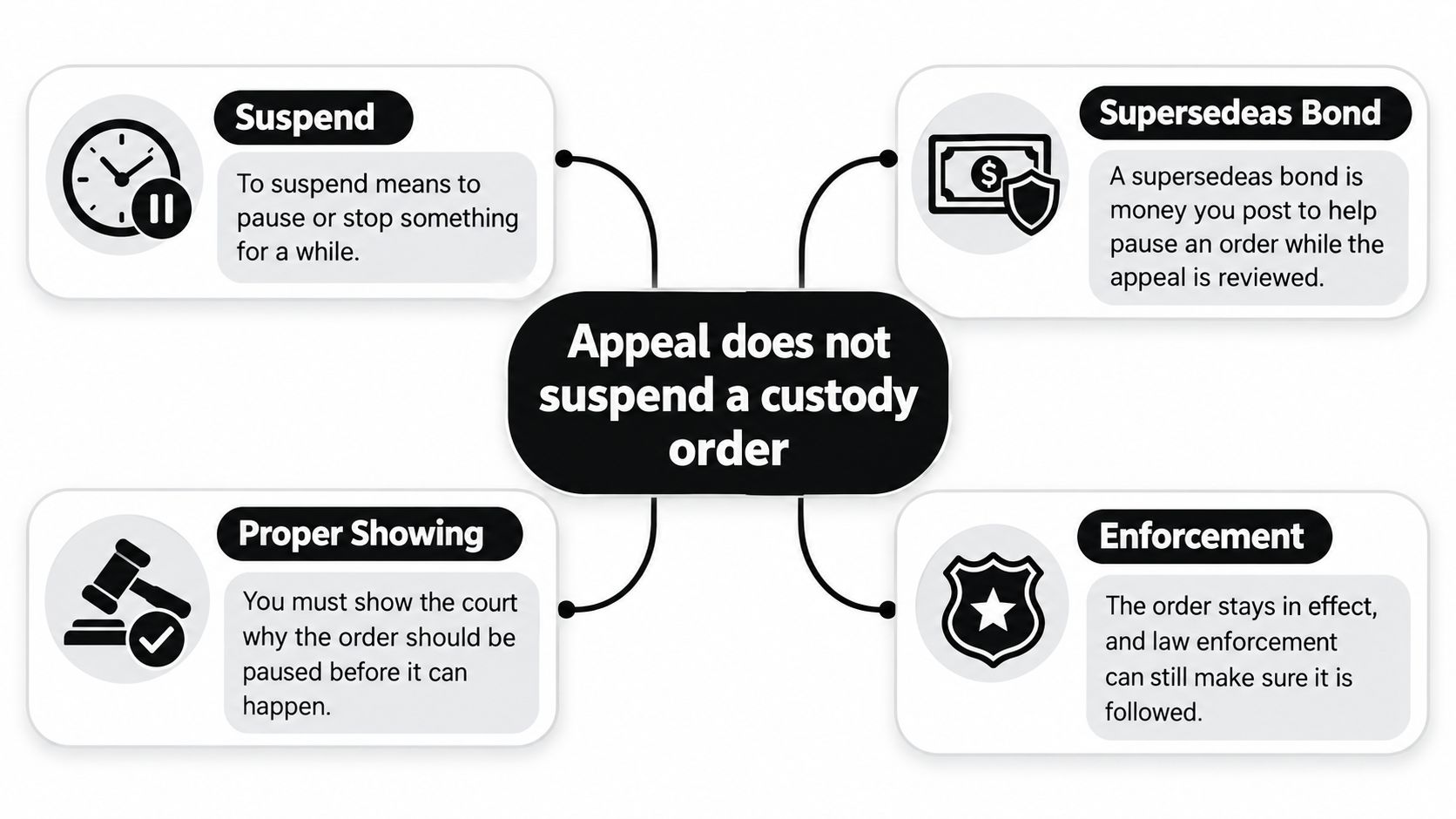
Four terms that matter
Think of a custody order like a traffic signal that stays green until a judge changes it. Filing an appeal doesn't turn the light red by itself.
Here are the main terms in plain English:
- Suspend: To pause the effect or enforcement of the order for now.
- Supersedeas bond: A type of security sometimes connected to suspending enforcement in other kinds of cases.
- Proper showing: Evidence and argument that give a court a solid legal reason to suspend the order.
- Enforcement: The process one party can use to ask the court to require compliance with the order.
The phrase family code 109.002 appeal does not suspend a custody order sounds formal, but in practice it means this: your appeal and your day-to-day obligations are running on separate tracks unless a judge merges them by entering a suspension order.
A bond alone doesn't change possession
This point matters because parents often hear the word “supersedeas” and assume money posted with the court will stop custody exchanges. In custody cases, that isn't how it works. Texas appellate opinions explain that courts look for a proper showing tied to child-welfare consequences, such as preserving living arrangements or preventing potential harm, and they distinguish that from merely posting security, which does not by itself alter possession schedules. The discussion of a proper showing appears in this Texas appellate opinion.
The real question is usually not, “Did the parent appeal?” It's, “Did the parent obtain a court order suspending enforcement?”
The exception readers should know
The statute contains an exception for certain termination cases brought by the state or a political subdivision. Those cases operate under a different rule set for suspension. For most parents reading about conservatorship, possession, and access, the practical takeaway is simpler. Don't assume your notice of appeal changes the custody schedule.
If you're also trying to sort out when an appeal must begin, The Notice of Appeal Deadline in Texas Family Cases addresses why you generally have only 30 days to start a family law appeal.
One more term lawyers use
Briefing means the written legal argument filed in the appellate court. A brief explains what the trial court did, what legal error occurred, where that error appears in the record, and what relief the appellate court should grant.
How Texas Created the Custody Non Suspension Rule
Texas did not adopt this rule by accident. The custody non-suspension rule has deep roots in statewide procedure.
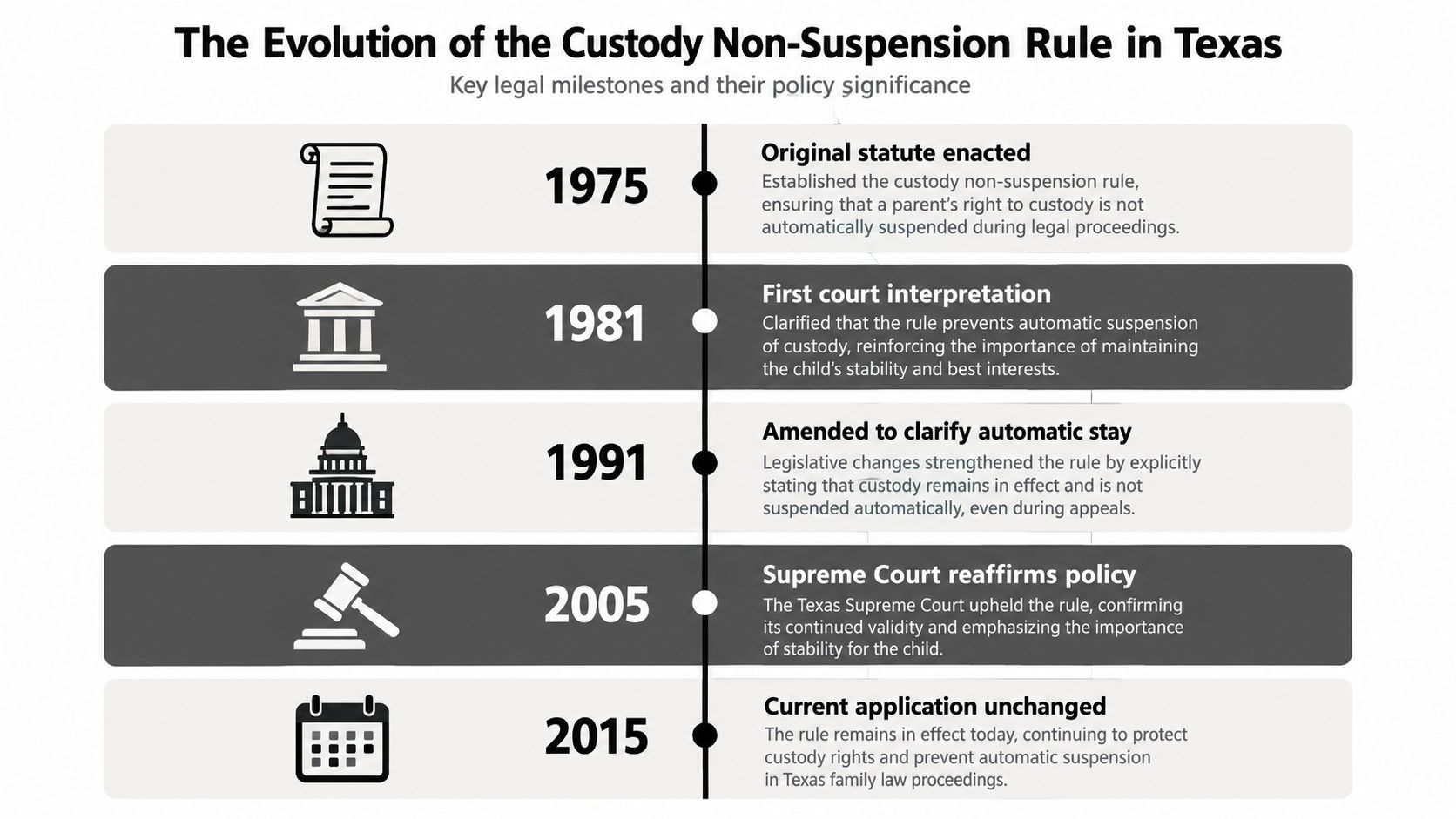
The historical thread goes back at least to the 1946 amendment to former Rule 364(f). That rule provided that when a judgment involved the care or custody of a child, an appeal with or without a supersedeas bond would not suspend the judgment unless the trial court ordered otherwise. You can see that historical language in the 1946 version of former Rule 364(f).
Why the history matters
Parents sometimes read the current statute and think this must be some recent procedural trap. It isn't. Texas adopted the child-custody exception nearly 80 years ago, and the basic language remained notably consistent through later codifications.
That consistency tells you something important about how Texas courts view these cases. The rule is not a narrow technical detail. It reflects a durable policy judgment that appellate review should remain available without automatically unsettling the child's court-ordered routine.
Stability is the policy, not a side effect
Judges often have to choose between two imperfect paths during appeal. One path pauses the order and creates uncertainty. The other path preserves the structure already ordered by the trial court unless someone makes a strong, child-focused case for change. Texas has long favored the second approach.
That history also helps explain why suspension requests need more than general unfairness arguments. A parent may strongly believe the ruling was wrong, but courts usually want a focused explanation of why continued enforcement during appeal would create meaningful disruption or risk.
This short overview may also help put the rule in context:
How courts tend to view stay requests
A court reviewing a suspension request is not deciding the full appeal at that moment. It is deciding whether to leave the current order in place while the appeal proceeds. Historical continuity matters here because it frames the judge's starting point. The status quo remains in force unless there is a persuasive reason to change it.
Parents often focus on whether the trial court was right or wrong. For a stay request, the immediate question is narrower: what happens to the child while the appellate court reviews the case?
Why Custody Orders Are Different From Money Judgments on Appeal
A lot of confusion comes from borrowing rules from other civil cases. In many contexts, people hear that an appellant can suspend enforcement by posting security. That concept doesn't translate neatly into custody and possession disputes.
Custody orders govern children's routines, exchanges, and parental decision-making. Money judgments govern payment obligations. Texas law treats those categories differently because they raise different kinds of harm.
The practical difference
With a money judgment, the legal system can often protect the parties through financial security while the appeal is pending. With a custody order, the court is dealing with a child's living arrangement, visitation pattern, and daily stability. Those aren't solved by money alone.
That's why parents should be careful not to import assumptions from property or financial litigation into a conservatorship appeal. A discussion of related stay issues in the divorce context appears in can you stop a house sale during a divorce appeal in Texas, but child-related orders require their own analysis.
Custody Orders vs Money Judgments on Appeal
| Order Type | Automatic Stay on Appeal | What Can Suspend Enforcement | Key Showing Required |
|---|---|---|---|
| Custody, conservatorship, possession, visitation | No automatic stay | Court-ordered suspension by the trial court or, on proper showing, the appellate court | A child-focused reason tied to disruption, living arrangements, or risk concerns |
| Money judgment | Different supersedeas rules may apply | Often security-based mechanisms, depending on the judgment and rules | Compliance with applicable supersedeas requirements |
Why this difference matters for strategy
A parent who misunderstands this distinction can make two costly mistakes at once. First, the parent may stop complying with the order. Second, the parent may fail to build the child-focused record needed for temporary relief.
Here's the better way to approach it:
- Your appeal argues legal error.
- Your suspension request argues interim child-centered harm.
- Those are related, but they require different proof and different drafting.
Common reversible errors in family court
Even when the order remains in effect during appeal, the appellate case itself may still be strong. Common reversible errors can include:
- Using the wrong legal standard: For example, applying the wrong rule to a modification or conservatorship issue.
- Excluding important evidence: If the ruling likely affected the result.
- Insufficient support in the record: When the order rests on a legal basis the evidence does not support.
- Procedural unfairness: Such as failing to provide the process the law requires.
An abuse of discretion review often applies in family law appeals. In plain English, that means the appellate court asks whether the trial judge acted within the legal choices allowed by law and facts. It is a deferential standard, but it is not a rubber stamp.
How to Ask the Court to Suspend a Custody Order During Appeal
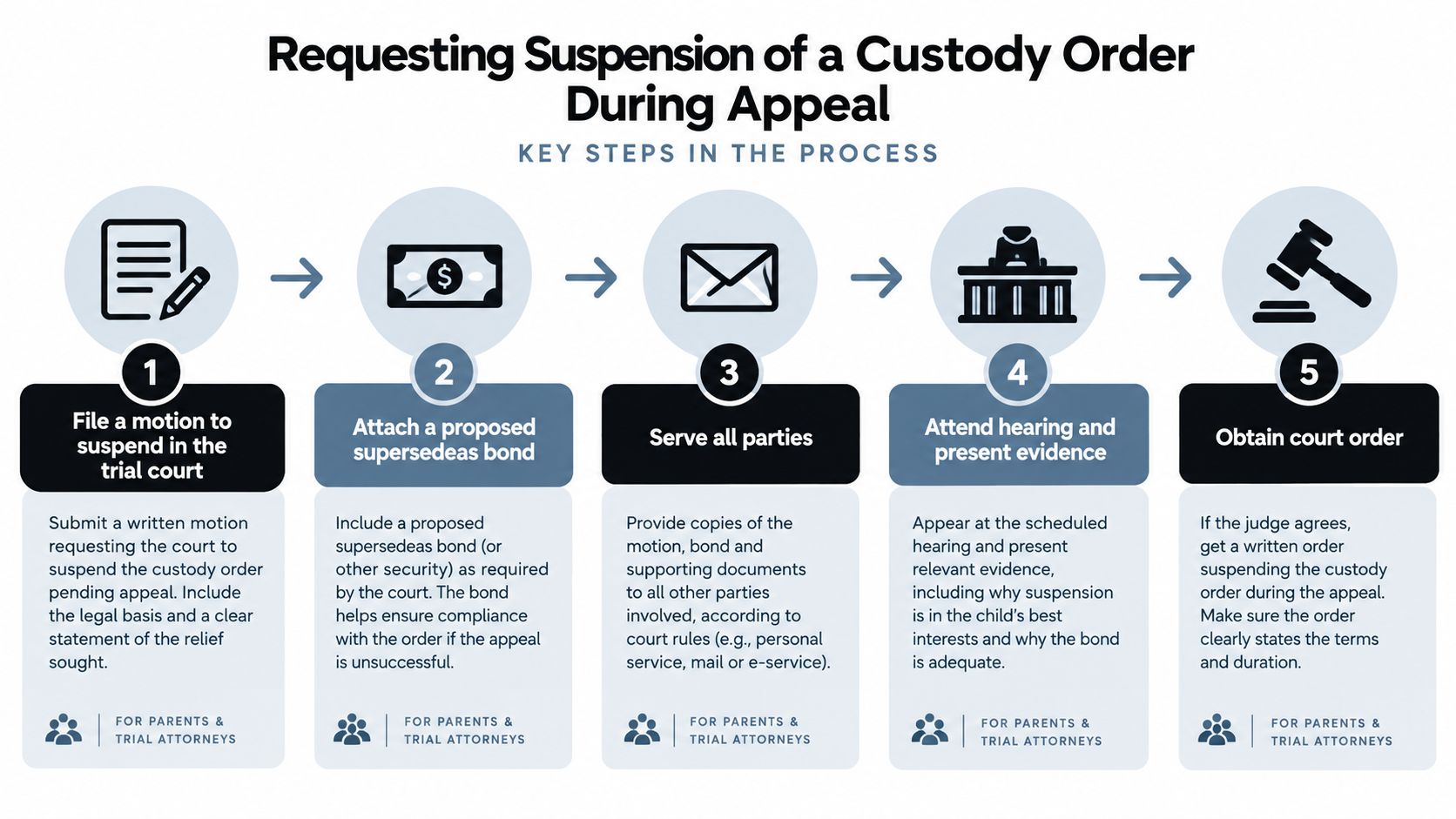
Parents often ask, “What do I file?” The answer is usually a separate motion asking the court to suspend enforcement while the appeal is pending. This request is different from the notice of appeal itself.
In custody cases, a useful starting point for the underlying stay framework is supersedeas and staying enforcement pending appeal. The motion still needs to be crafted to the child's circumstances rather than treated like a routine financial supersedeas issue.
Step one starts in the trial court
Texas Family Code § 109.002 places the trial court at the center of the initial suspension decision. In many cases, the first move is to file a motion in the trial court asking it to suspend the order during appeal.
That motion should identify the exact parts of the order you want suspended. Broad requests can be harder to justify than narrow ones. Sometimes the strongest request is targeted, such as asking the court to preserve an existing school arrangement or a living arrangement while the appeal proceeds.
What a proper showing usually looks like
A proper showing is not just “I disagree with the ruling.” It should be supported by facts in the record, sworn evidence where appropriate, and a child-centered explanation of what interim enforcement will do.
Strong points often focus on practical consequences such as:
- Living arrangement disruption: A sudden move or change in primary residence.
- School instability: A midstream change that affects attendance or consistency.
- Safety concerns: Facts that show a risk of harm if the order is enforced as written.
- Routine breakdown: Circumstances showing why preserving the current arrangement better protects the child during the appeal.
Key point: A stay request is usually more persuasive when it explains how the child, not just the parent, will be affected before the appeal can be decided.
What to include in the motion
A practical motion often covers several layers at once:
- Identify the appealed order and the date it was signed.
- Specify the provisions at issue rather than asking to suspend everything without distinction.
- Explain the child-focused harm that may occur if enforcement continues during appeal.
- Cite the legal basis for trial court or appellate court suspension.
- Attach supporting material that fits the procedural posture of the case.
Some parents also ask whether they should attach a proposed bond. Depending on the situation, counsel may consider that issue, but bond posting alone does not change possession schedules. The core of the request remains the showing tied to child welfare and disruption.
If the trial court says no
Texas Family Code § 109.002 also allows the appellate court to permit suspension on a proper showing. If the trial court denies relief, the next step may be to seek relief from the court of appeals using a record-supported filing.
That usually means your appellate lawyer needs a clean package that shows:
- what was requested below,
- what evidence or record support exists,
- how the trial court ruled, and
- why interim suspension is justified under the statute.
Sample language themes that often help
Not every case should use the same wording, but these themes often matter:
- Preserve current routine pending review
- Avoid immediate disruption before appellate decision
- Prevent harm tied to abrupt residential or school changes
- Maintain compliance structure while legal issues are reviewed
A parent may also consult appellate counsel early to frame both the appeal and the suspension request together. One available option is Texas Family Law Appeals Lawyer, which describes appellate representation challenging final family law orders for legal error.
Staying Compliant and Protecting Your Appeal While the Order Remains in Effect
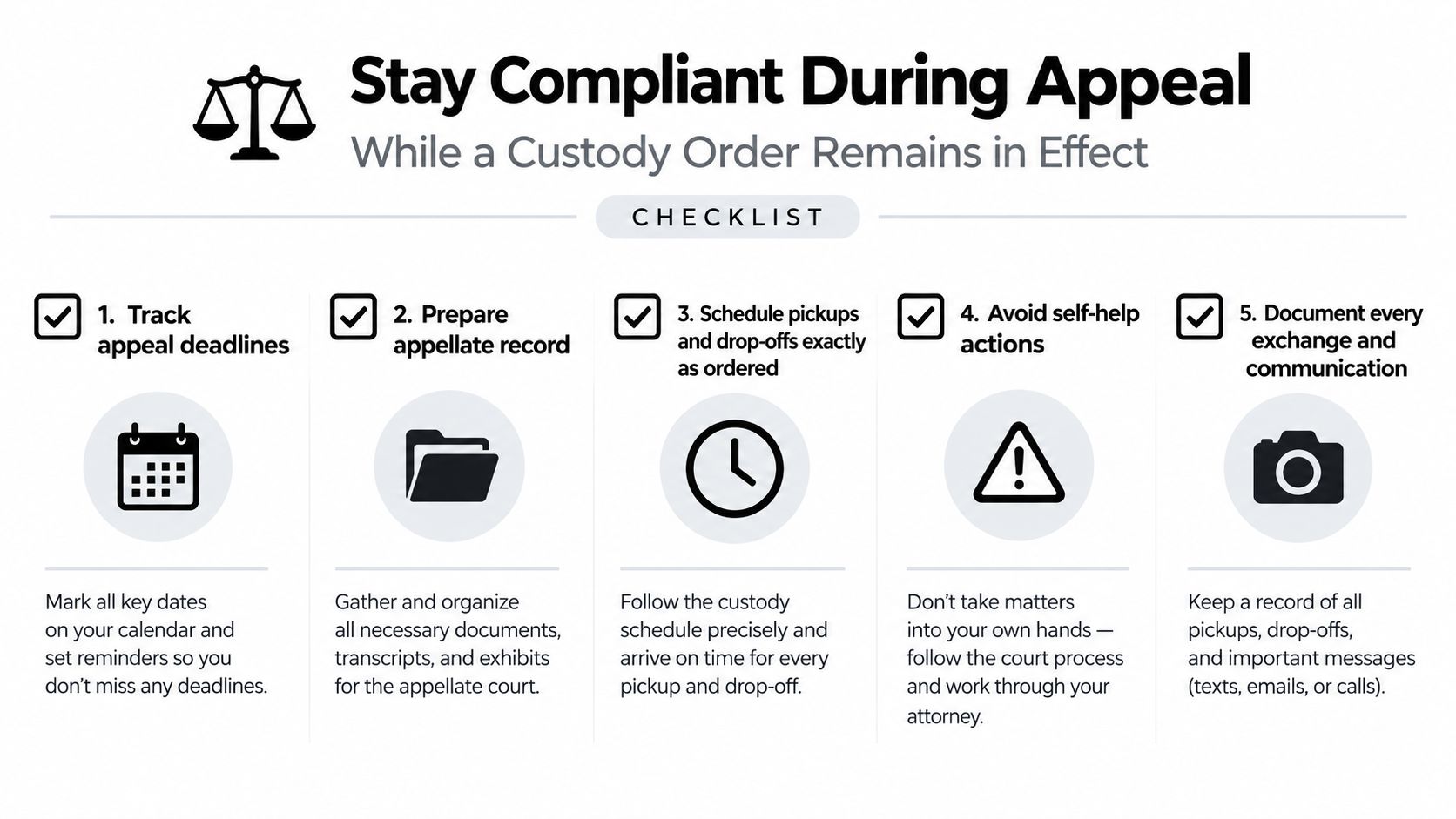
Once the appeal is filed, many parents feel stuck between frustration and urgency. The practical job during this period is twofold. Follow the order carefully, and build a reliable appellate record.
Track the deadlines that control the record
Under the Texas Rules of Appellate Procedure, the appellate record is generally due 60 days after the judgment is signed, but that extends to 120 days if a party filed a motion for new trial, motion to modify, motion to reinstate, or request for findings of fact and conclusions of law. In accelerated appeals, the record is due within 10 days after the notice of appeal is filed, as provided in the Texas Rules of Appellate Procedure.
Those deadlines matter because the appellate court reviews the record, not a parent's memory of what happened in court. If the record is late or incomplete, the appeal can become harder to present and, in some situations, harder to preserve effectively.
What compliance looks like in real life
Parents sometimes think compliance means silent acceptance. It doesn't. You can comply and still challenge the order forcefully on appeal.
A careful approach often includes:
- Follow exchange terms exactly: Use the dates, times, and locations in the signed order.
- Document communications: Keep messages organized and factual.
- Avoid self-help changes: Don't alter the schedule on your own because you believe the order is wrong.
- Preserve paperwork: Orders, notices, hearing settings, and filings all matter.
- Tell your lawyer about problems early: A missed exchange or disputed interpretation can affect both enforcement and appellate strategy.
Keep your conduct appeal-friendly. Judges notice which parent followed the order while asking for legal review.
Enforcement risk and appellate posture
If a parent violates an order that remains in effect, the other parent may seek enforcement or contempt remedies where the law allows. That can shift the focus away from the trial court's legal mistakes and toward the appellant's noncompliance.
At the same time, the appeal itself may still target legal error. Family appeals often involve abuse of discretion review. As noted earlier, that asks whether the trial judge made a decision outside the range the law permits. A reversible error is an error serious enough that it likely affected the outcome. Those concepts are central because appellate courts do not retry the whole case.
A workable checklist for parents
- Calendar every appellate deadline
- Confirm the clerk's and reporter's records are being prepared
- Read the exact wording of the signed order
- Maintain a clean log of exchanges and issues
- Separate emotional frustration from legal strategy
This stage is demanding, but it is manageable with discipline. The order remains operative unless suspended. Your appeal remains viable if it is timely, well-documented, and grounded in the actual record.
Finding a Fair Outcome Through Texas Custody Appeal Advocacy
An appeal can be a meaningful path when a family court made a legal mistake. It is not a retrial, and it is not a chance to start over with new evidence. It is a focused review of the trial court's rulings, the written record, and whether the law was applied correctly.
That's why the non-suspension rule matters so much. If you understand early that the order usually stays in effect, you can avoid avoidable mistakes. You can comply where required, seek a suspension through the right motion, and build an appeal around actual reversible issues rather than assumptions about an automatic pause.
For many parents, the strongest next step is to get a clear legal assessment of both the appeal and the possibility of interim relief. A brief is the written argument that explains those legal errors to the appellate court. A reversible error is a mistake that likely changed the result enough to justify appellate relief.
If your case involves conservatorship, possession, or related issues, a focused review of the order and record can help determine whether the trial court abused its discretion, misapplied the Family Code, or committed a procedural error. Related custody appeal issues are also discussed in custody ruling appeals involving sole, joint, shared, 50-50, and modification issues.
If you believe the court made a mistake in your family law case, our appellate attorneys can help you seek a fair outcome. Contact The Law Office of Bryan Fagan today for a free consultation.
The Law Office of Bryan Fagan, PLLC handles Texas family law appeals involving custody, divorce, property division, protective orders, and related judgments, including cases where parents need advice about whether a custody order remains enforceable during appeal. If you need a careful review of your order, deadlines, and options for requesting suspension, visit The Law Office of Bryan Fagan, PLLC to schedule a free consultation.