Skip to content
You may be looking at a final custody, support, property, or protective-order ruling and thinking the court got something important wrong. At the same time, your child's schedule, financial obligations, or safety arrangements still have to function while the appeal moves forward. That uncertainty can feel overwhelming, especially when filing a notice of appeal doesn't automatically answer what happens tomorrow morning.
Texas law provides a limited way to preserve a child's safety and welfare during that gap. Family Code 109.001 temporary orders while an appeal is pending can help stabilize possession, support-related arrangements, geographic restrictions, and certain litigation expenses, but the trial court's authority is narrow and time-sensitive.
An appeal also isn't a new trial. The appellate court generally reviews the existing record for legal error, abuse of discretion, or harmful procedural problems. It doesn't ordinarily receive new evidence or reconsider every disagreement about credibility. This guide to what happens after filing an appeal in Texas family court can help place the process in context.
When Your Family Law Judgment Feels Unfair and an Appeal Begins
Suppose a final order changes your child's primary residence, limits your possession, or requires support you believe the evidence didn't justify. You file an appeal, but the order remains part of daily life. School transportation still needs to be arranged, exchanges still need to occur, and support obligations may continue while the appellate court studies the record.
That situation creates two separate legal questions. First, did the trial court commit a reversible error in the final judgment? Second, what temporary structure is necessary to protect the child while the appeal is pending? Section 109.001 addresses the second question. It isn't designed to give either parent another chance to present evidence that could have been offered at trial.
Trials and appeals serve different purposes
At trial, the judge hears testimony, receives exhibits, evaluates credibility, and makes findings based on the evidence presented. The parties build the record through pleadings, objections, offers of proof, exhibits, and testimony. A missed objection or incomplete record can limit what an appellate court can later review.
On appeal, the parties work from that record. Briefing means presenting written legal arguments that identify the alleged error, cite the record, explain the governing law, and show why the error matters. The appellate court asks whether the trial court had sufficient information to make its decision and whether it acted within the bounds of its discretion.
Common concerns include:
- Custody and possession: The trial court may have applied the wrong legal standard, disregarded important admitted evidence, or entered findings that don't support the order.
- Child support: The court may have misapplied the governing provisions or failed to address a legally significant issue preserved in the record.
- Property division: A party may argue that the court mischaracterized property, misapplied the law, or divided the estate based on an unsupported premise.
- Protective orders and enforcement: A procedural defect, inadequate notice, or improper evidentiary ruling may affect the validity of the result.
An appeal can seek fairness, but it requires precision. While the appellate court reviews the final judgment, a properly supported temporary-order request may address immediate child-welfare needs during the appellate gap.
Understanding Texas Family Code Section 109.001 and What It Allows
Section 109.001 gives a Texas trial court a limited post-judgment power in a SAPCR appeal. After the appeal is perfected, the court may issue temporary orders necessary to preserve and protect the child's safety and welfare during the appeal. The court may act on its own motion or on a party's motion, but the process requires notice and a hearing. The statute also permits relief that can include reasonable attorney's fees and expenses, as recognized in Texas appellate discussion of the statute's timing and authority.
The controlling purpose
The statute's purpose controls the request. A parent should connect each requested term to a concrete need involving the child's welfare rather than presenting the motion as a second attack on the final judgment.
The central question is not whether the original judgment felt unfair. It is whether temporary relief is necessary to preserve and protect the child during the appeal.
A temporary order might address a possession schedule that needs practical clarification, a geographic restriction needed to maintain stability, or support-related arrangements that prevent disruption while the appellate court reviews the judgment. The order may also address reasonable attorney's fees and expenses when the statutory requirements are met.
What the statute doesn't do
Section 109.001 doesn't automatically erase the final judgment. It doesn't allow the trial court to decide the appeal, receive unlimited new evidence, or permanently revise the parties' rights. Its function is temporary preservation.
That distinction matters when drafting. A motion that repeats every trial complaint may miss the statutory focus. A stronger motion identifies the child-welfare problem, explains why immediate structure is needed, proposes specific terms, and provides evidence that permits the judge to act within the limited authority.
Parents also sometimes assume an appeal suspends every custody provision. It doesn't. A related explanation of that issue appears in Family Code 109.002 and why an appeal doesn't suspend a custody order. When relief can't wait for a final appellate decision, Mandamus in Texas Family Cases describes how to challenge a ruling that can't wait for a final appeal.
The Critical Timing Windows That Control Temporary Orders on Appeal
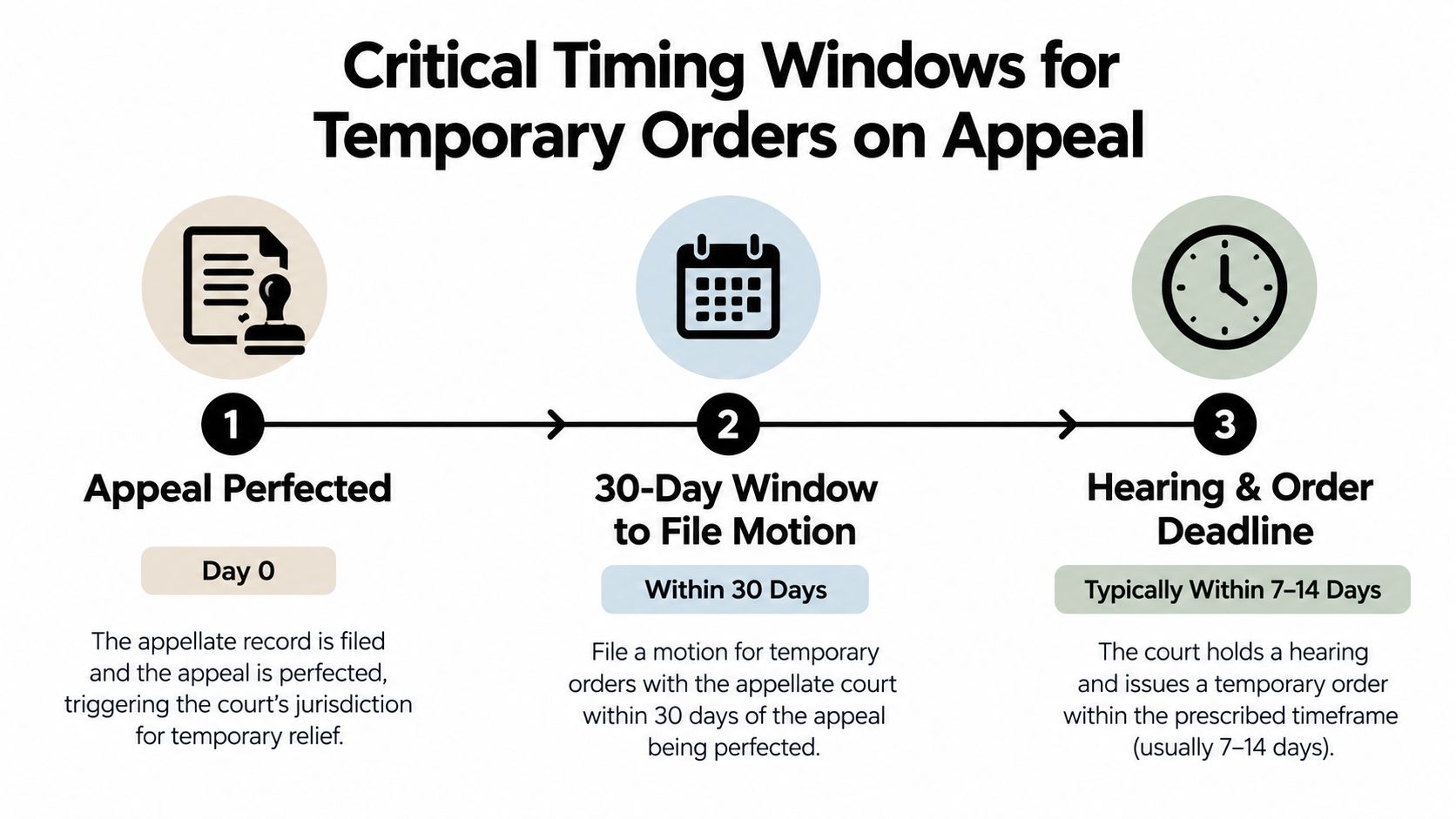
The most important practical lesson is that the calendar controls the trial court's power. Texas authority reflects two timing milestones that must be analyzed separately. One concerns the narrow period for entering temporary relief after an appeal is perfected. The other concerns the trial court's jurisdiction to hear and sign certain orders after a notice of appeal is filed.
The two milestones
Historically, Section 109.001 has been described as allowing temporary orders within 30 days after the appeal is perfected. That deadline is treated as a strict timing rule, not a flexible target. The statute's narrow purpose means a party must act promptly if immediate child-welfare protection is needed.
The modern framework also recognizes a 60-day jurisdictional window after notice of appeal is filed for the trial court to hear and sign certain temporary orders in SAPCR appeals. The statute specifies that jurisdiction to conduct the hearing and sign the order continues only until the 60th day after an eligible party files notice of appeal from the final judgment. The statutory text for Family Code Section 109.001 should be reviewed alongside the specific appellate posture of the case.
These milestones can create confusion because “filing the motion,” “holding the hearing,” “signing the order,” “perfecting the appeal,” and “filing the notice of appeal” are not interchangeable events. A lawyer should calendar each event from the correct trigger and confirm which statutory provision governs the requested relief.
What happens after the window closes
A jurisdictional deadline limits the court's authority. If the court acts after the applicable window, the order may be vulnerable as beyond the court's power. The parties shouldn't assume that a pending motion, a scheduled hearing, or the seriousness of the dispute extends jurisdiction.
Later modification presents a narrower question. Subsections (b-3) and (b-4) may permit modification of an existing temporary order when the statutory requirements are satisfied, including a material and substantial change in circumstances. That doesn't mean a party can create an initial order after the jurisdictional deadline. The existence of a timely entered order and the legal basis for modifying it must be examined separately.
The timing problem is one reason counsel should address temporary relief early, not after the appellate process has already advanced. A detailed discussion of Texas family-law appeal deadlines can help identify other calendar risks, but the specific dates in a Section 109.001 request require case-by-case calculation.
How to Request Modify or Challenge Temporary Orders During an Appeal
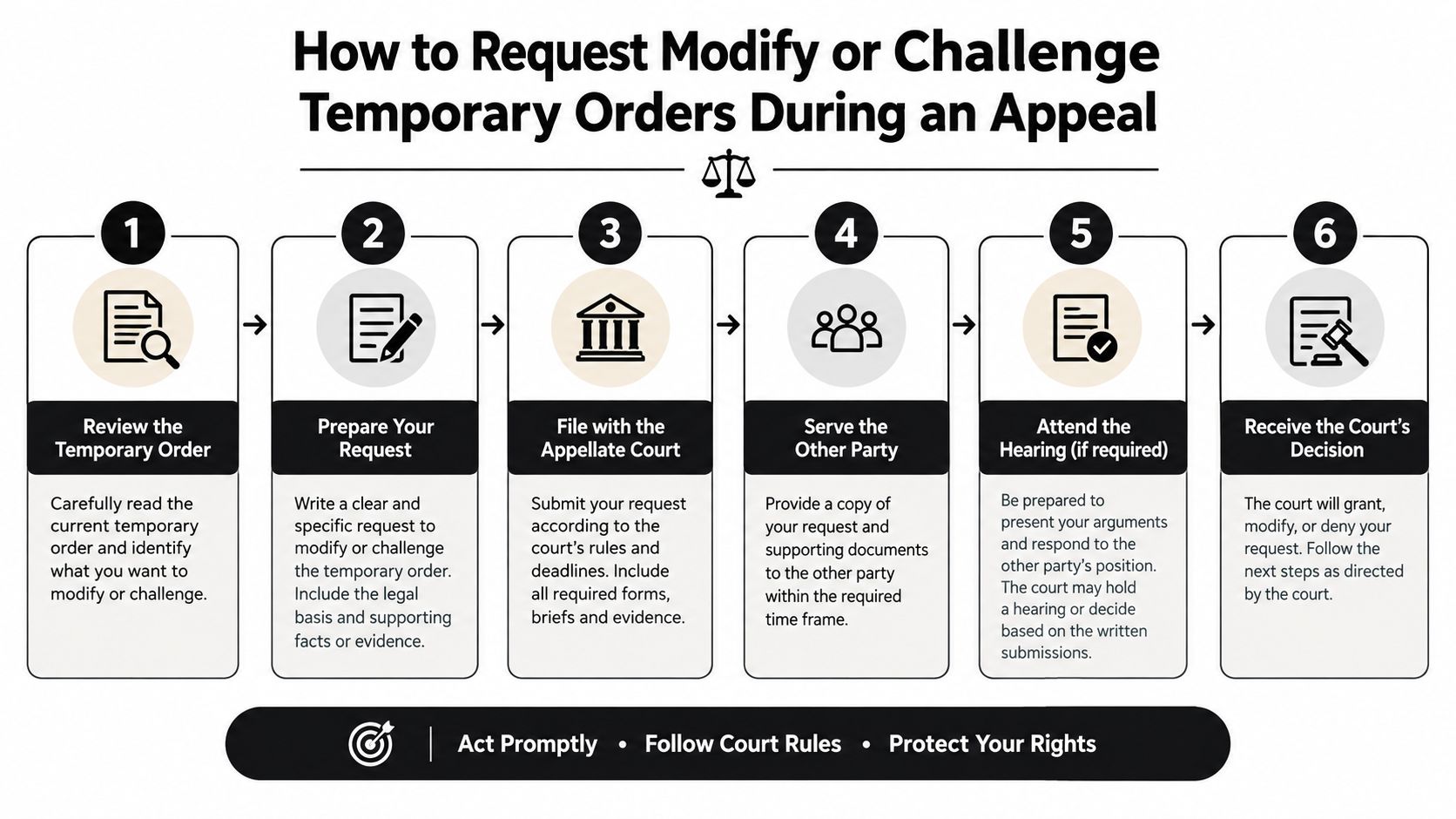
A parent seeking relief should treat the request as a focused procedural project. The court needs a proper motion, lawful notice, a timely hearing, evidence tied to the child's safety and welfare, and a signed written order. Missing one part can undermine relief even when the underlying concern is genuine.
A practical filing sequence
Start with the appellate posture. Confirm that the appeal has been perfected or that the notice of appeal has been filed, identify the final judgment being challenged, and calculate the applicable statutory deadlines. The motion should state why the requested order fits Section 109.001 rather than merely restating the appellate points.
Request specific temporary terms. A court can't manage a vague request. Identify the proposed possession schedule, exchange arrangement, geographic restriction, support-related term, or fee request. Each term should connect to a particular preservation or child-welfare need.
Support the motion with admissible evidence. Depending on the issue, that may include testimony, admitted records, school information, communications, or other evidence permitted by the court. The evidence should explain the present problem and why delay could harm stability or safety.
Provide notice and obtain a hearing. Section 109.001 contemplates notice and a hearing. The other party must have a meaningful opportunity to respond, subject to the court's applicable procedural rules and any properly supported emergency request.
Secure a signed order. A ruling announced in court isn't the same as a signed written order. Counsel should confirm what the court signed, when it was signed, and whether the document accurately states the relief granted.
Practical rule: Calendar the signing deadline, not merely the hearing date.
Modification and review
A later modification is not an invitation to relitigate the final judgment. The moving party must identify the existing temporary order and establish the statutory basis for changing it, including a material and substantial change in circumstances where required.
A party generally can't take an interlocutory appeal, meaning an immediate ordinary appeal from the temporary order itself. Section 109.001(c) bars that route. Subsection (b-5), however, permits review by mandamus or by properly assigning the issue in the appellate brief. Texas authority discussing this review structure is available in the First Court of Appeals' Section 109.001 opinion.
Mandamus is an extraordinary remedy, not a substitute for every disagreement with a temporary ruling. It becomes especially important when a temporary order causes immediate harm that an ordinary appeal from the final judgment may not adequately repair. Immediate attorney's-fee awards can present that concern because the financial effect may be difficult to undo later.
The appellate record still matters. A party considering mandamus should preserve objections, obtain the relevant reporter's record and clerk's record, and present a clear explanation of the trial court's legal error and the lack of an adequate remedy through ordinary appeal.
Stays Supersedeas Enforcement and Contempt While Your Appeal Is Pending
Filing a notice of appeal doesn't automatically suspend the judgment. That means the existing custody, possession, support, enforcement, or protective-order provisions may continue unless a separate legal mechanism changes their operation.
A temporary order under Section 109.001 addresses limited preservation of a child's safety and welfare. A stay pauses enforcement of a judgment or proceeding when properly granted. Supersedeas is the procedural method used to suspend enforcement under applicable Texas appellate rules and orders. These tools can overlap in practical effect, but they aren't interchangeable.
| Mechanism | Purpose During Appeal | When to Use |
|---|---|---|
| Temporary order under Section 109.001 | Preserve and protect the child's safety and welfare through temporary terms | When possession, geographic, support-related, or similar child-focused arrangements need immediate structure |
| Stay | Pause a proceeding or enforcement activity | When continuing the proceeding would interfere with appellate review or cause immediate harm |
| Supersedeas | Suspend enforcement of the judgment when the applicable requirements are met | When a party needs protection from enforcement while pursuing appellate relief |
| Existing judgment | Continue governing the parties unless properly suspended or modified | When no stay, supersedeas, or valid temporary order changes the operative terms |
Why contempt remains a concern
A parent who believes the final order is wrong still needs to understand its current force. Ignoring possession exchanges, support obligations, or other commands can expose that parent to enforcement proceedings or contempt allegations. The appeal may later establish that the judgment contained an error, but that possibility doesn't automatically authorize noncompliance.
The 60-day deadline under Section 109.001(b-2) is jurisdictional rather than discretionary, as reflected in the Texas Legislature's statutory materials. A parent who needs temporary protection should not wait for enforcement to begin before addressing the calendar and selecting the proper tool.
A careful strategy may involve seeking temporary relief, requesting a stay, pursuing supersedeas, or asking the appellate court for mandamus. The right path depends on what the judgment requires, what harm is occurring, and what authority remains available.
Preserving Error and Meeting the Standard of Review in Texas Family Appeals
An appellate argument must do more than show that the trial judge made a decision you dislike. It must identify a legally significant mistake, show that the issue was preserved when required, and explain why the mistake probably affected the result.
Abuse of discretion means the trial court acted without sufficient evidence, applied the wrong legal standard, or reached a decision outside the range of reasonable choices permitted by the law and evidence. Texas family-law appeals generally use that as the main standard. Legal and factual insufficiency aren't independent grounds for reversal. Instead, they help the appellate court decide whether the trial court abused its discretion, as explained in Texas authority on the family-law appellate standard.

Three terms that shape the appeal
Reversible error is a mistake that justifies changing the judgment because it probably caused an improper result or prevented a party from properly presenting the case on appeal. Not every mistake qualifies. The error must matter.
Briefing is the written presentation of the appellate argument. Effective briefing connects the legal rule to specific trial-court conduct, cites the record, and explains the requested remedy. A brief that raises a complaint without developing it may leave the appellate court without a workable basis to grant relief.
Preservation means giving the trial court a fair opportunity to correct an alleged error, usually through a timely objection, request, motion, or ruling. Preservation requirements vary by issue, so counsel should examine the transcript and filings rather than assume that a general objection protected every complaint.
Examples of issues that may matter
A custody appeal may involve a misapplied Family Code provision, a ruling unsupported by the evidence, or a procedural error that prevented a parent from presenting important evidence. A property-division appeal may involve mischaracterization of assets, an incorrect legal framework, or findings that don't support the division. A support, enforcement, or protective-order appeal may center on notice, evidentiary rulings, or an order that exceeds the court's authority.
The appellate court asks whether the trial court had enough evidence to act and whether it misapplied its discretion. It will reverse only when the error probably caused an improper judgment or prevented proper presentation of the case on appeal.
A focused review of the record should identify the exact ruling, the objection or request that preserved the issue, the evidence supporting the argument, and the remedy the appellate court can provide. Those steps transform a sense of unfairness into a legally reviewable claim.
Taking the Next Step Toward a Fair Outcome for Your Family
Feeling that a family-law judgment was unfair is a serious reason to seek an appellate evaluation, but time-sensitive temporary relief requires a separate and immediate analysis. Section 109.001 can provide a limited bridge for child-welfare concerns during an appeal, yet that bridge depends on correct deadlines, proper notice, a focused evidentiary presentation, and a signed order entered within the court's authority.
Your appeal may involve custody, visitation, child support, property division, spousal maintenance, a divorce decree, a protective order, enforcement, or contempt. Each issue brings different preservation requirements and standards of review. The appellate record, not new testimony offered after judgment, will usually determine what the court can consider.
An early consultation can help identify whether the trial court's ruling presents a potentially reversible error, whether a temporary order or stay is appropriate, and whether mandamus should be considered because ordinary appellate review may come too late. The Law Office of Bryan Fagan, PLLC handles Texas family-law appellate matters and works with parents, spouses, and referring trial counsel to develop a clear procedural strategy.
The Law Office of Bryan Fagan, PLLC evaluates Texas family appeals and related requests for temporary orders, stays, supersedeas, and mandamus relief. Visit The Law Office of Bryan Fagan, PLLC to schedule a free 30-minute consultation and discuss the deadlines, record, and appellate strategy affecting your family.