You may feel your Texas family law case was handled unfairly. Then the final decree arrives, and near the last pages you find an attorney's fee award that changes the financial impact of the entire case. You may want to challenge the award immediately, but an appeal attorney fees award Texas strategy must begin with procedure, not frustration.
An appeal isn't a second trial. The appellate court generally reviews the existing record, applies the correct standard of review, and asks whether the trial court committed a legal error that matters. A fee challenge can fail before the court reaches the merits if the objection wasn't preserved, the record is incomplete, or the evidence doesn't support the requested relief.
Why Appealing a Fee Award Feels Overwhelming
You've just received a divorce decree. The property division, custody orders, or support provisions may already feel difficult to accept. Then you see a separate order requiring you to pay the other side's attorney's fees. The amount may be substantial, and the award may seem to appear without a clear explanation of how the judge reached it.
That shock is understandable. But the first question isn't whether the award feels unfair. It's what legal authority supported it, what evidence was admitted, and what objections appear in the trial court record.

An appeal is a record review
At trial, the judge hears testimony, considers exhibits, evaluates credibility, and makes factual decisions. On appeal, the court of appeals usually doesn't hear witnesses again or decide which person seemed more believable. Texas family law appeals involving custody, visitation, child support, and property division are generally reviewed for abuse of discretion, meaning the trial court acted arbitrarily, unreasonably, or without reference to guiding rules and principles. Texas appellate authority explains this family-law standard.
That difference controls your strategy. A complaint that the judge “got it wrong” is rarely enough. Your brief must identify a specific legal or procedural error, show where the error appears in the record, and explain why it probably affected the judgment.
Timing controls your options
The notice of appeal, post-trial motions, clerk's record, reporter's record, and appellate brief all serve different purposes. Missing a deadline or failing to designate necessary materials can leave the appellate court without the information needed to review the fee award.
The financial stakes also include more than the court's filing charge. Texas law sets the appeal filing fee in the courts of appeals at $205, while attorney time and record preparation can create much greater exposure. Texas Civil Practice and Remedies Code section 51.015 creates a special fee-shifting rule for certain interlocutory appeals. If the challenged order is affirmed, the court of appeals must order the appellant to pay all costs and reasonable attorney's fees of the appeal. If the order isn't affirmed, each side pays its own appellate costs.
Practical rule: Treat an attorney's fee award as a separate appellate issue from the underlying divorce, custody, or property dispute. It needs its own legal basis, evidentiary analysis, and preservation review.
Preserving Your Right to Challenge Attorney Fees
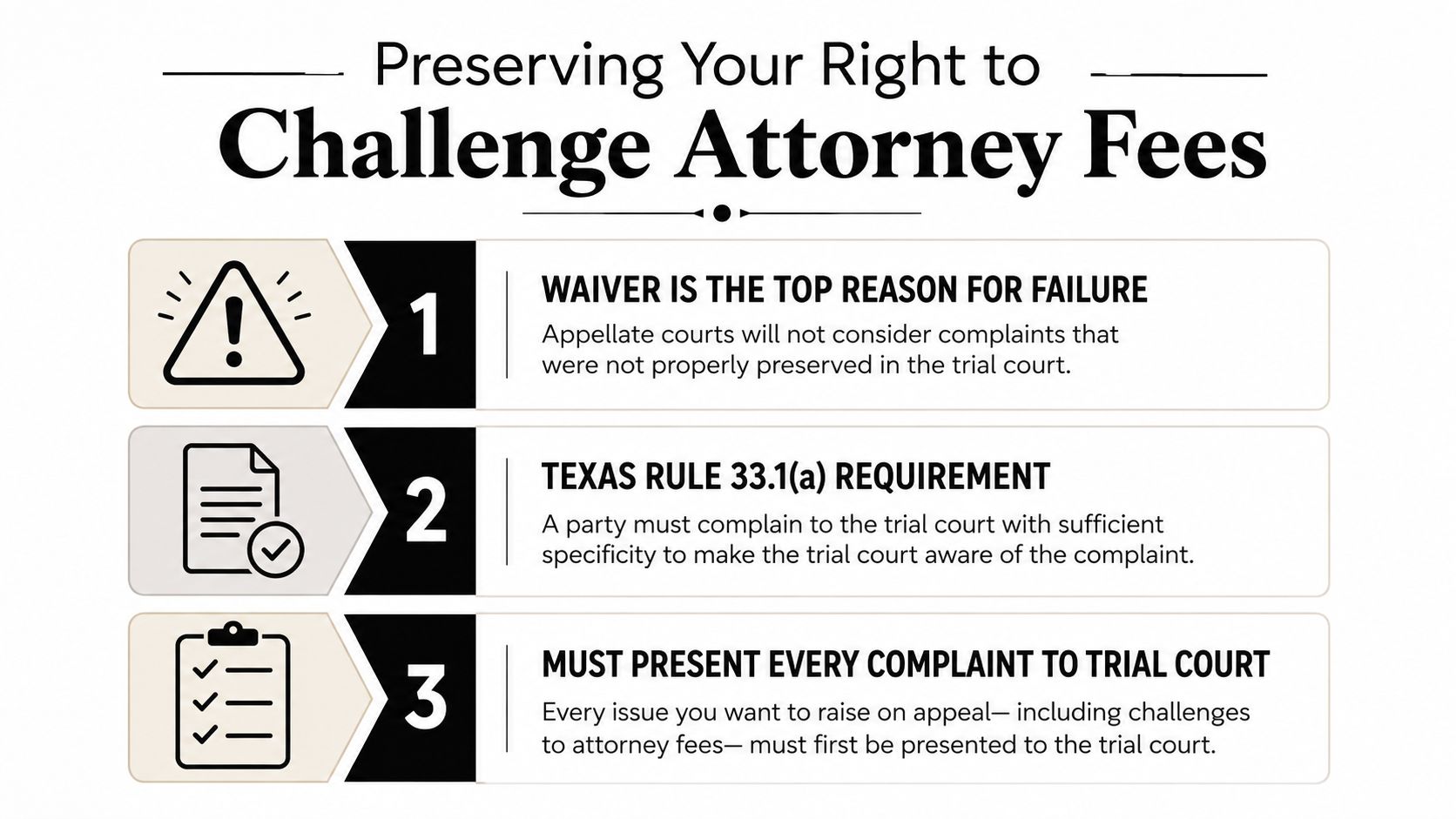
The most damaging mistake often happens before the appeal begins. Under Texas Rule of Appellate Procedure 33.1(a), a party generally must present a complaint to the trial court with enough specificity to make the judge aware of the issue and must obtain a ruling. A later appellate complaint may be waived if the trial record doesn't show that sequence.
Start with the legal basis
Ask the trial court to identify the statute, contract, rule, or other authority allowing the award. In family cases, Texas Family Code section 106.002 authorizes attorney's fees and expenses in suits affecting the parent-child relationship, but the requesting party still must establish that the fees are reasonable and necessary under the circumstances. The statutory text for section 106.002 is the place to begin when the case involves custody, support, visitation, or another parent-child claim.
A general objection such as “I object to the fees” may not preserve every argument. If you contend that the statute doesn't apply, the court lacks authority to award the fees, the evidence is legally insufficient, or the amount is unreasonable, those grounds should be stated separately and clearly.
Challenge the proof, not just the result
Fee evidence should connect the requested amount to identifiable work. The record should address the services performed, the people who performed them, when the work occurred, the time reasonably required, and the applicable hourly rates. Evidence may also address the recognized factors concerning reasonableness, necessity, complexity, skill, customary rates, results, time limitations, the attorney-client relationship, and the lawyer's experience.
If the opposing party offers little or no evidence, object at the time the evidence is offered. If the court relies on an affidavit, identify the specific deficiencies and request a ruling. A complaint raised for the first time in the appellate brief is vulnerable to waiver.
Protect factual complaints
A legal-sufficiency complaint and a factual-sufficiency complaint aren't interchangeable. If the challenge depends on the weight of the evidence or argues that the evidence is so weak that the award cannot stand, counsel should evaluate the need for a motion for new trial and other post-trial filings.
Texas appellate deadlines are strict. A motion for new trial is generally filed within 30 days after the judgment is signed, and the notice of appeal is generally due within 30 days as well, subject to rules that can extend the notice deadline when a qualifying post-trial motion is timely filed. Post-Trial Motions Before a Texas Appeal addresses how a motion for new trial can extend the appeal deadline.
Build the record while the case is still in trial court
Request findings of fact and conclusions of law when they can clarify the basis for the fee ruling. Make sure the reporter's record includes the hearing or trial testimony about fees, objections, exhibits, and the court's ruling. The clerk's record should include the pleadings, fee request, supporting materials, final decree, and post-trial motions.
A recent El Paso appellate decision discussed by Texas family-law practitioners illustrates the danger. The husband's challenge to attorney's fees was held waived under Rule 33.1(a) because he failed to preserve the complaint in the trial court. The discussion of Castro v. Castro and error preservation underscores the point: an appellate court can't review an issue that the trial record doesn't properly present.
A short procedural explanation is also available in the following video:
Understanding Fee Shifting and Conditional Awards
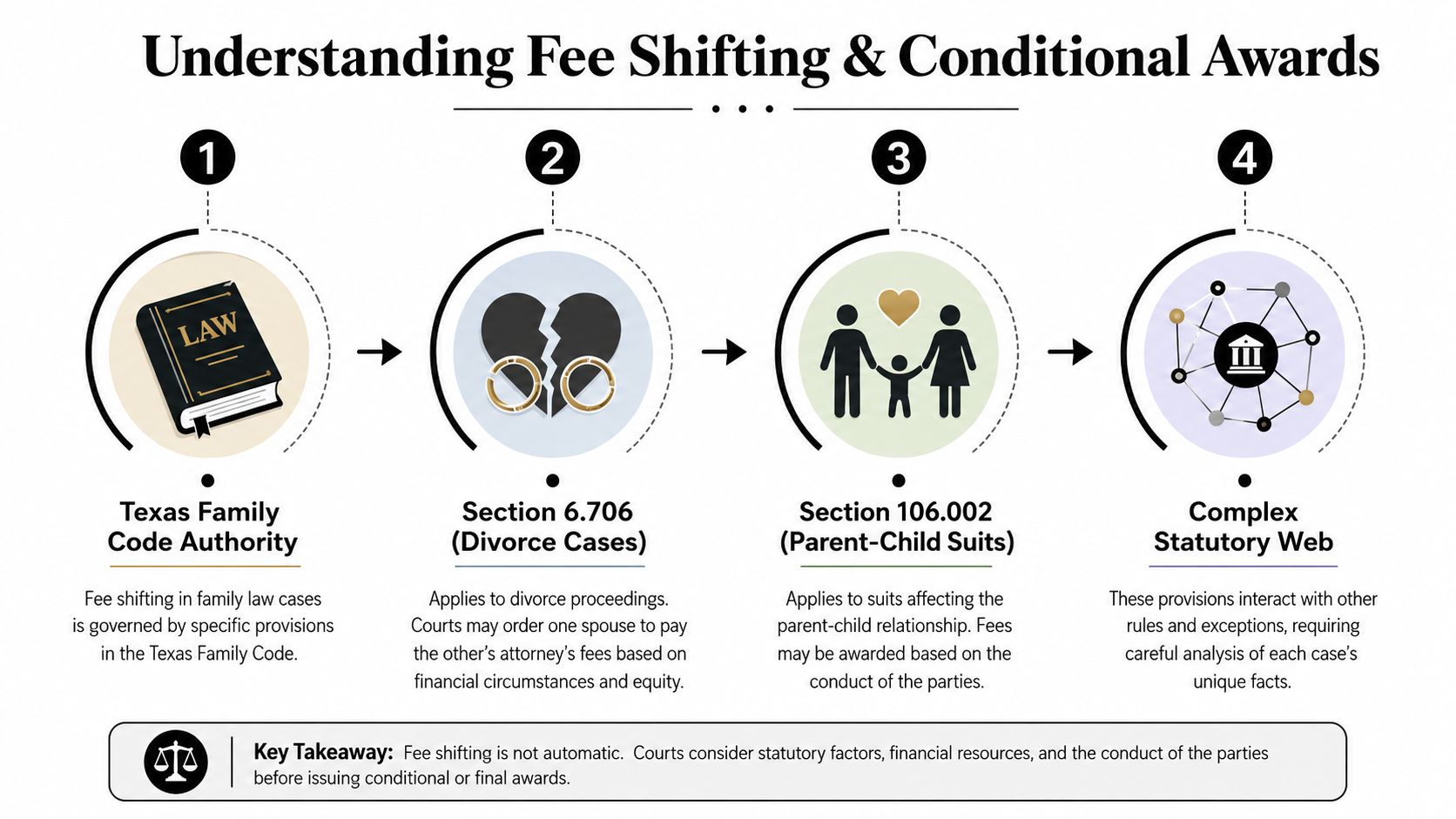
Texas family-law fee awards don't come from one universal rule. The court must identify a valid source of authority and then apply the requirements attached to that authority. In a suit affecting the parent-child relationship, section 106.002 allows the court to award attorney's fees and expenses. The award still depends on the statutory authority and proof that the requested amount is reasonable and necessary.
Conditional fees change the appeal calculation
A conditional appellate fee award is an amount awarded only if a party succeeds in defending the judgment or otherwise prevails at a later appellate stage. The trial court must make the original factual determination, and the request should be supported before the appeal proceeds. The proof usually involves testimony about the work likely to be required, the attorneys or staff who may perform it, the expected hours, the issues involved, and reasonable rates.
That evidence matters because future appellate work hasn't occurred when the trial court signs the judgment. Completed billing records can't prove work that hasn't yet been performed. A reasoned estimate tied to distinct appellate tasks gives the court a basis for setting a conditional amount.
The Texas Rules of Appellate Procedure identify the filing fee for an appeal from a district or county court as $205. The Texas Rules of Appellate Procedure provide the procedural framework, but the filing fee is only one part of the financial analysis. Record-intensive briefing and attorney time usually matter far more to the parties' strategy.
Interlocutory posture can create mandatory exposure
An appeal from a final family-law decree isn't the same as an interlocutory appeal. For certain interlocutory orders under Texas Civil Practice and Remedies Code section 51.014(a)(6), section 51.015 requires the court of appeals to award all costs and reasonable attorney's fees of the appeal to the appellee if the challenged order is affirmed. If the order isn't affirmed, each side pays its own appellate costs.
That rule is tied to the appellate posture, not to who was morally or factually right in the underlying family dispute. Before appealing an interlocutory order, determine whether this statute applies. The potential fee consequence can make the choice to appeal materially different from an appeal of a final decree.
Texas family-law enforcement proceedings have another statutory layer. Section 157.164 provides compensation rules for an attorney appointed to represent an indigent respondent and treats a proceeding in a court of appeals or the Texas Supreme Court as the equivalent of a bona fide appeal to the Texas Court of Criminal Appeals. That structure places appointed appellate work within a statutory, county-funded compensation framework rather than leaving it entirely to private billing.
The practical lesson is straightforward. Don't evaluate the appeal by looking only at the amount awarded in the decree. Identify whether the fees are discretionary, conditional, appointed-counsel compensation, or subject to a statute that shifts appellate fees after an interlocutory affirmance. The discussion in Standards of Review in Texas Family Appeals explains why the governing standard can decide whether a fee challenge has practical force.
Standards of Review That Decide Fee Appeals
The standard of review determines what the appellate court is allowed to do with your complaint. Most family-law fee challenges face an abuse-of-discretion framework. The appellate court asks whether the trial judge acted without reference to guiding rules, acted arbitrarily or unreasonably, or applied the law incorrectly.
That's different from asking whether the appellate judges would have awarded the same amount. A party who believes the fee was too high may not prevail. The challenge needs to connect the amount to a legal or evidentiary failure, such as an award unsupported by proof of reasonable and necessary services.
A challenge to the existence of legal authority is different. If the trial court awarded fees under a statute that doesn't authorize them, the appellate court can address that legal question without deferring to the trial judge's interpretation. The same is true when the complaint concerns a purely legal issue that doesn't depend on disputed credibility.
| Standard of Review | When It Applies | What You Must Prove | Difficulty Level |
|---|---|---|---|
| Abuse of discretion | The amount, necessity, or manner of a discretionary family-law fee award | The court acted arbitrarily, unreasonably, or without reference to guiding rules, or applied the law incorrectly | High |
| Legal sufficiency | The record lacks evidence supporting a required element of the award | No more than a scintilla of evidence supports a necessary finding, or the evidence conclusively establishes the opposite | High |
| De novo | The appeal presents a legal question, such as whether statutory authority exists | The trial court used the wrong legal rule or reached an incorrect legal conclusion | Focused, but dependent on preservation |
Consider two different complaints. If the court awarded fees after hearing evidence but you contend the billing was inflated, you're likely attacking the exercise of discretion and the sufficiency of the proof. If the statute doesn't authorize fees for the claim at issue, you're challenging the legal basis itself.
The distinction affects briefing, requested relief, and the record you need. This guide mapping standards of review to ruling types can help organize that analysis, but an attorney must still apply the standard to the actual decree and record.
The strongest fee appeal usually starts with the question, “What rule did the trial court have to follow, and where did the record show that it failed?”
A fee award may also be reversed when the trial court had authority but lacked adequate evidence. Texas Bar practice materials explain that appellate fee awards require proof of reasonableness and that the trial court, not the appellate court, must make the original factual determination. Texas Bar materials on attorney's fees emphasize why a party must build the evidentiary foundation before the case reaches the court of appeals.
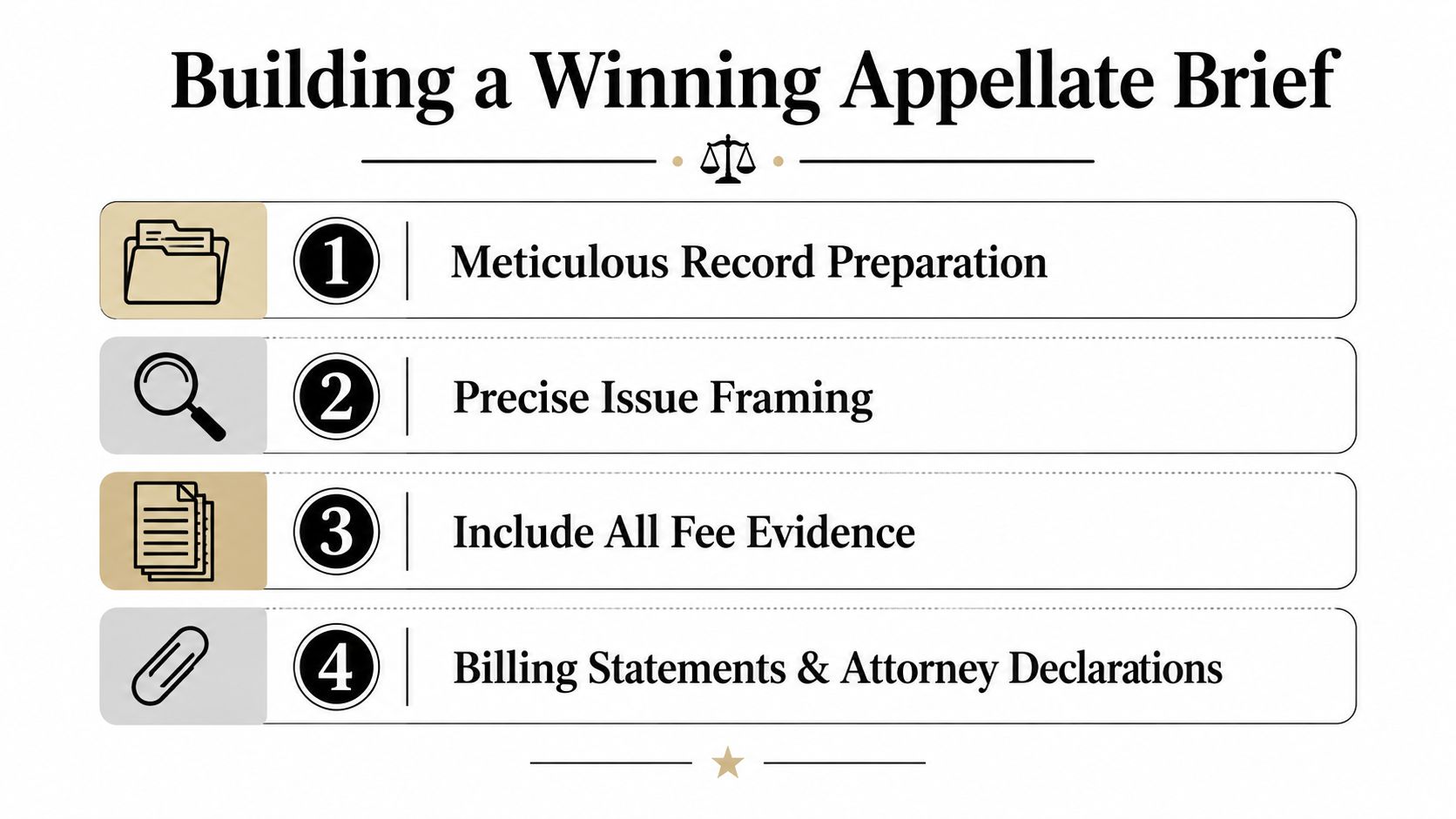
Building a Winning Appellate Brief on Fees
A fee brief should give the appellate court a clean path to the requested result. Start with the judgment and the statutory authority. Then identify the evidence supporting the award, the objection or request that preserved your complaint, the standard of review, and the remedy available if the court finds error.
Prepare the record first
The clerk's record should contain the pleadings that requested fees, the supporting affidavit or exhibits, the final decree, any separate fee order, findings, conclusions, and post-trial motions. The reporter's record should include testimony about the legal work, fee amount, necessity, reasonableness, conditional appellate services, and objections.
Use a record checklist before drafting:
- Fee authority: Locate the statute, rule, contract, or other basis for the award.
- Fee evidence: Identify billing material, attorney testimony, affidavits, agreements, and exhibits.
- Preservation: Mark every objection, offer of proof, request for a ruling, and post-trial complaint.
- Conditional language: Determine whether the judgment makes appellate fees dependent on success.
- Requested relief: Decide whether the proper remedy is reversal, modification, remand, or rendition.
A missing transcript can be as damaging as a weak argument. If the appellate court can't verify what evidence the trial judge considered, it may be unable to sustain your complaint.
Frame a precise issue
“ The fee award was excessive” is too broad. A stronger issue identifies the legal failure and the missing proof: the trial court abused its discretion by awarding fees without evidence showing the particular services performed, who performed them, the time required, and the applicable rates.
For a conditional award, address two separate questions. First, was the underlying judgment properly affirmed or reversed? Second, did the trial court make a supported finding concerning the likely appellate work and condition the award on the required outcome?
The brief should also explain segregation when the record requires it. If the requesting party sought fees for claims that don't support fee recovery, the evidence should distinguish recoverable work from nonrecoverable work when segregation is required. Don't assume the appellate court will reconstruct the attorney's billing for the parties.
Write for the appellate record
Briefing means presenting the legal argument, supporting authorities, record citations, and requested relief in the format required by the appellate rules. It isn't a narrative about everything that happened in the marriage or custody dispute. Include only facts that matter to the fee issue and cite the record for each material statement.
An effective brief should let the court answer four questions quickly:
- What authority allowed the award?
- What evidence supported reasonableness and necessity?
- What objection preserved the challenge?
- What remedy follows from the error?
The Texas family-law appellate brief requirements provide a useful procedural reference. Your appellate lawyer should then tailor the brief to the particular decree, fee findings, and record.
Your Next Steps Toward a Fair Resolution
If you're considering an appeal, preserve the documents before doing anything else. Gather the signed decree, fee affidavit, fee order, hearing notices, exhibits, post-trial motions, clerk's record, and reporter's record. Write down every objection made about attorney's fees while the events are still fresh.
Next, have an appellate attorney evaluate the record, not just the outcome. The attorney should identify the fee authority, classify the complaint under the correct standard of review, check preservation under Rule 33.1(a), and determine whether the judgment contains conditional appellate fees. That review can also show whether the stronger issue concerns the fee award itself, the underlying property division, custody ruling, support order, protective order, or enforcement judgment.
Texas appellate procedure rewards early analysis. A lawyer who reviews the record before deadlines pass can advise you about post-trial motions, notice requirements, record designation, settlement discussions, and whether an appeal can address the relief you need. A lawyer can also explain the difference between challenging a fee award and seeking temporary relief while the appeal is pending.
Cost should be discussed plainly during the consultation. Ask what work the proposed representation includes, how record preparation will be handled, what briefing will cover, and whether the fee issue can be evaluated separately from the rest of the appeal. You deserve a candid assessment, not a promise that every unfavorable ruling can be overturned.
The Law Office of Bryan Fagan, PLLC handles Texas family-law appeals involving divorce decrees, child custody, visitation, property division, child support, protective orders, and enforcement matters. Its appellate team focuses on record review, preserved error, statutory authority, and precise briefing for clients seeking a fair result.
The Law Office of Bryan Fagan, PLLC can review your Texas fee award, assess preservation and conditional-fee issues, and identify whether the record supports an appeal. Visit The Law Office of Bryan Fagan, PLLC to schedule a consultation and discuss a focused strategy for restoring fairness in your family law case.