You may feel blindsided when a family court adds a sanctions award to an already painful divorce or custody fight. Maybe you lost a hearing you thought was routine, then saw a written order that shifts fees, labels your conduct unfair, or threatens your finances in a way that feels impossible to accept.
The first question is not whether the judge was wrong. The first question is whether you can appeal the sanctions order now, whether you need an accelerated appeal, or whether the issue has to wait until a final judgment. If you choose the wrong path, you can lose the right to review before the court ever reaches the merits.
Texas family-law appeals are procedural, and sanctions appeals are even more so. Chapter 109 of the Texas Family Code ties final-order appeals to the ordinary Texas Rules of Appellate Procedure, gives termination cases expedited treatment, and says a final order does not automatically pause enforcement without a suspension order from the trial court or appellate court (Texas Family Code Chapter 109).
When a Sanctions Order Feels Unfair, Start Here
A sanctions order is a procedural event. It starts clocks, shapes jurisdiction, and can lock in the only appellate route that matters.
In family court, the order often comes out of a discovery fight, a fees dispute, or a hearing where the judge decides one side missed an order or slowed the case down. The written page may feel complete, but Texas appellate review turns on posture, not on how final the ruling feels in the moment.
The three questions that control everything
Start with the order itself. Is it final, appealable now, or only part of a still-pending case? Then identify the appellate vehicle, because direct appeal, accelerated appeal, and mandamus do not follow the same rules. After that, check whether the deadline has already started, because Texas appellate courts usually will not excuse a missed clock while the parties are still deciding what to do.
Practical rule: do not file first and sort out jurisdiction later. In an appeal, the deadline and the vehicle are part of the case.
That order of analysis avoids the mistakes that end sanctions appeals before the merits are ever reached. Parties file a notice of appeal from an order that is not final, choose mandamus when accelerated review was required, or wait for a reconsideration motion to be resolved and miss the actual deadline. Texas appellate practice leaves little room for recovery after that.
Texas family courts see a heavy mix of custody, support, enforcement, and sanctions disputes, so these mistakes come up often. Texas court statistics reflect that family cases made up 43% of the total civil caseload in fiscal year 2023. Separate reporting from the Texas court system also shows the volume of new family filings and agreed judgments remains high, which helps explain why procedural missteps can be expensive.
If your case involves a sanctions order, the first job is classification. The next sections examine that classification the way an appellate court will, one gate at a time.
Deciding Whether the Sanctions Order Is Appealable Right Now
A Texas family-law sanctions order can be final, interlocutory, or tied to contempt. The label in the order matters less than where the case stands procedurally, because that determines whether a party can appeal now or has to wait.
Final orders and orders that merge into judgment
If the sanctions award is folded into a final divorce decree, a final post-judgment order, or another appealable final order, ordinary appeal rules usually apply. The notice of appeal runs from the signed written order, not from the hearing or the judge's oral ruling. A sanctions ruling that looks complete can still be nonfinal if custody, property, support, or enforcement issues remain open.
That is the point where many pro se parties lose the right to review. Harris County family court files often show notices of appeal from interlocutory sanctions orders that the court of appeals later dismisses for lack of jurisdiction, because the underlying case was still pending. The order may have resolved sanctions, but if the main family case was still alive, the appellate court may not treat it as separately appealable.
Interlocutory sanctions and accelerated review
Some sanctions orders belong on accelerated appeal. Texas appellate procedure sets a 20-day notice deadline for accelerated appeals after the judgment or order is signed (Texas Rules of Appellate Procedure accelerated timetable). In family cases, that shorter timetable matters because some sanctions rulings become immediately reviewable only when the governing statute and the appellate rules match up.
The harder question is jurisdiction. A sanctions order may be reviewable right away, or it may have to wait until final judgment. Texas family-law guidance explains that the issue is not whether the order is harsh, but whether the court has a path to review it now under the posture of the case (Texas Law Help on family-law appeals).
Texas Family Law Appeals Lawyer addresses appellate review of final family-law orders, which is the correct lens when sanctions are part of the final judgment rather than a separate, immediately appealable ruling.
Contempt-based sanctions are different
Contempt changes the route. Texas courts have long treated contempt orders as outside ordinary direct appeal, with review usually sought by habeas corpus or mandamus (Texas contempt review principles). That matters when the order involves confinement, coercive payment, or a contempt finding that is being used to compel compliance.
| Appealability of Texas Family-Law Sanctions Orders | Controlling Statute | Appealable Now? | Vehicle |
|---|---|---|---|
| Sanctions merged into final decree or final post-judgment order | Texas Family Code Chapter 109, Texas appellate rules | Usually yes | Direct appeal |
| Interlocutory sanctions that qualify for accelerated review | Texas appellate rules, Family Code provisions where applicable | Sometimes | Accelerated appeal |
| Contempt-based sanctions involving confinement or coercive payment | Texas contempt review law | Usually not by direct appeal | Habeas corpus or mandamus |
The word “sanction” does not answer the appeal question by itself. The procedural category does. Get that wrong, and the rest of the appeal becomes harder to fix.
Choosing the Right Appellate Route in Texas Family Cases
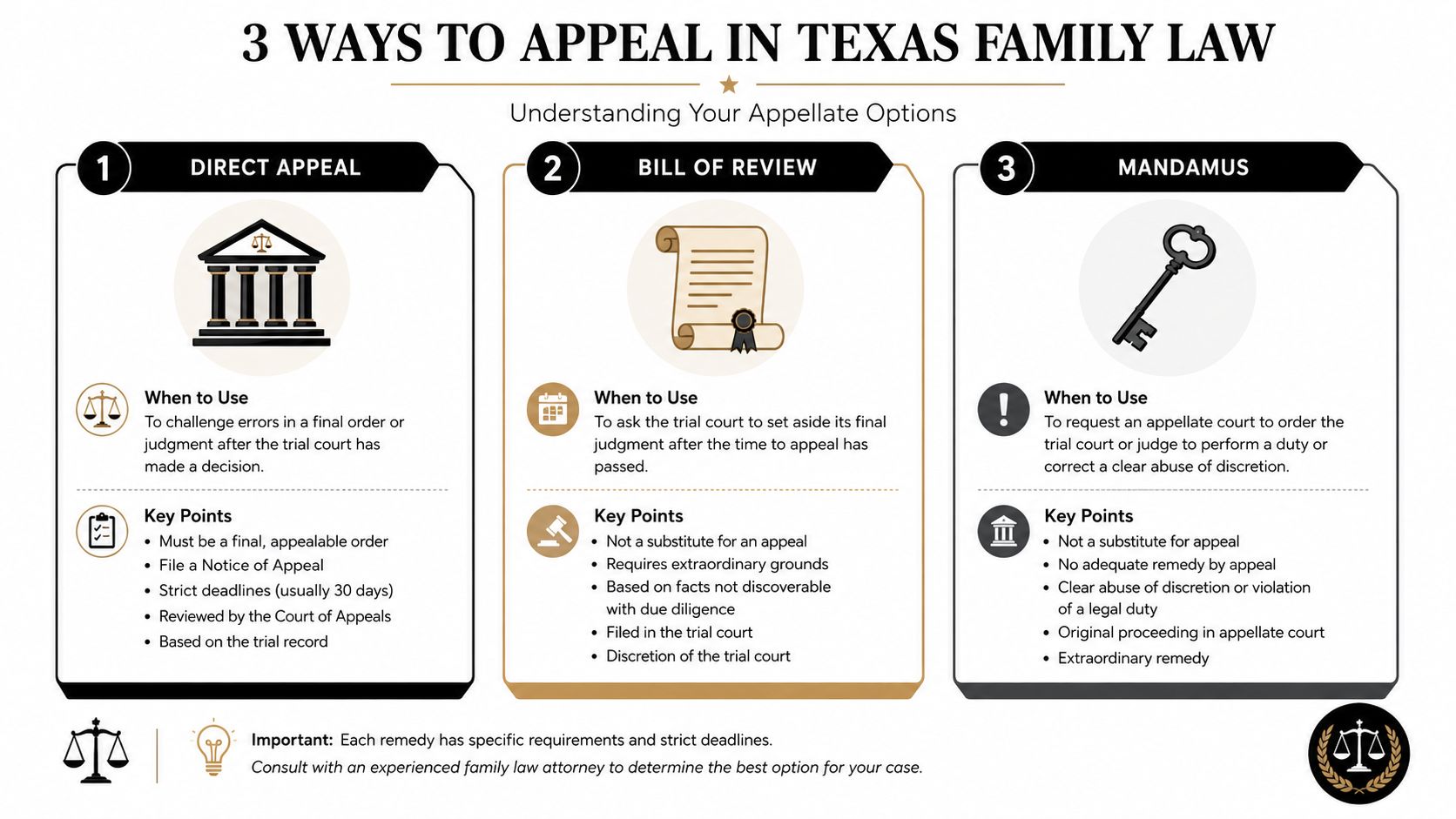
A sanctions order can send a family case in three different directions on appeal. Direct appeal is the usual route for a signed final order. Accelerated appeal applies when the rules or statute place the order on a shorter timetable. Mandamus is the extraordinary path when the order cannot be reviewed in the ordinary way and the harm will not wait.
Direct appeal
A direct appeal is the standard route when the sanctions ruling is folded into a final judgment. Texas family-law appeals follow the civil appellate rules in Chapter 109, and a timely notice of appeal is jurisdictional, so a late notice usually leaves the court of appeals without power to reach the merits (Texas Family Code Chapter 109, timely notice of appeal requirement). If the deadline is missed, the underlying complaint may never get reviewed.
Accelerated appeal
Accelerated appeal is the faster track. The notice deadline is 20 days after the judgment or order is signed. That shorter clock matters when a sanctions ruling falls into a category the rules treat as immediately reviewable, because a lawyer who assumes the ordinary timeline can lose the chance for appellate review.
Mandamus
Mandamus serves a different purpose. It is reserved for orders that are not otherwise appealable and for harms the normal appeal process cannot fix in time, including some discovery sanctions that effectively end the case.
For a practical comparison of which tool fits which family-law problem, see mandamus versus appeal in Texas family law. The right vehicle depends on whether the order can be reviewed now, whether it is subject to accelerated review, or whether only extraordinary relief makes sense.
Meeting the Deadlines That Protect Your Right to Appeal
A sanctions order can feel like the end of the fight, but the appellate clock usually starts the moment the judge signs the order. Deadlines are the hardest part for pro se litigants in Travis County, where the average docketing delay runs 14 days longer than in Harris County. The signed order, not the hearing date or the clerk's stamp, usually controls the timeline.
The ordinary 30-day track
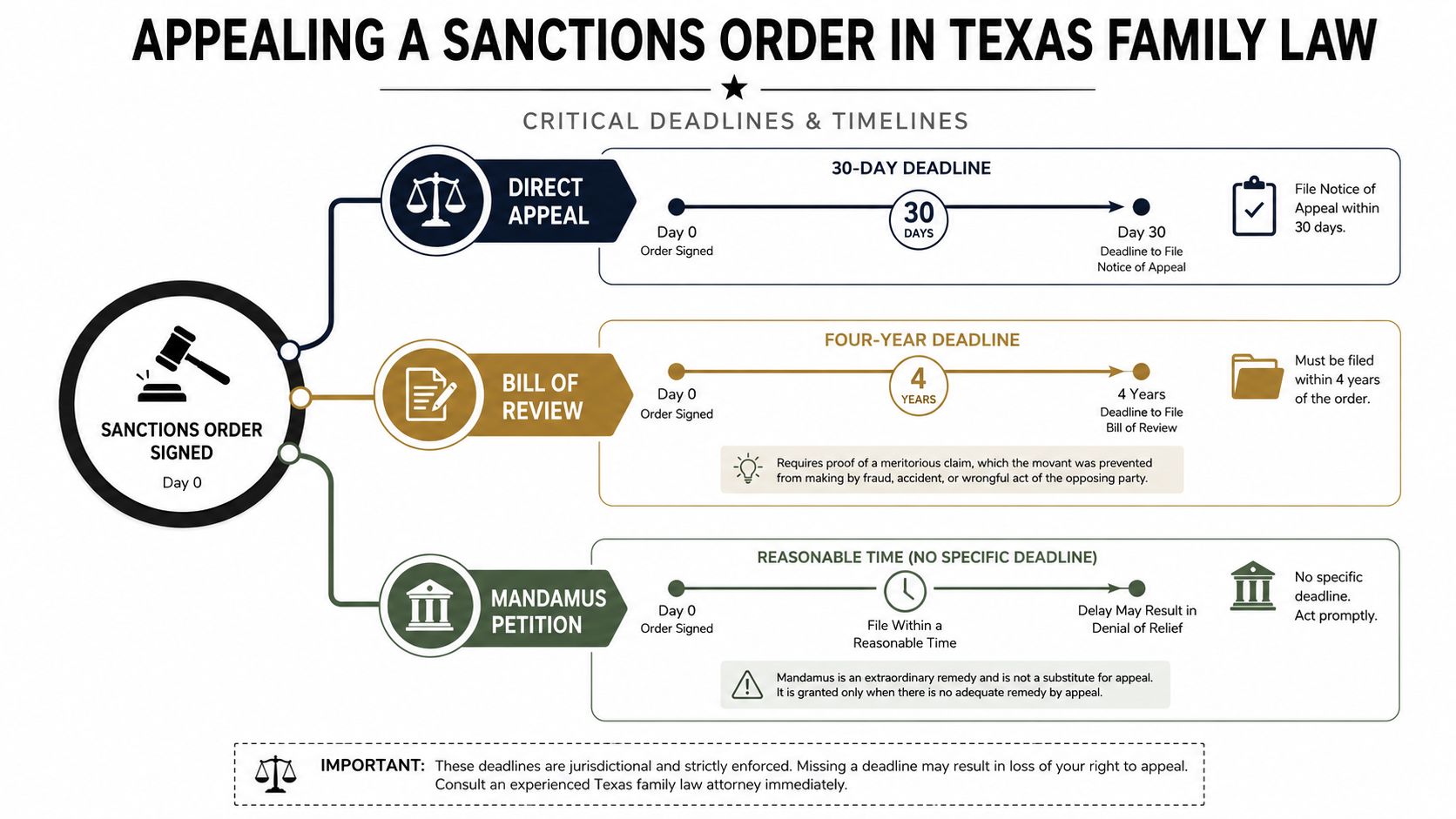
In most Texas family cases, the notice of appeal is due 30 days after the signed written judgment or order. Chapter 109 ties family-law appeals to the civil appellate rules, so the family-court deadline follows the same basic framework (Texas Family Code Chapter 109). A late notice usually ends the appeal before the court ever reaches the merits.
A motion for new trial or reconsideration does not automatically fix a late filing. Treat the signed order as the trigger, then check whether any rule-based extension applies.
Accelerated deadlines
Some sanctions orders fall on an accelerated path, which shortens the notice deadline to 20 days after the order is signed (accelerated timetable). That shorter window is where many family-law appeals go wrong. A party assumes the ordinary schedule applies, then learns too late that the order required faster action.
Rule 306a and the timing trap
If a party did not receive notice of the signed order, Texas Rule 306a may extend the deadlines, but only if the rule is used correctly. The extension is not automatic, and casual knowledge of the order is not enough. Docket sheets, oral comments, and hallway conversations do not replace a signed order and a documented trigger date.
Practical rule: if the order was signed, assume the appellate clock is running unless you have a verified basis to say otherwise.
That is why waiting is risky. Texas appellate courts expect diligence, not guesswork. Calendar the signing date immediately, confirm whether the route is ordinary or accelerated, and file early enough that clerical uncertainty does not turn into a jurisdictional problem.
For a fuller roadmap on the filing window, use this guide on Texas appellate deadlines for notices of appeal. Sanctions appeals are often lost before the first brief is drafted.
Building the Appellate Record Without Leaving Issues Behind
A sanctions appeal rises or falls on the record. If the appellate court can't see what happened, it won't guess. That means the first job is not writing the brief, it's making sure the clerk's record and reporter's record contain the materials that prove the alleged error.
Start with the right record requests
Under Texas record practice, you need to designate the clerk's record and request the reporter's record from every hearing that matters. In a sanctions appeal, that usually includes the hearing where the judge heard evidence or argument, signed the order, or made oral rulings that shaped the written result. If the court held multiple hearings, the safest path is to request every one that could bear on the sanctions decision.
A family-law appellant also needs to think about findings. A Rule 296 request for findings of fact and conclusions of law can force the trial court to explain the reasoning, and a Rule 297 request for additional or corrected findings can sharpen the record when the first findings are incomplete. A Rule 298 reporter's record correction request is the right move when the transcript needs correction. These tools matter because Texas appellate courts do not fill gaps for the appellant.
Choose the transcript format strategically
The reporter's record can be prepared in narrative, question-and-answer, or hybrid form, and the choice affects how usable the record is on appeal. In a sanctions case with a lot of back-and-forth about discovery, billing, or compliance, question-and-answer format usually preserves tone and context better. Narrative format can work in simpler hearings, but it can flatten the exchange in a way that makes abuse-of-discretion review harder to challenge.
If the sanction turns on what the judge heard, the transcript has to show it.
That point gets overlooked when the dispute feels document-driven. A sanctions order may rely on oral testimony, a lawyer's explanation, or an in-court concession that never appears in the written order. If the reporter's record is missing, the appellate court may assume the omitted material supports the ruling.
Don't leave out the quiet documents
Several items are missing in sanctions appeals more often than they should be.
- The signed sanctions order. Without it, the appellate court can't confirm the exact ruling.
- The transcript of the oral ruling or hearing. If the court explained itself on the record, that explanation matters.
- The request for findings. If you want the trial court's reasoning, ask for it.
- The billing records or sealed materials at issue. If fees are part of the sanctions, the underlying support has to be in the record.
For a practical breakdown of record assembly, see this guide on designating and paying for the appellate record. It's the right place to start because a strong argument can't rescue a missing record.
Drafting a Brief That Persuades and Survives Rule 45
A sanctions appeal is usually decided on paper, and the paper has to do real work. The brief should identify the right issue, use the correct standard of review, and show the panel exactly where the trial court went wrong. In Texas family cases, that means writing for judges who are reviewing an order for legal error, not reweighing the dispute from the beginning.
Get the structure right
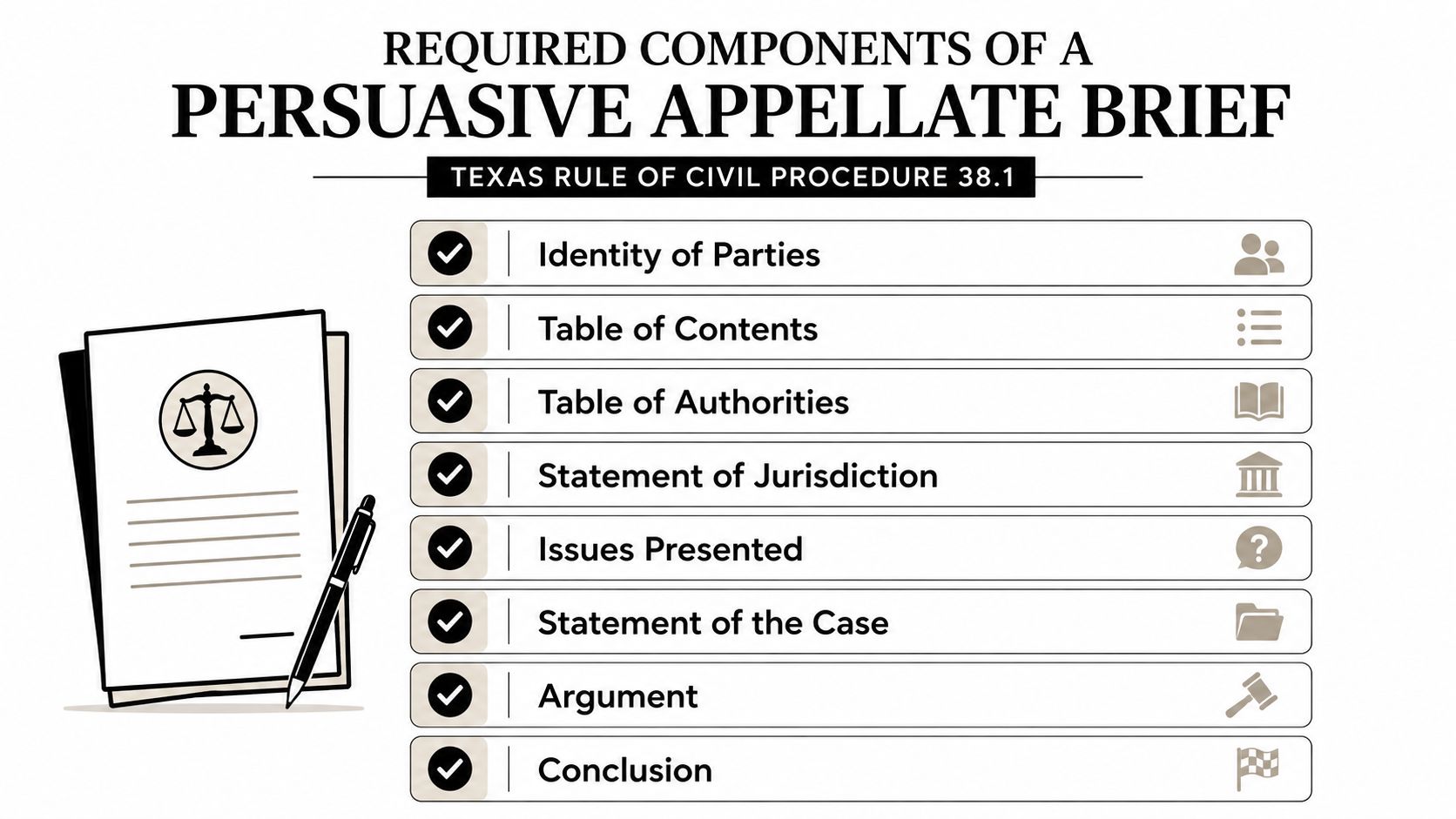
Texas appellate briefing under the civil rules calls for the core pieces in a set order, including the parties, table of contents, jurisdiction, issues presented, facts with record citations, summary, argument, prayer, and service information. Frame the issues as direct questions. A sanctions appeal usually turns on whether the trial court used the right legal framework and whether the record supports the sanction it imposed.
The standard of review usually starts with abuse of discretion. In plain English, the appellate court asks whether the judge acted without reference to guiding rules or principles, not whether the appellate judges would have made the same call from scratch. Texas courts describe many family-law rulings through that lens (Texas standards of review resource).
Match the argument to the kind of sanction
The brief should separate ordinary fee shifting from harsher sanctions. If the sanction is severe enough to function like a death-penalty-style ruling, the argument has to explain why the remedy went beyond the misconduct and whether it stayed tied to the harm. If attorney's fees are at issue, the record has to support the award with more than bare assertions.
Due process matters too. Texas family courts cannot use sanctions to skip over basic notice and a fair chance to be heard, and the trial court's power still depends on the nature of the order and the evidence behind it. That matters when the sanction affects custody, property, support, or the ability to present evidence at trial.
Write for the court, not against the judge
A persuasive brief usually follows a simple drafting discipline.
- Lead with the standard of review. The court wants the lens first.
- Tell the facts in order. Use pinpoint citations, not broad references.
- State one issue per question. Keep each issue clean and self-contained.
- Put authority before argument. The rule or case comes before the facts.
- Tailor the prayer. Ask for the exact relief, not a vague request for fairness.
An appellate court cannot reverse a sanctions order without a record that shows the error. If the record is incomplete, the court has nothing to review. That is why the brief has to rely on actual authority and a complete record, not outrage. Rule 45 also gives Texas appellate courts authority to sanction frivolous appeals, so the brief needs a real legal basis for reversal and a careful explanation of why the trial court's order cannot stand (A list of required components for a persuasive appellate brief according to Texas civil procedure rules.)
Family-Law Strategy and Next Steps for Sanctions Appeals
Sanctions appeals are never just about sanctions. They affect the underlying divorce, custody, support, or protective-order fight, and they can change settlement power while the case is still active. A fee award can pressure a parent or spouse to accept terms they would otherwise challenge, especially when the underlying judgment already divides property or sets conservatorship terms.
Match the strategy to the underlying case
An attorney-fee sanction attached to a property division issue needs a different strategy than a discovery sanction tied to conservatorship or support. The same is true for contempt-based monetary orders, which may require a separate review path because direct appeal often won't work. If the order affects enforcement or coercive compliance, the question is not only whether the trial court erred, but whether the appellate vehicle can even reach the issue.
Supersedeas can matter. If the sanctions award is enforceable while the appeal is pending, you need to ask whether a suspension order is available and what that means for collection efforts. Chapter 109 makes clear that a final order does not automatically suspend just because an appeal is filed (Texas Family Code Chapter 109).
Know when the facts support a reversal argument
Common reversible errors in Texas family courts include using the wrong legal standard, misapplying the standard of review, basing a ruling on an incomplete record, imposing sanctions that aren't tied to the misconduct, and entering contempt findings that should have been reviewed another way. Those mistakes don't look dramatic in the moment, but they matter on appeal because appellate judges focus on whether the trial court followed guiding rules and whether the record supports the result.
If you're deciding whether to challenge a sanctions order, timing and record control the odds. By the time briefing starts, most of the strategic choices are already locked in.
The abuse of discretion standard remains the centerpiece of many family-law appeals, and that's why the appeal has to be built around the record, the order, and the specific procedural vehicle. Sanctions issues that feel broad at the trial level become narrow on appeal, which is exactly why precision matters.
The best appellate position is usually the one that preserves options early, before the trial court's order hardens into a jurisdiction problem.
If your order is on the final track, the next step is to calendar the notice deadline and secure the record. If it may be accelerated or contempt-related, the next step is to identify the correct review vehicle before the window closes. Either way, the appeal needs appellate counsel before the brief is drafted, not after the deadline is gone.
If you believe the court made a mistake in your family law case, our appellate attorneys can help you seek a fair outcome. Contact The Law Office of Bryan Fagan today for a free consultation.