Skip to content
You may feel like the judge's order closed the door on your family case before you ever had a fair chance to be heard. If you're a parent staring at a custody loss, a property division you can't accept, or a termination order that feels devastating, the next step is usually not a new trial. It's a careful appeal strategy built around what the record preserves.
In Texas family appeals, the statement of points on appeal is one of the first places where that strategy either takes shape or falls apart. It is not a full brief, and it is not a second chance to re-argue everything. It is a focused list of the complaints you want the appellate court to review, and in some family cases, it has historically been the gatekeeper for whether those complaints could even be considered later Texas appellate opinion on preservation in termination appeals.
What a Statement of Points on Appeal Means in Texas
A statement of points on appeal is a short written list of the legal errors you want the appellate court to review. It identifies the issues you preserved, so the rest of the appeal can be built around them.
In practical terms, this filing tells the court, “These are the rulings I'm challenging, and these are the complaints I'm not waiving.” That matters because family-law appeals are not open-ended replays of the case. The court reviews the record, not live testimony, and it looks for reversible error in specific rulings, findings, or procedural steps.
Why it exists at all
Texas appellate practice is issue-driven. If an issue was never preserved in the trial court, it is usually lost on appeal. The statement of points sits inside that preservation structure, especially in family cases where the law historically required appellants to identify complaints early rather than save them for a later brief Texas preservation and statement-of-points analysis.
Practical rule: if you cannot say exactly what went wrong, where it happened, and why it matters, the appellate court probably cannot use it.
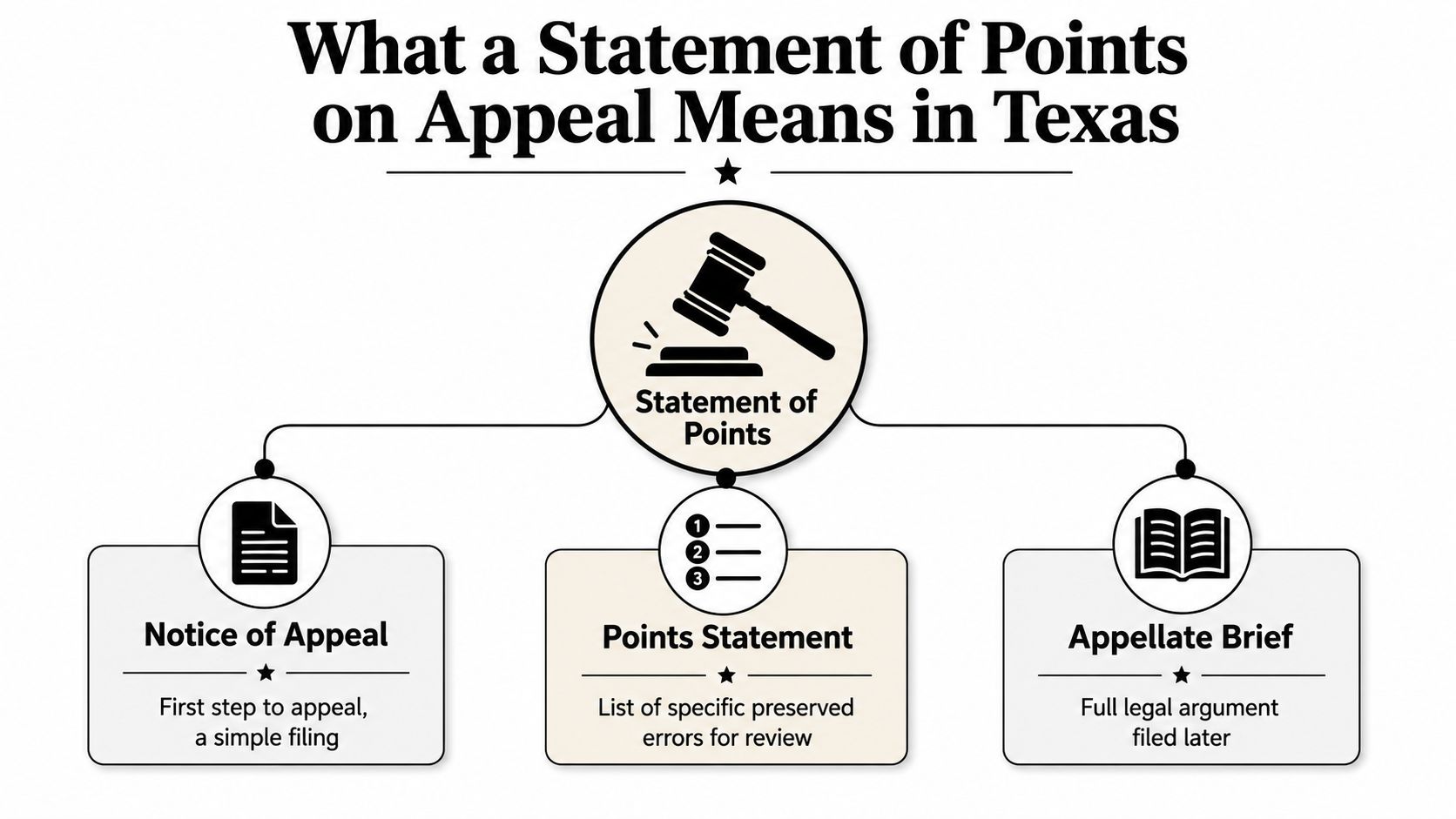
A parent who just received an adverse custody or property order often wants to know whether the appeal starts with a notice, a points statement, or a full brief. Each document has a different role. The notice of appeal starts the case, the statement of points preserves the complaints, and the brief argues why the trial court's ruling should be reversed or modified.

For a fuller look at the rules that control these filings, Texas Rules of Appellate Procedure for Family Law Appeals explains how the deadlines and preservation requirements fit together.
When and Why the Points Statement Is Required
A parent who has just received an adverse custody or property order often learns quickly that the appellate clock does not wait for the full brief. In Texas family cases, the points statement has historically served as the early preservation filter, the place where you identify the complaints you want the appellate court to review. In termination cases, Texas materials explain that the statement had to be filed within 15 days after the decree was signed, and courts treated that filing as a statutory prerequisite for preserving issues, even though it was not jurisdictional because jurisdiction came from the notice of appeal Texas family termination preservation opinion.
That distinction matters in practice. If the statement is late or missing, the appeal may still exist, but specific complaints can be lost before briefing ever begins. The notice of appeal remains a separate filing, and the deadline for that filing needs attention on its own. For a practical overview of the notice timeline, the guide on The Notice of Appeal Deadline in Texas Family Cases is a useful companion piece.
The timeline that controls your next move
The filing sequence is simple. The strategy is not.
- Notice of appeal first. This starts the appellate process.
- Points statement next. In historically covered family cases, the specific complaints are preserved here.
- Brief later. The brief develops the preserved points into legal argument.
Texas appellate materials note that the notice of appeal is generally due within 30 days after judgment, subject to extension by post-judgment motions Texas appellate deadline and record guidance. That deadline shapes the rest of the appeal, because it tells you how little time may be left to identify every reversible-error theory before briefing starts. Filing the notice on day 29 leaves only one day to draft the points statement, forcing a rushed preservation list. For current procedural guidance tied to family-law appeals, see Texas Rules of Appellate Procedure for Family Law Cases.
That is why the points statement deserves early attention, not afterthought status. It forces counsel to decide which complaints are preserved, which ones need record support, and which theories are too weak to carry forward. A narrow, careful list can protect the appeal. A vague list can leave the court with nothing usable.
A Texas appellate briefing guide also explains that the brief's statement of facts should be concise, record-based, and separate from argument Texas appellate briefing guide. The same discipline begins with the points statement. If the issue is framed too broadly, the appeal becomes unfocused. If it is framed too narrowly, a complaint that should have been preserved may be left out entirely.
Building Your Points From the Record
The strongest points statements don't start with frustration. They start with the record. In practice, that means pulling the clerk's record and reporter's record, then matching each complaint to a real ruling, objection, motion, or finding.
A workable framework
The cleanest method is to map each issue to three things:
- The ruling you're challenging.
- The legal standard that controls that ruling.
- The record pages that show the problem and any harm.
That approach keeps the appeal grounded in what the trial court did. It also helps you separate an unfavorable ruling from a reversible one. A parent may dislike the result of a custody hearing, but the appellate issue has to be tied to an error the court made, not just a result that feels unfair.
Appellate judges read a paper record. They don't hear the tone, pauses, or emotions from the courtroom, so the record citations do the heavy lifting.
A common mistake is to draft a points statement that sounds like general dissatisfaction, such as “the court got it wrong on custody” or “the property division was unfair.” Those phrases don't tell the court what legal error to look for. A better point is short, specific, and tied to a preserved complaint.
For a deeper refresher on how appellate facts should be presented, the family-law writing guide on how to write a statement of facts is helpful because it reinforces the same record-first mindset used in issue framing.
What this looks like in practice
Suppose a parent wants to challenge a custody modification. A workable point statement might identify that the trial court erred by modifying conservatorship without sufficient evidence of a material and substantial change in circumstances, or by entering a ruling after excluding a preserved line of evidence. The point is not the full argument. It is the label that tells the appellate court what issue will later be developed in the brief.
A strong point statement often reads like a checklist of reversible-error theories, not a narrative. That is the point. It forces you to decide early whether each complaint is preserved and whether the record supports it.
Drafting the Statement With Model Language
Texas briefing rules historically required points to be stated in short form and without argument, and concise enough to fit on a single page in older practice. That drafting style still tells you what the court expects, even if modern briefing is more structured. The point is not to persuade in full. The point is to preserve and identify.
A sample family-law point statement
Here is the kind of language a Texas appellate lawyer might use in a custody-modification appeal:
- The trial court abused its discretion by modifying conservatorship because the evidence was legally and factually insufficient to prove a material and substantial change in circumstances.
- The trial court erred by excluding preserved evidence relevant to the child's best interest.
- The trial court's possession schedule is unsupported by the record and should be reversed or modified.
That format works because each point is separately numbered, concise, and tied to a potential appellate theory. It also leaves room for the later brief to explain the governing law, the record citations, and why the error mattered.
Captioning and filing basics
The document should be captioned with the trial court information, the case style, and the appeal reference so the clerk and court can connect it to the right case. In modern Texas appellate practice, the overall brief structure includes the identity of parties and counsel, table of contents, statement of the case, issues presented, statement of facts, summary of the argument, argument, prayer, and appendix Texas appellate brief requirements.
The point statement needs to line up with that later structure. If you preserve an issue in the statement of points, the brief should track it. If the brief tries to raise a brand-new issue, the court may treat it as waived.
For a practical example of how appeals are organized in this area, the firm's overview of Texas Family Law Appeals Lawyer can help frame the difference between issue spotting and full appellate advocacy.
Common Pitfalls and Preservation Strategies
A parent can have a real complaint and still lose review if the statement of points on appeal does not preserve the issue with enough precision. Texas family appeals turn on triage. The lawyer has to decide, early, which rulings are preserved, which ones can support reversal, and which ones should be left out because they only clutter the briefing strategy.
The traps that cost review
The first trap is raising a complaint for the first time on appeal. Texas appellate practice generally requires preservation in the trial court through an objection, motion, request, or offer of proof. A statement of points on appeal cannot bring back an issue that was never made part of the record.
The second trap is vague drafting. A point that says the court was unfair, or that the result was wrong, does not tell the court what happened. The complaint has to identify the legal problem, such as an evidentiary ruling, a findings issue, a misapplied standard, or a due-process complaint.
The third trap is loading the statement with every grievance from the hearing. A long list of complaints can bury the stronger issues and make it harder to see what is preserved. Separate, tightly written points help the appellate court and keep the later brief focused on the theories that still have a path to relief.
The fourth trap is failing to tie the point to the record. If the objection, motion, or ruling cannot be matched to a clerk's record entry or a reporter's record page, the court may not be able to test error or harm. That is why early record triage matters. The appeal has to be built from the pages that show what was said, what the judge ruled, and what the lawyer preserved.
Use the reporter's record index to confirm that every page you cite really contains the objection or ruling you are relying on. If the index does not support the citation, the point needs to be fixed before briefing, not explained away later.
Preservation habit: if it mattered in the trial court, make sure it appears in the record, then make sure it appears in the points statement.
A practical guide on preserving error for appeal in Texas family court is useful here because it keeps the focus on what must be preserved before the argument is written.
A practical checklist
- Check the deadline early. Wait too long, and the appeal may already be narrowing itself before you choose the issues.
- Match each point to a preservation event. Link it to the objection, motion, request, offer of proof, or ruling that created the record.
- Use short labels. State the error plainly, not the entire theory behind it.
- Verify the record citations. Confirm the cited pages show the exact objection or ruling you are describing.
- Leave out emotional complaints. Keep only the issues that can support reversal or modification under Texas appellate standards.
That discipline keeps the statement of points useful as a filter, not just a list of frustrations.
Responding and Supplementing as an Appellee
If you're defending the trial court's order, the points statement is your roadmap too. The fastest response is to test whether each point was preserved, whether it matches the record, and whether it asks for reversible relief. Weak points often reveal themselves before briefing is even complete.
How the appellee should respond
An appellee can frame the response in a few practical ways. Some points can be answered by showing that no timely objection was made. Others can be defeated by pointing to the record, which may show the trial court's ruling was supported by evidence or by the governing legal standard. If the appellant misstates the record, the appellee's brief should correct that with page citations and authority.
The appellee's brief must also follow the record-based rules. Texas appellate briefing requires argument supported by record references and legal authority, and the appendix should include the judgment or order, plus findings of fact and conclusions of law if they exist Texas Rule 38.1 briefing requirements.
That is one reason appeals are so different from trials. The trial court decides facts in real time. The appellate court decides whether the law was applied correctly to a preserved record.
Where supplementation fits
Sometimes the appellee may need to rely on findings or clarify the record through the existing appellate process. The key is not to create new evidence, but to use the materials the rules allow so the judgment is defended as written. In family cases, that often means showing why the order should be affirmed even if the appellant's version of events sounds persuasive in the abstract.
If the appellant's point is broad, the appellee's advantage is specificity. The record usually decides the argument.
There are times when a parent or former spouse needs defense counsel to explain why the trial court's decision should stand, and there are times when the same person needs a fresh review of whether the order can be challenged at all. If you're evaluating those options, a Texas family-law appellate team, including The Law Office of Bryan Fagan, PLLC, can review the preserved issues and the appellate record, then map the response to the actual procedural posture.
Key Takeaways and Next Steps for Your Appeal
The statement of points on appeal is not paperwork for its own sake. It is the early filter that shapes the whole case. In Texas family appeals, that means the deadline, the wording, and the record references all matter because the appellate court will only review issues that were preserved and properly framed.
Keep four ideas in mind. First, the notice of appeal starts the process, but it does not preserve every complaint. Second, the points statement should be short, numbered, and specific. Third, the brief has to track the preserved issues and cite the record. Fourth, broad frustration is not the same thing as a reversible error.
If you believe the court made a mistake in your family law case, our appellate attorneys can help you seek a fair outcome. Contact The Law Office of Bryan Fagan today for a free consultation.
If you believe the court made a mistake in your family law case, our appellate attorneys can help you seek a fair outcome. Contact The Law Office of Bryan Fagan today for a free consultation.