Skip to content
You may feel like the judge got it wrong, and maybe the order on custody, support, or property division just doesn't match what happened in court. That frustration is real, but Texas law does give you two different paths, and picking the wrong one wastes time you may not have. One path asks the trial court to change the order because life has changed. The other asks a higher court to review the order because the judge made a legal mistake.
The hard part is that these remedies are not interchangeable, and Texas parents often need to think about both at once. A modification can fit a new set of facts. An appeal can attack the original ruling. In some cases, both are available, especially when a custody dispute keeps moving while the appeal is still pending.
| Feature | Modification | Appeal |
|---|---|---|
| Who hears it | Trial court | Appellate court |
| Main question | Have circumstances materially and substantially changed? | Did the judge make legal or procedural error? |
| What gets reviewed | New facts since the order | The existing trial record |
| Typical result | New or changed order | Affirmance, reversal, or remand |
| Key Texas focus | Best interest of the child in custody cases | Abuse of discretion or reversible error |
When a Texas Family Court Order Does Not Feel Right
A mother leaves court with a custody order she never expected. A father reads a support order and knows the numbers came from an argument that the judge accepted without giving enough weight to the records. A divorced spouse sees a property division that feels lopsided and wants someone to explain how that happened. That is the moment people start asking the same question, do I modify this order or appeal it?
The answer depends on what went wrong. If the judge ruled on the facts that existed at trial, and you believe the legal call was wrong, an appeal is the path that tests that ruling. If life changed after the order, a modification may be the proper route because Texas family law lets the court revisit certain orders when the circumstances have materially and substantially changed.
Two paths, two very different purposes
A modification looks forward. It asks the trial court to adjust an existing order because the child's needs, a parent's situation, or another relevant fact has changed in a meaningful way. An appeal looks backward. It asks a higher court to examine the record and decide whether the trial court made a reversible legal or procedural mistake.
That distinction matters because the relief is different. A successful modification can produce a new order. A successful appeal can undo or send back the old one for more work. In Texas, the right move turns on what happened, when it happened, and whether the problem is a changed circumstance or a legal error.
The worst mistake is treating every bad order like an appeal issue. Sometimes the fastest path is a modification, sometimes it is an appeal, and sometimes both need to be evaluated together.
Texas family courts provide structured remedies for exactly this kind of dispute. The law does not promise a perfect result, but it does give you a clear way to challenge unfairness, correct mistakes, and protect a child's best interests when the facts support it.
What Modification and Appeal Actually Mean in Texas
Modification means asking the trial court to change an existing family order because the facts have changed enough to justify a new ruling. In Texas, that usually means a material and substantial change in circumstances, and for custody or visitation the court still has to find that the requested change serves the child's best interest. TexasLawHelp explains that the threshold can be met in limited situations like parental agreement, a child at least 12 years old expressing a preference in chambers, or a primary custodian voluntarily allowing another person to provide primary care for at least 6 months. It also notes that in many cases, parents must wait at least 1 year before seeking a primary-custody modification unless an exception applies. The TexasLawHelp summary is here: material and substantial changes in circumstances for custody modification suits.
Appeal means asking a higher court to review the trial record for legal or procedural error. It is not a do-over, and it is not a second trial. The appellate court looks at the record that already exists, asks whether the judge abused discretion or made another reversible mistake, and then decides whether the order should stand, be reversed, or be sent back. For a plain-English overview of that distinction, see Texas Family Law Appeals Lawyer, which focuses on appellate representation challenging final family law orders for legal error.
Modification vs Appeal at a glance
| Feature | Modification | Appeal |
|---|---|---|
| Core question | Did circumstances materially and substantially change? | Did the trial court commit reversible legal or procedural error? |
| Decision maker | Trial judge | Appellate judges |
| Evidence used | New facts after the order | The existing trial record |
| Typical family-law focus | Child custody, visitation, support | Custody, support, property division, protective orders, contempt judgments |
| Legal lens | Best interest and changed conditions | Abuse of discretion and reversible error |
The practical difference is simple. A modification asks the court to adjust the order to today's facts. An appeal asks a higher court to fix the order that was already signed.
The Legal Standards That Decide Each Case
Texas courts do not use the same test for every request. A modification lives or dies on the material and substantial change standard. An appeal lives or dies on the abuse of discretion and reversible error standards.
What the trial court looks for in a modification
For custody and visitation, the court does not just ask whether something changed. It asks whether the change is meaningful enough to justify altering the order, and whether the new arrangement serves the child's best interest. Texas law and TexasLawHelp recognize that the analysis can include an agreement between parents, a child age 12 or older expressing a preference in chambers, or a custodian allowing another person to provide primary care for at least 6 months. Those examples matter because they show how Texas treats stability as the default, change as the exception.
The word best interest is the anchor. In practice, that means the court is focused on the child's safety, routine, schooling, and overall well-being, not just which parent is angrier or more persuasive.
What the appellate court looks for in an appeal
An appeal is narrower. The appellate court reviews the record and asks whether the judge made a legal mistake that mattered. The standard is abuse of discretion, which means the ruling stands unless it was arbitrary, unreasonable, or outside guiding legal principles. Texas appellate courts do not reweigh the evidence or decide who they personally believe more.
Practical rule: if your complaint is about how the judge weighed evidence, appeal may be difficult. If your complaint is about a legal rule being applied incorrectly, the appellate path deserves serious attention.
That's why standards of review often decide the case before briefing even starts. A strong argument can still fail if it is aimed at the wrong standard.
Deadlines and Final-Judgment Rules You Cannot Miss
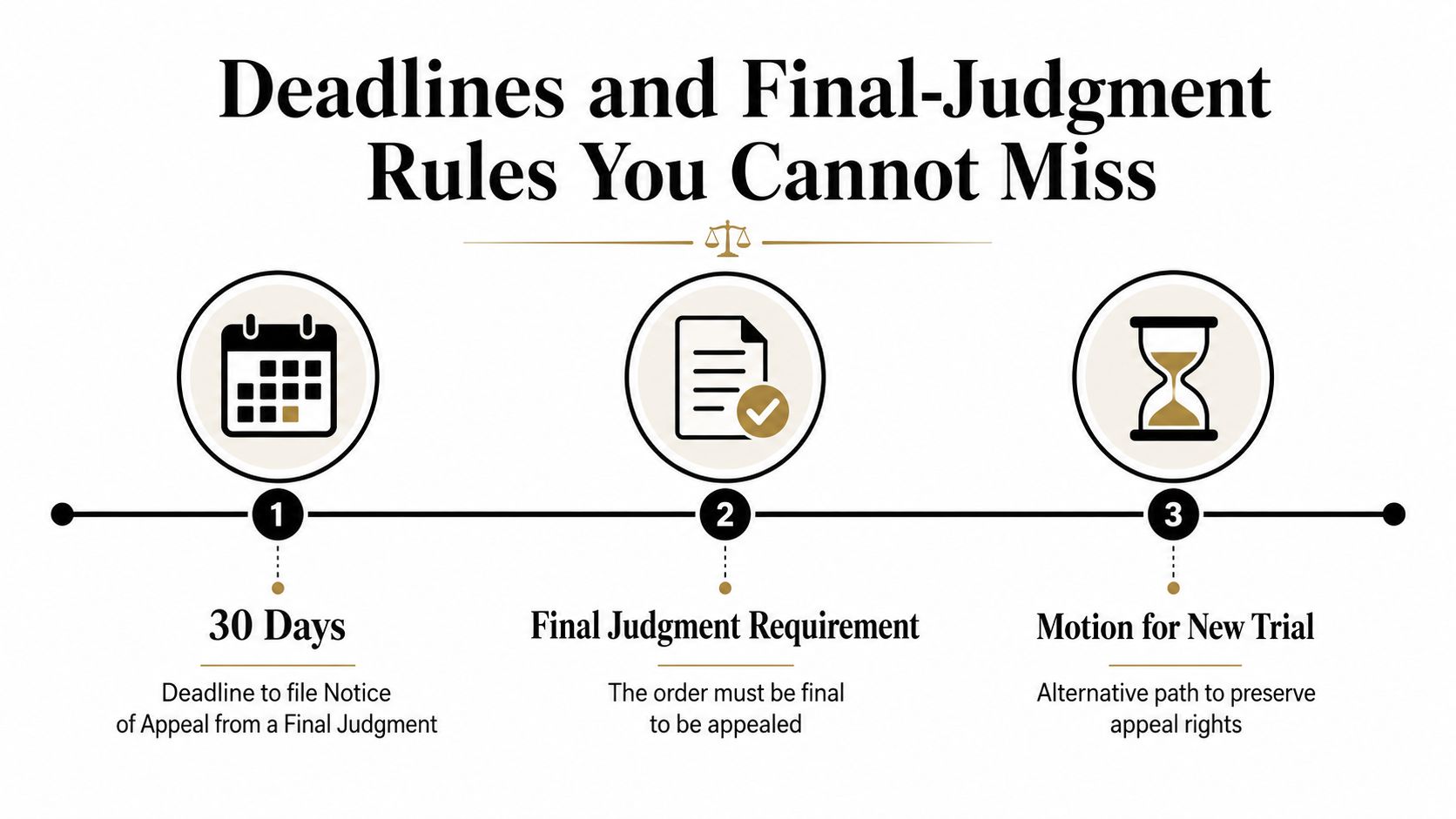
A Texas family appeal lives or dies on timing. A notice of appeal is generally due within 30 days after the judge signs the final order, and appellate review usually reaches final judgments, not temporary or interim rulings. Texas Family Code § 105.001(e) says temporary orders entered before a final order are not subject to interlocutory appeal, and the order normally stays in force unless a court stays it or changes it. For the timing benchmark, see the deadline for filing a notice of appeal in Texas.
Do not file first and ask questions later. Identify whether the order is appealable before you spend your deadline window. If the order is temporary, ordinary appeal is usually the wrong vehicle. If the order is final, the clock starts the day the judge signs it.
The modification side has its own timetable. TexasLawHelp explains that many primary-custody modification requests must wait at least 1 year unless an exception applies. That rule protects stability and stops parents from relitigating custody every time the conflict heats up. Texas also allows some modification paths when the parties agree or when the facts fit one of the limited exceptions described earlier.
A parent who misses the appeal deadline can lose the right to appellate review even if the complaint has real merit. For a deeper procedural overview, review appeal deadlines in Texas family law.
The practical rule is simple. If you want appellate review of a final order, act immediately. If the facts have changed and you need a different order, the modification timeline may be the better fit.
Can You Modify and Appeal at the Same Time
Many parents get stuck at this juncture, and it is also where Texas law gets more practical than most summaries admit. A trial court can consider a custody modification during an appeal if the movant proves a material and substantial change in circumstances after the original order or mediated settlement agreement. That means the remedies are not always mutually exclusive, even though many explainers present them that way. The jurisdictional overlap is real, and it matters in high-conflict custody cases where the child's life keeps changing while the appeal is still pending.
The appeal still does its own job. The appellate court reviews the existing record for error. The trial court, meanwhile, can hear a new request if the facts since the order justify it. The new case cannot reargue the same points already decided, so the evidence has to be new.
Bottom line: a pending appeal does not automatically freeze every custody issue forever. If the facts changed after the order, the trial court may still have work to do.
That overlap creates a deadline mismatch problem. If the appeal window has passed, a modification may be the only realistic option. If a parent is dealing with open child-support issues, the administrative process can also matter, and recent guidance warns that a modification request in that setting should be filed only once. For readers comparing appeal timing with post-judgment relief, appeal vs motion for new trial in Texas family law is a useful companion topic.
The strategic answer is not to guess. It is to map the facts onto the right forum. If the complaint is about what the judge already decided, appeal. If the child's situation changed after the order, modification may still be available while the appeal is pending.
Three Real Scenarios That Show the Right Path Forward
A parent loses a custody modification hearing and wants the appellate court to fix the judge's reasoning. That is an appeal question, not a fresh modification question, because the parent is challenging the trial court's handling of the evidence already presented. If the complaint is that the judge misapplied the law or ignored the proper framework, the appellate record is what matters.
A second parent misses the appeal deadline, then learns the child's school, care needs, or living situation has changed enough that the current order no longer works. That parent should focus on modification, not try to force a late appeal. Texas law gives the trial court room to act when the facts have materially changed, and the child's best interest becomes the center of the dispute.
A third parent wants to attack an unfair property division and also needs relief on a support issue that keeps affecting the monthly budget. That situation often calls for a mixed strategy. The property division challenge belongs in the appellate lane if the order is final and the deadline is still open, while the support issue may require a separate modification or enforcement analysis.
The key decision points
- Challenge to what already happened: appeal.
- New facts after the order: modification.
- Both present at once: evaluate both paths immediately, because the deadlines and forums are different.
If your case feels split like that, it usually is. Treat each issue separately, or you may lose the better remedy while chasing the wrong one.
Step-by-Step Procedural Roadmap for Each Remedy
An appeal starts with the record. You file the notice of appeal, designate the reporter's record, and make sure the clerk's record contains the right filings and orders. Then comes the appellant's brief, followed by the appellee's response, and then a reply brief if needed. Oral argument may happen in some cases, but many appeals are decided on the papers.
A modification follows a different track. You file the petition to modify, serve the other party, and then prove the changed circumstances at hearing. Discovery may be necessary, mediation often helps narrow the fight, and the court can then enter a new order if the evidence supports it.
There are preservation rules that matter on appeal. Most complaints need a timely objection in the trial court, because appellate judges generally do not rescue issues that were never raised. Common reversible errors in Texas family court include misapplying the best-interest standard, excluding evidence that should have been heard, or failing to apply the correct statutory framework to the facts.
A practical appellate team also watches the record for issues tied to protective orders, child support calculations, and property division. Those are areas where a trial judge's legal mistake can have lasting consequences.
If you need a place to start, the firm's resource on modification to custody order is a helpful companion to the appellate process. The right filing depends on whether you are changing the order or attacking the legal ruling behind it.
Choosing the Right Path and Taking the Next Step
Use this rule first. If the trial court made a legal mistake in a final order, appeal. If your circumstances materially changed after the order, seek modification. If both issues are alive, you may need a combined strategy that protects the deadline while you pursue the new facts.
A few quick answers usually help. Can a temporary order be appealed? Generally no, because Texas Family Code § 105.001(e) bars interlocutory appeal of temporary orders before final judgment. How long does an appeal take in Texas? That depends on the record, briefing, and whether oral argument is set, so the timeline is case-specific. Does an appeal stop enforcement? Not automatically, because the order normally stays in effect unless a court stays it or changes it. How do you preserve issues for review? By making timely objections and building a clean record at the trial level.
The smartest next move is to get a lawyer to sort the remedy before the deadline closes. A consultation can tell you whether your complaint belongs in an appeal, a modification, or both. That decision can save months of unnecessary motion practice and put the focus back where it belongs, on fairness, due process, and your child's best interests.
If you believe the court made a mistake in your family law case, our appellate attorneys can help you seek a fair outcome. Contact The Law Office of Bryan Fagan today for a free consultation.