You may feel your Texas family law case was handled unfairly, only to receive a notice that the other side has appealed. Maybe the trial court awarded custody, divided property, ordered support, or entered a protective order in your favor. Now you're worried that the appellate court will reopen everything and take away the result you fought to obtain.
An appeal isn't a new trial. The appellate court reviews the existing record for legal error, procedural error, or an abuse of discretion. Your job as the person defending the judgment is to protect that record, identify defects in the appellant's arguments, and show why the trial court's decision should remain in place.
You Just Got Served With an Appeal: What to Do Next
A parent in a custody dispute receives a notice of appeal soon after the final decree. The parent feels blindsided. Testimony has ended, the judge has ruled, and the family expected to focus on enforcement or compliance. Instead, the dispute has moved to an appellate court that will not hear new witnesses or consider evidence that was never presented to the trial court.
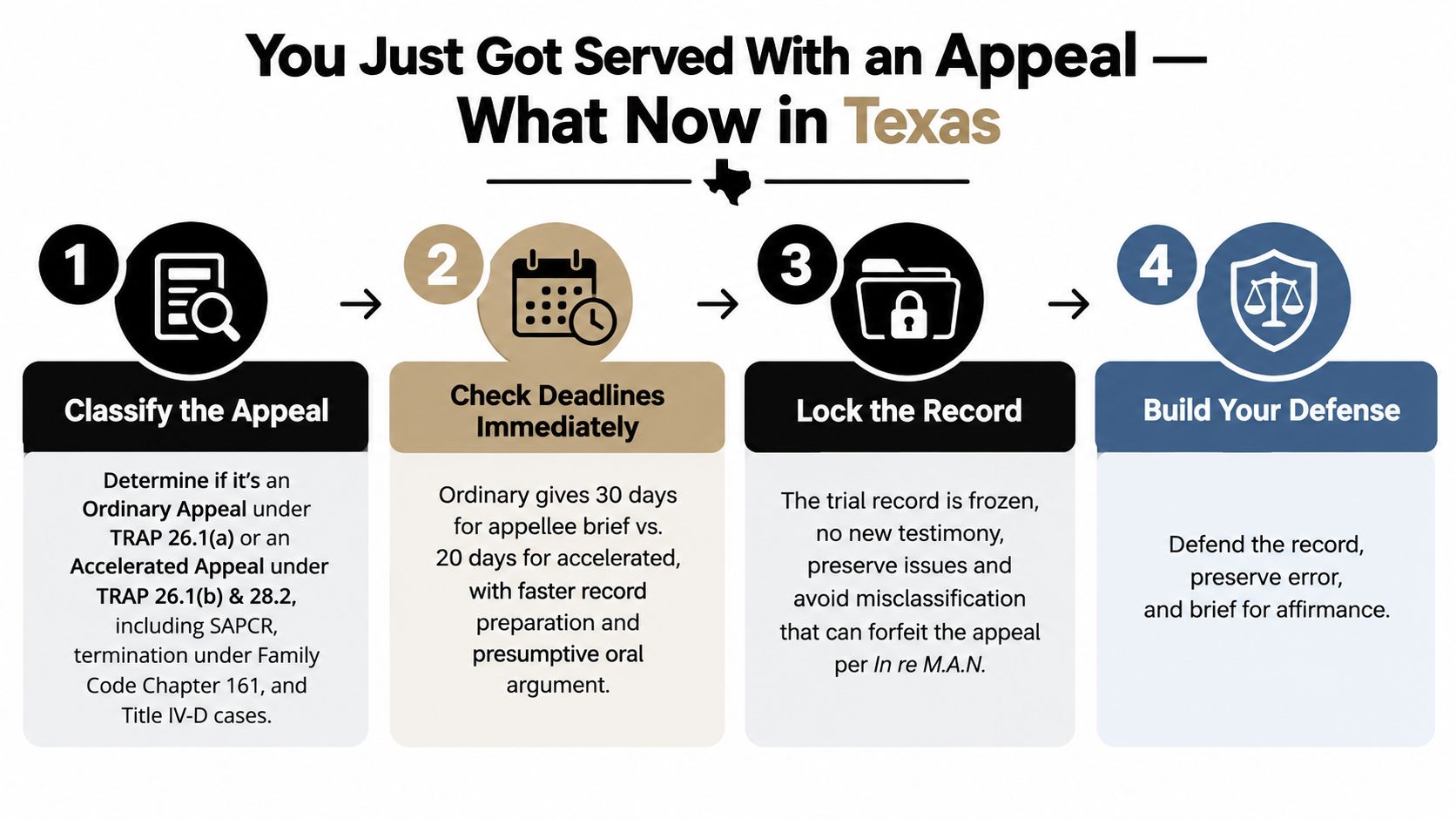
Respond with discipline, not panic. The first strategic move is to classify the appeal as ordinary or accelerated, then build the defense around the existing record.
At trial, your attorney could question witnesses, offer exhibits, answer objections, and ask the judge to correct mistakes immediately. On appeal, the written record controls. The justices generally review the clerk's record and reporter's record, rather than later explanations from the parties about what happened in court.
The first appellate decision is classification, not argument. Determine whether the case is ordinary or accelerated before relying on a briefing deadline.
Classify the appeal before defending it
Texas Rule of Appellate Procedure 26.1(a) generally governs ordinary appeals. The notice of appeal is usually due 30 days after the final judgment or order is signed. A timely post-judgment motion can extend that period to 90 days. Accelerated appeals fall under Rule 26.1(b), with additional procedures under Rule 28.2, and commonly require the notice of appeal within 20 days.
These deadlines can affect the appellate court's jurisdiction. A wrong classification may therefore threaten the appeal itself. Review the signed order, notice of appeal, docket sheet, and any post-judgment motions together. The label placed on an order does not by itself settle the legal analysis. The Texas Rules of Appellate Procedure address these filing requirements and the consequences of an untimely appeal, including issues discussed in the In re M.A.N. line of cases.
Family-law matters that may receive accelerated treatment include final orders in a suit affecting the parent-child relationship, or SAPCR, termination-of-parental-rights cases under Chapter 161 of the Texas Family Code, and certain Title IV-D enforcement matters. Classification also determines the time available to answer the appellant's brief. An appellee's brief is generally due 30 days after the appellant's brief, but the period is 20 days in an accelerated appeal. If the appellant does not file a brief, the appellee may still file one within 30 days after the appellant's briefing deadline passed. A reply brief, if needed, is due 20 days after the appellee's brief.
Ordinary vs Accelerated Appeal at a Glance
| Feature | Ordinary Appeal | Accelerated Appeal |
|---|---|---|
| Notice of appeal | Usually 30 days after signing, subject to applicable extensions | Typically 20 days after signing |
| Appellee's brief | Generally 30 days after appellant's brief | Generally 20 days after appellant's brief |
| Family-law examples | Many ordinary final orders | SAPCR orders, termination matters, and certain Title IV-D matters |
| Oral argument | Governed by the court's procedures | Presumptively granted under the accelerated framework |
| Main concern | Full record and briefing preparation | Compressed record and briefing schedule |
The practical difference is substantial. An accelerated appeal demands faster record preparation and briefing, and oral argument is presumptively granted under the applicable rules. In parental-termination cases, the shorter schedule reflects the need for prompt review of a child's legal relationship with a parent.
Do not wait passively for the appellant's brief. Review what an appellee is in a Texas appeal and begin identifying record support, preservation problems, and weaknesses in the appellant's requested relief. Your response should center on classifying the appeal, defending the record, and briefing for affirmance.
Your First Thirty Days of Defensive Moves
Start by confirming the appellate court has jurisdiction. Determine whether the order is final or whether the appellant is relying on a properly perfected interlocutory appeal, including an appeal authorized by Section 51.014 of the Texas Civil Practice and Remedies Code. Review the signed order, notice of appeal, docket sheet, and any post-judgment motions together. Don't assume that a document labeled “final” or “interlocutory” controls the legal analysis.
Secure the record early. Under the Texas appellate rules, the clerk's record and reporter's record supply the material the appellate court can review. Confirm that the clerk's record includes pleadings, motions, orders, findings, admitted exhibits, and the final judgment. Request the reporter's record for every hearing that bears on the issues, and address the required cost deposit and the court reporter's response process. Rule 34 concerns the appellate record, while Rule 35 addresses preparation and filing of the reporter's record.
Then perform a preservation check. Read the transcript for objections, motions, rulings, offers of proof, and requested findings. If the appellant complains about excluded evidence but never made an offer of proof, that issue may be difficult or impossible to review. If the appellant remained silent when the trial court made a ruling, the lack of a timely, specific objection may defeat the complaint regardless of its underlying merit.
The appellate record, including clerk's and reporter's records determines what the appeals court can consider. Treat record collection as defensive work, not administrative cleanup.
Building the Record That Wins the Appeal
The appellate record is the entire battlefield. The clerk's record contains filed documents and orders. The reporter's record contains the transcribed proceedings when a court reporter recorded them. Together, they provide the foundation for defending a custody ruling, property division, support order, enforcement judgment, or protective order.
Review the clerk's record against the appellant's issues. Look for missing findings of fact, omitted motions, absent exhibits, and orders that explain the trial court's reasoning. Confirm that exhibits used during a de novo hearing were filed or included in the record. An exhibit discussed in court but never admitted may not carry the same value as an admitted exhibit, and an argument supported only by an item outside the record won't substitute for proper appellate proof.
Check the reporter's record with equal care. Confirm that the transcript includes the testimony, admitted evidence references, bench conferences when necessary, oral rulings, and discussions that explain preservation. Court reporters don't automatically include every chambers conference or informal exchange. If something material is missing or inaccurate, act through the procedures governing correction and completion of the record, including Rule 34.6.
A complete record doesn't mean a record that favors you. It means the appellate court can evaluate the actual ruling instead of an incomplete version created by the appellant's citations.
Missing record support can independently damage an appellate argument. Texas appellate briefing requires accurate citations, and courts generally won't search the entire record to find support for a party's position. A respondent should identify the appellant's record gaps, but should also inspect the record for weaknesses in the judgment's support. That review tells counsel whether to defend the ruling broadly, narrow the response to preserved issues, or seek relief through a procedural motion.
For practical guidance on record designation and payment, review designating and paying for the appellate record. Record preparation also connects directly to the standard of review. When the record is incomplete, the appellate court may defer to the trial court rather than consider a claim for reversal.
How Texas Courts Review Family Law Decisions
Texas family-law appeals usually turn on the standard of review, meaning the legal test the appellate court applies to the trial court's ruling. The standard determines how much authority the trial judge receives and what the appellant must prove.
Abuse of discretion applies to many family-law decisions. In plain English, the appellate court asks whether the trial court acted arbitrarily or unreasonably, or without reference to guiding principles. Texas appellate courts may also ask whether the trial court had enough information to exercise discretion and whether it applied that discretion correctly. The standard is explained in Texas case law addressing abuse of discretion in family-law proceedings.
A property-division challenge illustrates the point. The appellant can't argue that the appellate judges would have divided the marital estate differently. The appellant must identify a legal or procedural problem, or show that the trial court's division lacked a reasonable basis under the governing law and evidence.
Legal sufficiency, sometimes called no-evidence review, asks whether the record contains legally adequate evidence supporting a finding. For example, an appellant attacking a family-violence finding must identify why the evidence legally cannot support that finding. Factual sufficiency gives the appellate court more ability to weigh the evidence, but reversal requires a finding so contrary to the great weight of the evidence that it is clearly wrong or unjust.
Texas family-law appeals are generally not retrials. The abuse-of-discretion standard overlaps with sufficiency review, so evidentiary insufficiency often becomes part of the reversible-error analysis rather than a separate route around the trial court's discretion. Texas appellate authority on family-law review explains that framework.
Texas Standards of Review in Family Law Appeals
| Standard | Question Court Asks | Family-Law Example |
|---|---|---|
| Abuse of discretion | Did the judge act unreasonably or without guiding principles? | A property division or conservatorship decision |
| Legal sufficiency | Is there legally adequate evidence supporting the finding? | A finding of family violence |
| Factual sufficiency | Is the finding so against the great weight of evidence that it is clearly wrong or unjust? | A child-support calculation |
| Reversible error | Did a preserved error probably cause an improper judgment? | Excluding material evidence without a proper correction |
Reversible error means an error that matters. A mistake alone doesn't guarantee reversal. The appellant generally must show that the error was preserved and that it probably caused an improper judgment. Your brief should use preservation, the standard of review, and harmlessness together instead of treating them as disconnected defenses.
Drafting an Appellee Brief That Holds the Line
An appellee brief should defend the judgment through the record, not retry the family dispute. Start with the strongest factual and legal foundation for the trial court's decision, then explain why the appellant's theory doesn't satisfy the applicable standard of review.
A dependable structure has four parts:
- Narrow the dispute: Frame the statement of the case and issues presented around the actual ruling, the preserved complaint, and the relief the appellant seeks.
- Cite the record: Tie the factual background to pinpoint citations from the clerk's and reporter's records. Avoid broad statements such as “the evidence showed” without identifying where the evidence appears.
- Answer the strongest argument: Address the appellant's best point directly. A brief that ignores the central complaint can make the court wonder whether the respondent has an answer.
- Protect the judgment: Explain why the complaint wasn't preserved, why the trial court ruled correctly, or why any error was harmless and didn't justify reversal.
Weave the standard of review into each argument. Don't place one generic standard-of-review section at the beginning and then forget it. A custody argument should explain why the record supports the trial court's discretion. A property argument should identify the legal rule and show how the judge applied it. A preservation argument should point to the missing objection, absent ruling, or undeveloped record support.
The appellate brief in a Texas family appeal is the heart of the written appeal. Keep the tone calm and precise. Use authority where it matters, pinpoint citations throughout, and no new factual theory that wasn't presented below. The justices have already read the appellant's version. Give them a reliable record and a clear legal reason to affirm.
Motions a Respondent Can Use to End the Appeal Early
Not every appeal deserves full merits briefing. A respondent should evaluate whether a procedural motion can resolve the case sooner, but the motion must match the defect. A weak motion wastes time and can distract from the appellee's brief.
Dismissal for want of jurisdiction
A motion to dismiss for want of jurisdiction is usually the highest-value option. It may be appropriate when the notice of appeal was untimely, the order isn't appealable, the appellant lacks standing, or the supposed interlocutory appeal doesn't fall within an authorized category.
The evidentiary burden depends on the asserted defect. The motion should attach or cite the signed order, notice of appeal, docket entries, post-judgment filings, and any other record material that establishes the jurisdictional problem. If the defect is clear, dismissal ends the appeal without requiring the court to decide the family-law merits.
The respondent must be careful with accelerated matters. A termination order or another order subject to expedited treatment may have a shorter deadline than an ordinary divorce appeal. Before filing, compare the order and notice dates against the applicable Texas Rules of Appellate Procedure and Family Code provisions.
Sanctions for a groundless appeal
Rule 45 allows an appellate court to award damages for a frivolous or groundless appeal brought in bad faith or for delay. Sanctions aren't a routine answer to a losing appeal. An appellant can make a weak argument without automatically exposing themselves to sanctions.
The better target is an appeal that ignores settled law, relies on facts outside the record, repeats arguments the law clearly forecloses, or appears designed to delay enforcement. The request should identify the specific conduct and explain why ordinary affirmance isn't enough. Sanctions can provide influence, but an aggressive request without strong support may weaken the respondent's credibility with the panel.
Staying enforcement while the appeal proceeds
A motion to stay enforcement serves a different purpose. It doesn't end the appeal. It seeks to pause enforcement of the judgment while the court reviews the case, often through a supersedeas arrangement or other security required by the applicable rules.
A stay may matter when enforcement could cause harm that can't be easily repaired after reversal. In a family case, the practical question may involve possession, support, property transfer, or enforcement consequences. The respondent should distinguish between protecting the favorable judgment and preventing enforcement activity that could create an irreversible problem during review.
The post-trial motions before a Texas appeal may also affect the appellate timeline, including whether a motion for new trial extends the deadline for filing the notice of appeal. That timing issue belongs in the jurisdiction review, not as an afterthought.
Comparing early-response motions
| Motion Type | Rule Citation | Best Used When | Typical Outcome |
|---|---|---|---|
| Dismissal for want of jurisdiction | Texas Rules of Appellate Procedure and applicable jurisdiction statutes | The notice is untimely, the order isn't appealable, or standing is absent | Appeal may end without merits review |
| Sanctions | Rule 45 | The appeal is groundless, brought in bad faith, or intended to delay | Possible damages, but not routine |
| Stay of enforcement | Texas appellate procedures governing supersedeas and stays | Enforcement creates a serious risk during review | Enforcement may pause while appeal continues |
After briefing, the court may schedule oral argument. Ordinary appeals often proceed without argument unless a party requests it and the court grants it. Accelerated appeals receive special treatment under the applicable rules, including presumptive oral argument. Counsel should expect strict time limits, direct questions from the justices, and a focus on the record rather than emotional testimony.
In the final two weeks before argument, reread the relevant transcript, identify the appellant's strongest point, and practice answering it without wandering. Prepare a one-sentence preservation defense for every issue. A useful mandamus comparison appears in Texas family-law writs of mandamus, because mandamus is an extraordinary proceeding and isn't another form of ordinary appeal.
The court may issue an opinion or order after submission, circulate a memorandum opinion, or take the case under advisement. If the court affirms, the judgment remains in place subject to the applicable post-opinion procedures. If it reverses or remands, the mandate controls what happens next. Supersedeas and enforcement questions should be addressed immediately after the ruling rather than left to informal assumptions.
When to Bring in an Appellate Attorney
You should stop handling the appeal alone when the procedural posture becomes difficult. Accelerated deadlines, jurisdictional traps, a possible mandamus proceeding, or overlapping trial-court enforcement can create problems that a general family-law strategy won't solve.
The stakes also matter. Bring in appellate counsel when the appeal could change conservatorship, possession, parental rights, property division, spousal maintenance, child support, or the effect of a protective order. The risk is greater when the appellant has hired an appellate specialist and is presenting technical arguments about preservation, sufficiency, or the record.
Look for counsel with focused appellate experience, including Texas Board of Legal Specialization certification in civil appellate law, recent oral-argument experience in the relevant court of appeals, and a willingness to give a candid viability assessment. You need an attorney who will tell you whether the judgment is defensible, where the record is weak, and whether a jurisdictional motion deserves priority.
Early involvement preserves choices. Counsel can review the notice, classify the appeal, protect the record, evaluate settlement or enforcement concerns, and prepare for briefing before deadlines become emergencies. A free consultation can help determine whether your response should focus on jurisdiction, preservation, merits briefing, or a combination of those defenses.
If you believe the court made a mistake in your family law case, The Law Office of Bryan Fagan, PLLC can review the appellate posture, examine the record, and develop a strategy for defending a favorable judgment or seeking relief from an unfair one. Schedule a free consultation by visiting The Law Office of Bryan Fagan, PLLC before an accelerated or ordinary appellate deadline limits your options.