You may feel your Texas family law case was handled unfairly. Perhaps the court entered a custody order without addressing important evidence, divided property in a way that ignored the law, or signed a protective order you believe rests on a serious procedural mistake. Or perhaps you won at trial and your former spouse has filed an appeal that appears designed only to delay enforcement.
The phrase frivolous appeal sanctions Texas can sound threatening, but sanctions aren't automatic. Texas appellate courts focus on the legal and factual material properly before them, and the result often turns on whether the appeal presents a genuine, supportable path to reversal. This distinction matters whether you're seeking review of an adverse order or defending a judgment you worked hard to obtain.
When an Appeal Feels Unfair and Sanctions Loom
A parent receives a final order changing possession of a child. The parent believes the trial judge misapplied the Texas Family Code and failed to address a preservation objection. Counsel reviews the clerk's record and reporter's record, identifies a possible abuse of discretion, and files a notice of appeal. The other parent responds that the appeal is baseless and threatens to seek sanctions.
That threat doesn't mean the appeal is frivolous. A losing party has the right to ask an appellate court to correct legal error. Appeals involving child custody, visitation, property division, spousal maintenance, child support, divorce decrees, protective orders, contempt, and enforcement can affect a person's rights for years. A careful appeal may be necessary to restore fairness and protect due process.
The opposite situation creates a different concern. You may have received a favorable final order, only to face an appeal that repeats arguments rejected at trial, ignores controlling law, or relies on a record that doesn't support the requested relief. Delay can affect child-related orders, property transfers, enforcement proceedings, and the cost of moving forward.
Why the appellate record matters
An appeal isn't a second trial. The appellate court generally reviews the record created below, the parties' briefs, and the applicable law. It doesn't ordinarily hear new witnesses or receive new evidence to fill gaps in the trial record.
That limitation makes early strategy essential. A lawyer evaluating an appeal must ask:
- What order is being challenged? Finality and appealability matter.
- What error was preserved? An argument may be lost if the required objection or request wasn't made in the trial court.
- What does the record prove? The appellate court can't rely on facts that never entered the record.
- What remedy is available? Reversal, remand, modification, or another form of relief may depend on the type of error.
For an appellant, the best protection against sanctions is a candid evaluation of whether the judgment can legally be reversed. For an appellee, the strongest sanctions request is tied to the actual appellate filings, not frustration with the litigation or disagreement with the trial court's factual decisions.
Practical rule: A difficult appeal isn't automatically a frivolous appeal. The question is whether a reasonable legal basis existed when the appeal was taken.
This article focuses on how Texas Rule of Appellate Procedure 45 and Texas Civil Practice and Remedies Code Chapter 10 operate, what courts can consider, and how family law clients can make strategic decisions without treating sanctions as either a bluff or a certainty.
What Makes an Appeal Frivolous Under Texas Law
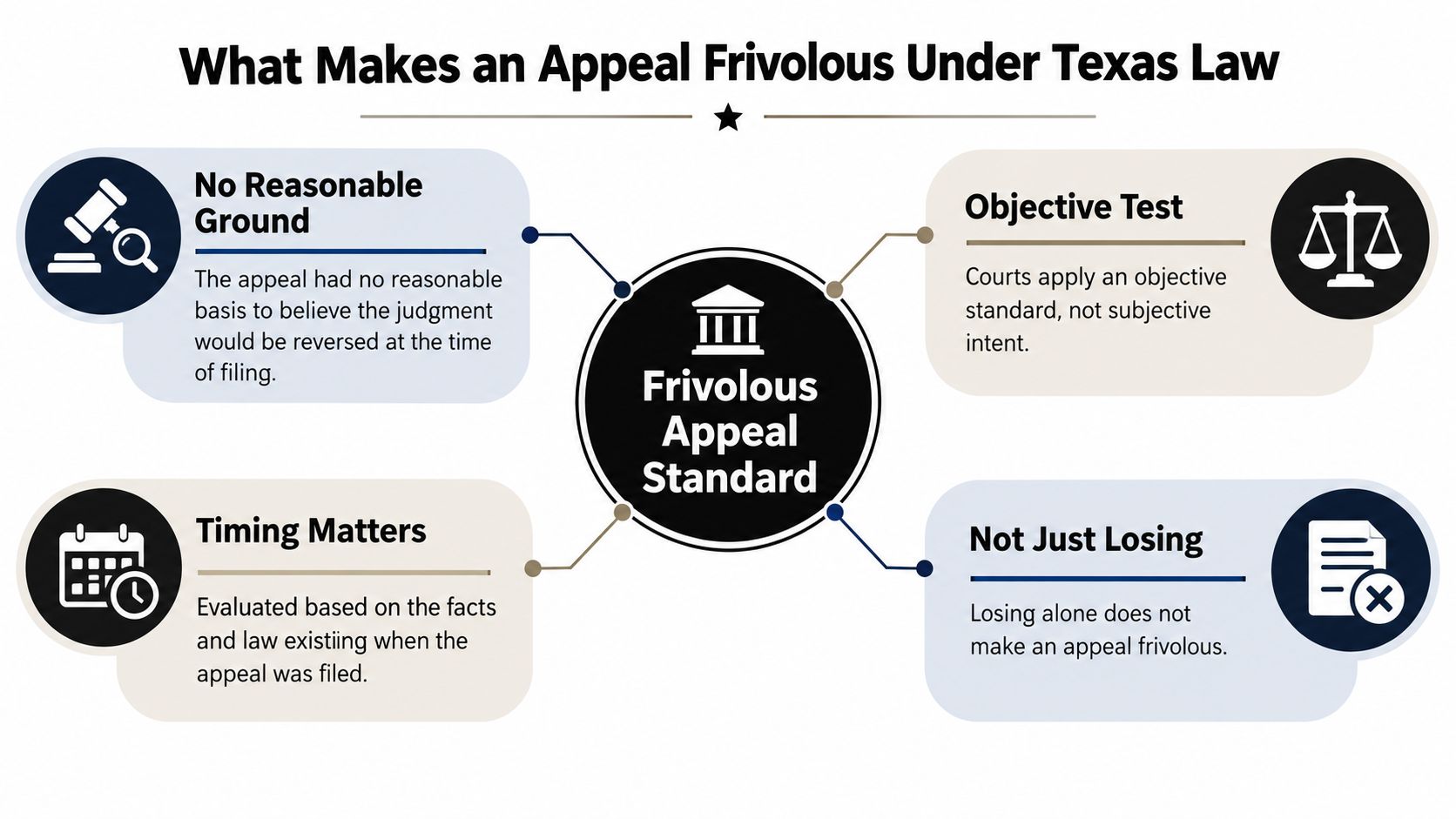
Texas courts apply an objective standard. The central question is whether, at the time the appeal was taken, the appellant had a reasonable ground to believe the judgment could be reversed. Texas appellate decisions also describe bad faith as a possible basis, but Rule 45 doesn't require a separate finding of bad faith when the appeal is objectively frivolous. The governing rule is available in the Texas Rules of Appellate Procedure.
An appeal is not frivolous merely because the appellant loses. Appellate law often involves close questions, discretionary rulings, incomplete precedent, and arguments that courts ultimately reject. A weak argument can still be colorable. A frivolous appeal is different because the legal position lacks a reasonable basis for expecting reversal when counsel files it.
The objective test in plain English
Think of the standard as a professional judgment question. Before filing, does the record contain a preserved complaint, a legal theory, or a recognized standard of review that could reasonably support reversal? If the answer is yes, the appeal may be unsuccessful, but that doesn't necessarily make it sanctionable.
The court isn't required to decide whether the appellant privately felt confident. A sincere belief can help explain conduct, but sincerity alone won't rescue an appeal that has no reasonable legal foundation. The court examines the objective support available when the appeal began.
That timing matters. Later developments, an unfavorable opinion, or the appellant's inability to persuade the panel doesn't retroactively make every unsuccessful appeal frivolous. The court looks at the legal and record-based grounds available at filing.
Weak is not the same as frivolous
Consider two family law arguments:
- A colorable argument: The appellant claims the trial court applied the wrong legal standard to a conservatorship decision and points to a preserved objection, relevant findings, and record evidence.
- An objectively baseless argument: The appellant asks the court to reconsider testimony without identifying a legal error, cites no authority supporting the requested result, and disregards a controlling preservation problem.
The first may fail because the appellate court views the evidence or law differently. The second creates greater sanctions risk because the briefing itself may show that reversal was never reasonably supportable.
A Texas Family Law Appeals Lawyer handles appellate representation challenging final family law orders for legal error. That work begins with separating a genuine appellate issue from an attempt to relitigate dissatisfaction with the trial result.
Bad faith isn't the only concern
Bad faith generally means pursuing an appeal for an improper purpose, such as delay or harassment. But Texas courts have stated that Rule 45 doesn't require proof of bad faith in every case. An objectively frivolous appeal can be enough.
That doesn't mean courts sanction every poorly written brief. The threshold remains meaningful. The appellee must give the court a record-based reason to conclude that the appeal had no reasonable ground for reversal, rather than just arguing that the appellant's position was wrong.
The Rules and Statutes That Control Sanctions
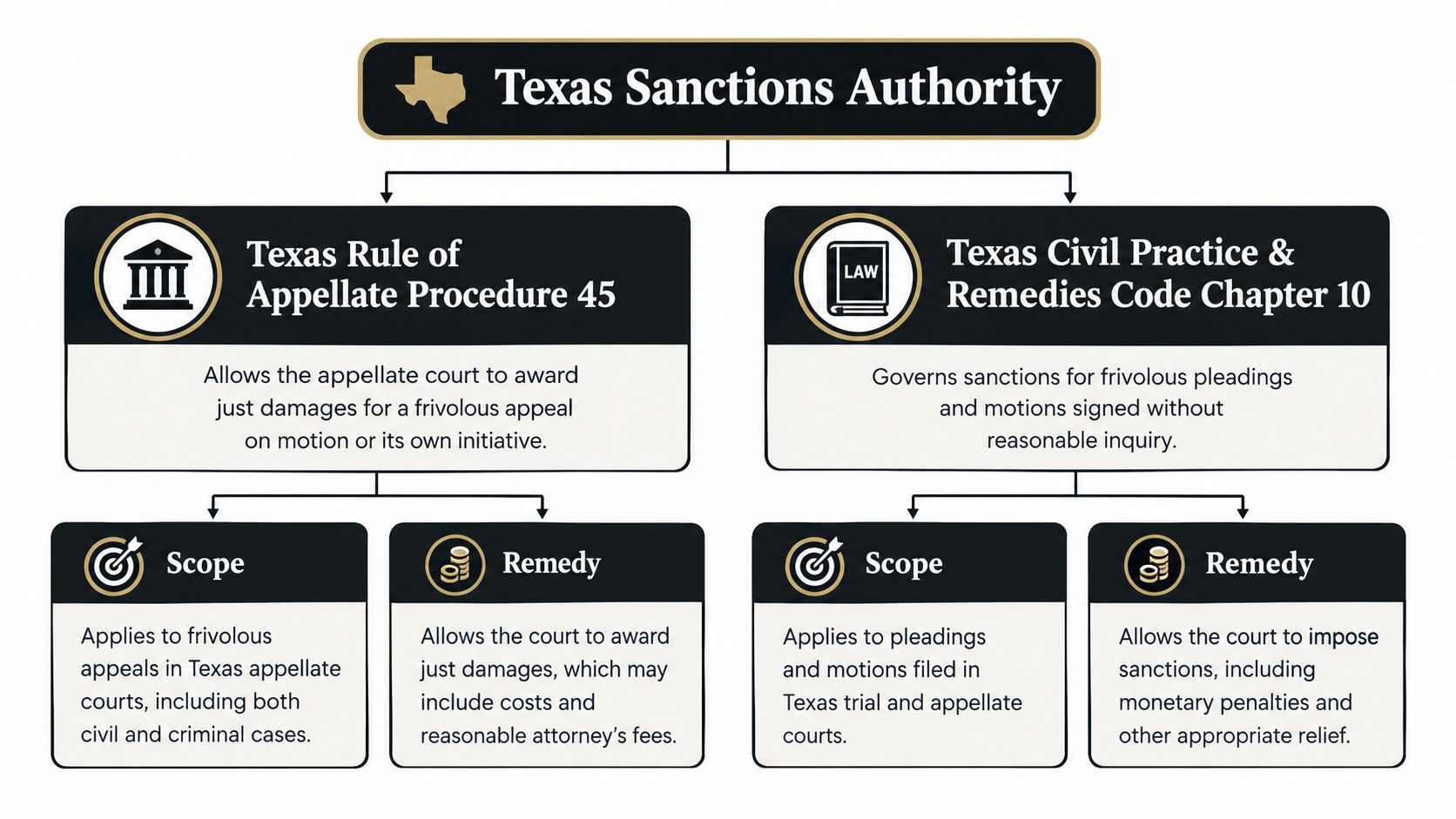
A family law client facing a sanctions request must identify the authority first. Texas Rule of Appellate Procedure 45 governs frivolous appeals in the courts of appeals. Texas Civil Practice and Remedies Code Chapter 10 governs sanctions for certain frivolous pleadings, motions, and other filings in trial-court proceedings. The two provisions address unsupported litigation conduct in different settings and cannot be treated as interchangeable.
Rule 45 gives a court of appeals authority to award “just damages” after notice and a reasonable opportunity to respond if it determines that an appeal is frivolous. The court's review is confined to the appellate record, the briefs, and other papers filed in that court. For family law parties, that limitation controls strategy. The trial-level history may explain why the dispute matters, but the appellate materials must show why the appeal lacks a reasonable basis.
Rule 45 keeps the inquiry appellate
A court of appeals is not conducting a new trial into whether a parent was difficult, evasive, or unreasonable throughout the underlying family dispute. It examines the appellate record and briefing, then asks whether the appeal itself is objectively baseless.
An appellee should therefore build a Rule 45 request around material the appellate court can review. Missed discovery, disputed testimony, or conduct during mediation may matter in another proceeding, but those facts do not establish a frivolous appeal unless the appellate record connects them to a legally unsupported appellate position.
Rule 45 authorizes discretionary just damages, not a preset penalty. Published Texas authority includes $1,500 in attorney's fees as sanctions for a frivolous appeal, discussed in the Fifth Court of Appeals' decision in the Texas Fifth Court of Appeals opinion discussing Rule 45 sanctions. The award depends on the harm shown and the court's assessment of an appropriate remedy. A sanctions request should explain that connection rather than demand an arbitrary amount.
Chapter 10 serves a different setting
Texas Civil Practice and Remedies Code section 10.004 limits trial-court sanctions to what is sufficient to deter repetition of the challenged conduct, or comparable conduct by similarly situated parties. Available remedies include:
- Nonmonetary directives, including an order requiring or forbidding a specific act.
- A penalty paid into court.
- Reasonable expenses and attorney's fees incurred because of the violation.
Chapter 10 may apply to the signer, the represented party, or both, subject to statutory limits and procedural protections. It also addresses monetary sanctions against represented parties for certain certification violations and restricts sanctions imposed on the court's own initiative unless the required show-cause process occurs. The governing provision is Texas Civil Practice and Remedies Code section 10.004.
Before responding to a sanctions threat, determine where the alleged misconduct occurred, which filing is challenged, what notice was provided, and what remedy is requested. For appellate procedure in a family law matter, use this guide to Texas rules of appellate procedure in family law cases.
The following video offers general context about Texas appellate procedure. It does not replace advice about the specific appellate record.
How Sanctions Are Sought and Defended in Practice
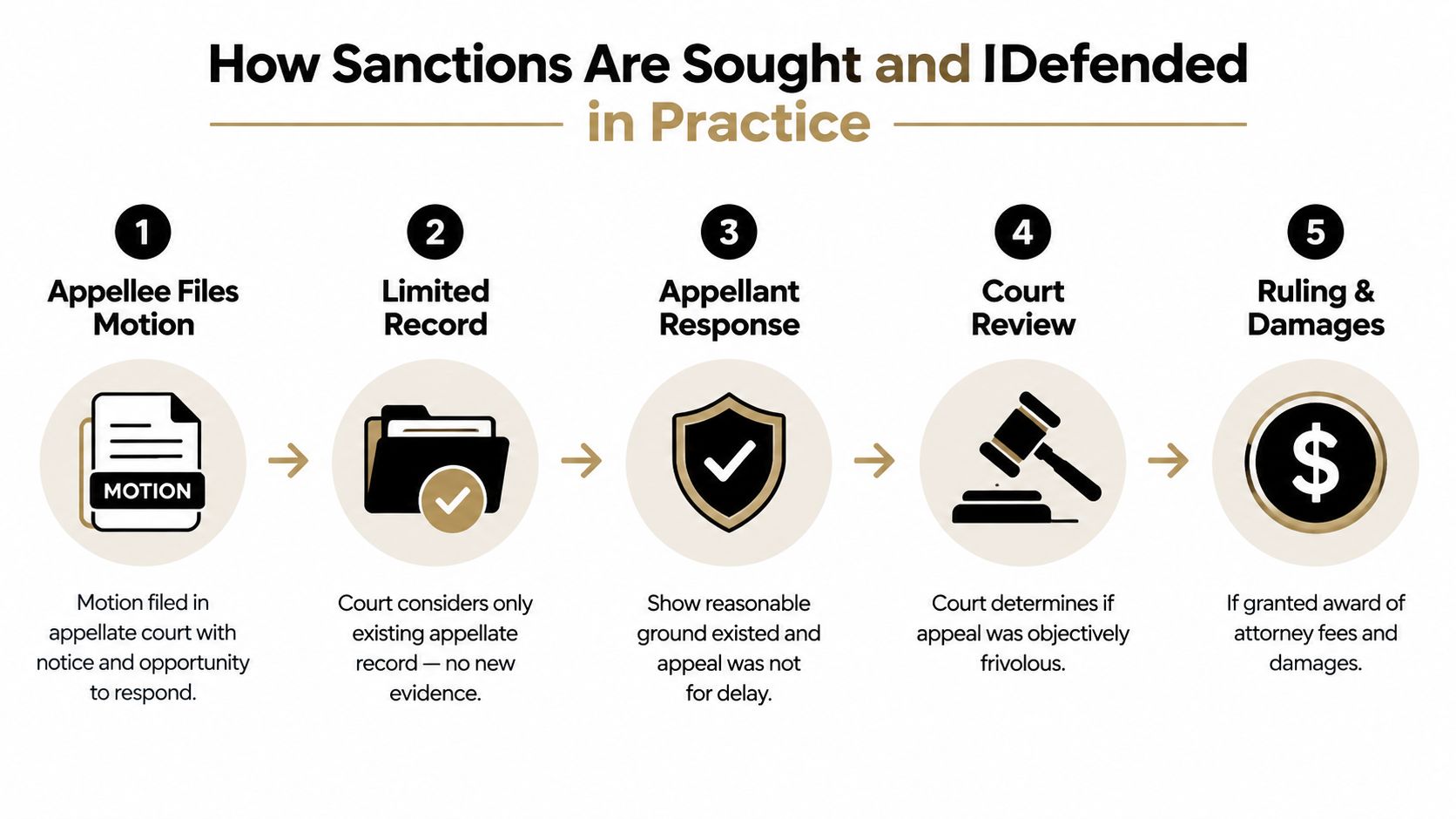
A sanctions dispute is usually decided within the appeal itself. The appellee asks the appellate court for damages, and the appellant receives notice and an opportunity to answer. The court evaluates the appellate record, briefing, and permitted filings under Rule 45. Trial-level conflict matters only if the record shows an appellate basis for relief or supports the sanctions request.
The appellee's path
An appellee seeking sanctions should file a focused motion. Identify the challenged issue, explain why the record supplied no reasonable basis to expect reversal, and cite the precise briefing or record problems that support the request.
A strong motion may show that the appellant:
- Ignored preservation requirements, without explaining why the complaint remains reviewable.
- Relied on no supporting authority, while seeking relief contrary to controlling law.
- Misrepresented the record, or described evidence absent from the appellate materials.
- Repeated an argument without addressing the trial court's ruling, leaving no legal route to reversal.
- Asked for fact findings the appellate court cannot make, instead of identifying an appellate error.
The motion should also document the appellee's requested damages. Counsel should separate fees caused by defending the appeal from fees incurred in the underlying family dispute, identify the work performed, and connect the requested amount to the sanctions request. A vague fee demand gives the court less to evaluate.
The appellee must avoid turning the filing into a general attack on the opposing party. The issue is the appeal's objective basis, not whether the family litigation has been painful or expensive.
The appellant's response
An appellant defending against sanctions should answer the motion with the record that existed when the appeal was filed. The response should identify the legal issue, show preservation when applicable, and explain the path from the alleged error to the requested relief.
Useful points include:
- A preserved objection or request that the trial court ruled on.
- A colorable legal theory, even if the appellant ultimately loses.
- Record support, including findings, admitted exhibits, or relevant testimony.
- A disputed standard of review, particularly where the issue concerns legal interpretation or an alleged abuse of discretion.
- A focused requested remedy, rather than a demand for a new trial without a legal explanation.
The response should address each sanctions argument directly. General statements that the appeal was filed in good faith are weaker than a specific explanation tied to the record and governing law.
The appellate court does not require a guarantee of success. It requires a reasonable basis for pursuing review.
Damages are discretionary
Rule 45 does not establish a mechanical sanctions amount. Texas courts may tailor just damages to the harm shown in the appellate materials. Attorney's fees may be included, but the award reflects the court's discretionary assessment rather than an automatic result of losing.
A party facing a sanctions order should examine the appellate ruling, the motion, the response, and the fee support together. A challenge may focus on inadequate notice, an unsupported fee request, improper reliance on matters outside the record, or the absence of an objectively frivolous issue.
The Texas family law sanctions-order appeal resource explains considerations for appealing that type of order. Reviewing the sanctions record promptly helps counsel decide whether to challenge the award or defend it.
Strategic Moves for Family Law Appellants and Appellees
The most important decision happens before the notice of appeal is filed. An appellant should not begin with the question, “Was the trial judge unfair?” The better question is, “What legal error can the appellate court correct based on this record?”
For the appellant
Start with reversibility. Reversible error is an error that affected the judgment and provides a legally recognized basis for relief. A disappointed party may have strong reasons to disagree with a custody or property ruling, but disagreement alone doesn't identify reversible error.
Then examine preservation. If counsel objected to excluded evidence, requested findings, challenged a legal standard, or raised another issue in the trial court, the record should show what happened and how the judge ruled. Without that foundation, the appellate court may be unable to review the complaint.
The record also needs disciplined framing. An appeal involving conservatorship may require attention to the standard of review and the trial court's findings. An appeal involving property division may focus on statutory requirements, characterization, valuation methodology, or an alleged abuse of discretion. A protective-order appeal may turn on notice, evidentiary rulings, findings, or the court's authority under the governing law.
Use this guide to strengthen a Texas family law appeal before filing as a practical reminder to address preservation, record completeness, and appellate theory before filing.
For the appellee
A sanctions request should be selective. Filing one merely because the other side lost can weaken your credibility and distract from the merits. File when the appellate materials themselves show that the appeal lacks a reasonable path to reversal.
Frame the motion around the brief and record. Identify the missing preservation step, unsupported proposition, contradiction, or legally unavailable remedy. If you seek attorney's fees, document the expenses attributable to the appeal and explain why those damages are just under Rule 45.
A custody dispute illustrates the difference. An appellant who argues that the court applied the wrong statutory standard and cites preserved objections presents a colorable issue. An appellant who asks the court to rehear every factual disagreement, cites no authority, and ignores the trial court's findings presents a stronger sanctions concern.
The same approach applies to property division and protective orders. Don't rely on the emotional force of the underlying dispute. Show why the appellate record makes reversal unreasonable.
A practical decision screen
Before filing or opposing sanctions, ask:
- Is the error preserved?
- Does the record support the argument?
- Does authority provide a route to reversal?
- Does the requested remedy fit the error?
- Can the court evaluate the issue from the appellate materials?
If the answers are largely yes, the appeal may be difficult but defensible. If the answers are largely no, counsel should reconsider filing, narrow the issues, or avoid presenting arguments that invite a Rule 45 motion.
Sample Language and Your Next Steps Toward Justice
Sanctions briefing succeeds through precision. An appellee should identify the defect without overstating it. For example:
Appropriate framing: “The appellant's sole issue depends on an objection that the record does not show was made or ruled on. The brief identifies no authority allowing review despite that omission and points to no record-based ground for reversal. Because the issue was not preserved and the requested relief is unavailable on this record, the appeal is frivolous under Rule 45.”
That language is stronger than a personal attack. It directs the court to the record, the preservation problem, and the missing route to reversal.
A weak motion would say:
“The appellant has always tried to delay this case and is abusing the courts again. The appeal is ridiculous, and the court should punish the appellant.”
That may express genuine frustration, but it doesn't establish the Rule 45 standard. The appellate court needs legal reasoning, record citations, and a focused explanation of why reversal was not reasonably supportable.
A useful response for appellants
An appellant can answer with the same discipline:
Appropriate response: “The appeal presents a preserved challenge to the legal standard applied to the custody ruling. The reporter's record contains the objection and the trial court's ruling, and the brief identifies authority supporting review. The court may reject the argument on the merits, but the issue supplied a reasonable ground to seek reversal when the appeal was filed.”
That response doesn't promise victory. It separates an unsuccessful appeal from a frivolous one.
Briefing is the written argument submitted to the appellate court. It should explain the issue, cite the record, provide legal authority, and connect the alleged error to the requested relief. Good briefing doesn't merely repeat trial testimony. It explains why the appellate court has authority to act.
Understanding common appellate terms
Abuse of discretion means the trial court acted without reference to guiding rules or principles, or made a decision that was arbitrary or unreasonable under the circumstances. It doesn't mean the appellate judges would have made the same choice. The standard can be demanding, which is why counsel must identify the legal framework the trial court allegedly failed to follow.
Reversible error means a legal mistake that warrants appellate relief because it affected the judgment or requires a remedy recognized by law. Not every mistake changes the result, and not every objection preserves an issue.
Briefing is the structured written presentation of the appeal. It should turn the record into a focused legal argument rather than ask the appellate court to conduct a new trial.
Appeals also carry procedural deadlines. A party considering review should examine the notice of appeal deadline in Texas family cases promptly, because missing a filing deadline can affect the right to appellate review.
The Law Office of Bryan Fagan, PLLC provides appellate evaluation and representation for Texas family law matters, including challenges to final orders involving custody, property division, support, divorce, protective orders, and enforcement. A consultation should focus on the signed order, the notice deadline, the clerk's record, the reporter's record, preservation, and the specific legal error that could support relief.
If you believe the trial court made a mistake, don't let a sanctions threat prevent you from getting a careful appellate assessment. If you prevailed and are facing a baseless appeal, don't assume every weak argument justifies sanctions. The record, the briefing, and the available path to reversal should drive the decision.
The Law Office of Bryan Fagan, PLLC evaluates Texas family law appeals and sanctions disputes through focused record review, preservation analysis, and persuasive briefing grounded in the Texas Family Code and appellate rules. Visit The Law Office of Bryan Fagan, PLLC to schedule a free consultation and discuss whether your case presents a viable appeal or a defensible response to a frivolous-appeal claim.