You may feel like the trial judge got it wrong and the only thing standing between you and a fair result is the appeal. In Texas family law, that feeling is common, and it's also why the appellate record matters so much. The court of appeals will not relitigate your case. It will review the record you designate, the rulings you preserve, and the issues you can prove from the paperwork and testimony that make it into the file.
That is why designating and paying for the appellate record, clerk's plus reporter's, is not a clerical chore. It's a budget decision, a strategy decision, and in many cases, the difference between a meaningful appeal and an empty one. Texas procedure puts the burden on the appellant to get the record moving, and family-law appeals make that burden heavier because custody hearings, temporary orders, property trials, and enforcement proceedings can stretch across multiple dates.
Why the Appellate Record Drives Your Texas Family Law Appeal
An appeal is not a second trial. The court of appeals does not hear your case from scratch, and it does not decide whether your side seemed more believable in the courtroom. It asks whether the trial court made a legal mistake that matters, and it can only answer that question from the record.
That is why appellate lawyers talk about the record first and the briefing second. Briefing is the written argument filed in the court of appeals. It explains why the trial court erred, but it cannot fix a missing record. If the reporter's record or clerk's record leaves out the key hearing, the key order, or the key exhibit, the court may never see the problem you're trying to raise.
What “abuse of discretion” really means
In Texas family law, many rulings are reviewed for abuse of discretion, which means the appellate court gives the trial judge room to make judgment calls. The question is not whether the appeals court would have ruled the same way. The question is whether the trial judge acted without guiding legal principles, or made a decision that the law will not support.
That standard matters because it makes the record even more important. A complaint about custody, support, conservatorship, or enforcement can rise or fall on one hearing, one objection, or one offer of proof. If that moment never gets designated, there's nothing for the appellate court to review.
Practical rule: if you think the judge misunderstood the evidence, ignored an important ruling, or cut off your chance to present proof, the record has to capture that moment exactly.
Understanding the Clerk's Record and Reporter's Record
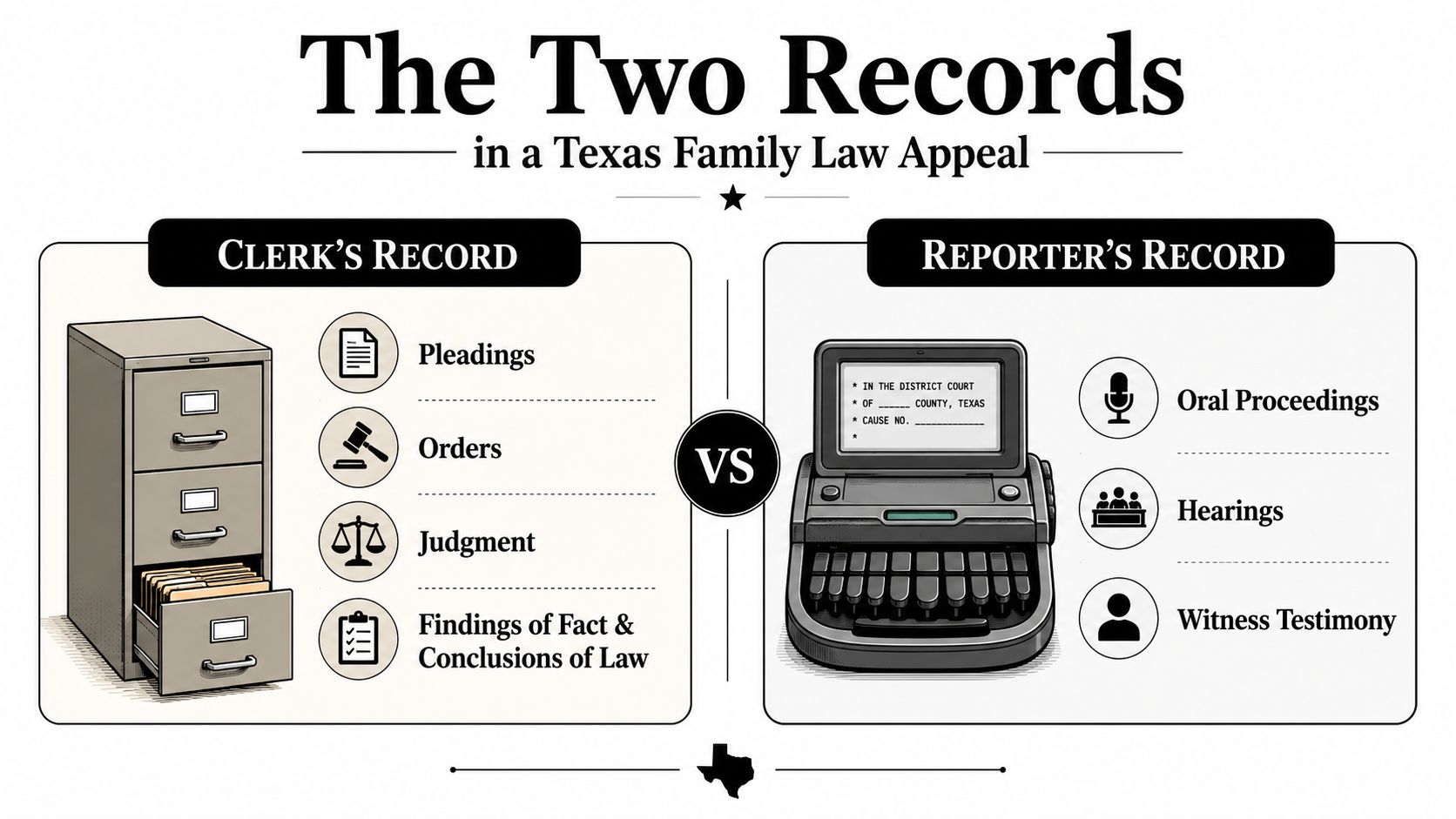
In Texas, the appellate record is split into two parts, the clerk's record and, when needed, the reporter's record. Texas appellate materials also make clear that any party may designate additional items for the clerk's record before it is prepared, and a civil appellant who asks for unnecessary extra material can be made to pay for that unnecessary portion, no matter who wins the appeal (Texas appellate record rules). That rule is plain enough, and it tells you something important, over-designation can cost real money.
The clerk's record contains the paper trail. In a family-law appeal, that usually means the petition, answer, motions, orders, final decree, findings of fact and conclusions of law if any, notices, and the filed documents that show what the trial judge had in front of the court. The reporter's record captures the live proceeding, testimony, objections, rulings from the bench, and exchanges that never appear on the written docket.
A simple family-law example
If the issue is whether the trial judge made the wrong call on possession, property division, or a protective order, the clerk's record alone rarely tells the whole story. The clerk's file may show the signed order, but the reporter's record shows how the judge got there. That distinction matters because appellate courts do not guess at what was said in open court.
Reversible error means a mistake that probably affected the outcome and gives the court of appeals a reason to change the judgment. A missing oral record can hide that mistake completely. If you're arguing that the judge excluded important testimony, misapplied the law during a hearing, or based a ruling on evidence that was never properly admitted, the reporter's record is where that issue lives.
Briefing is the lawyer's written argument, but it has to point back to the record line by line. That is why the record and the brief work together. One without the other is usually not enough.
A good way to think about it is this, the clerk's record proves what was filed, and the reporter's record proves what was said.
The appellate court can only correct what the record shows. If it doesn't show up there, it may as well not have happened.
For a more detailed look at the paper portion of the record, see Clerk's Record in a Texas Appeal.
Step-by-Step Process for Designating and Paying
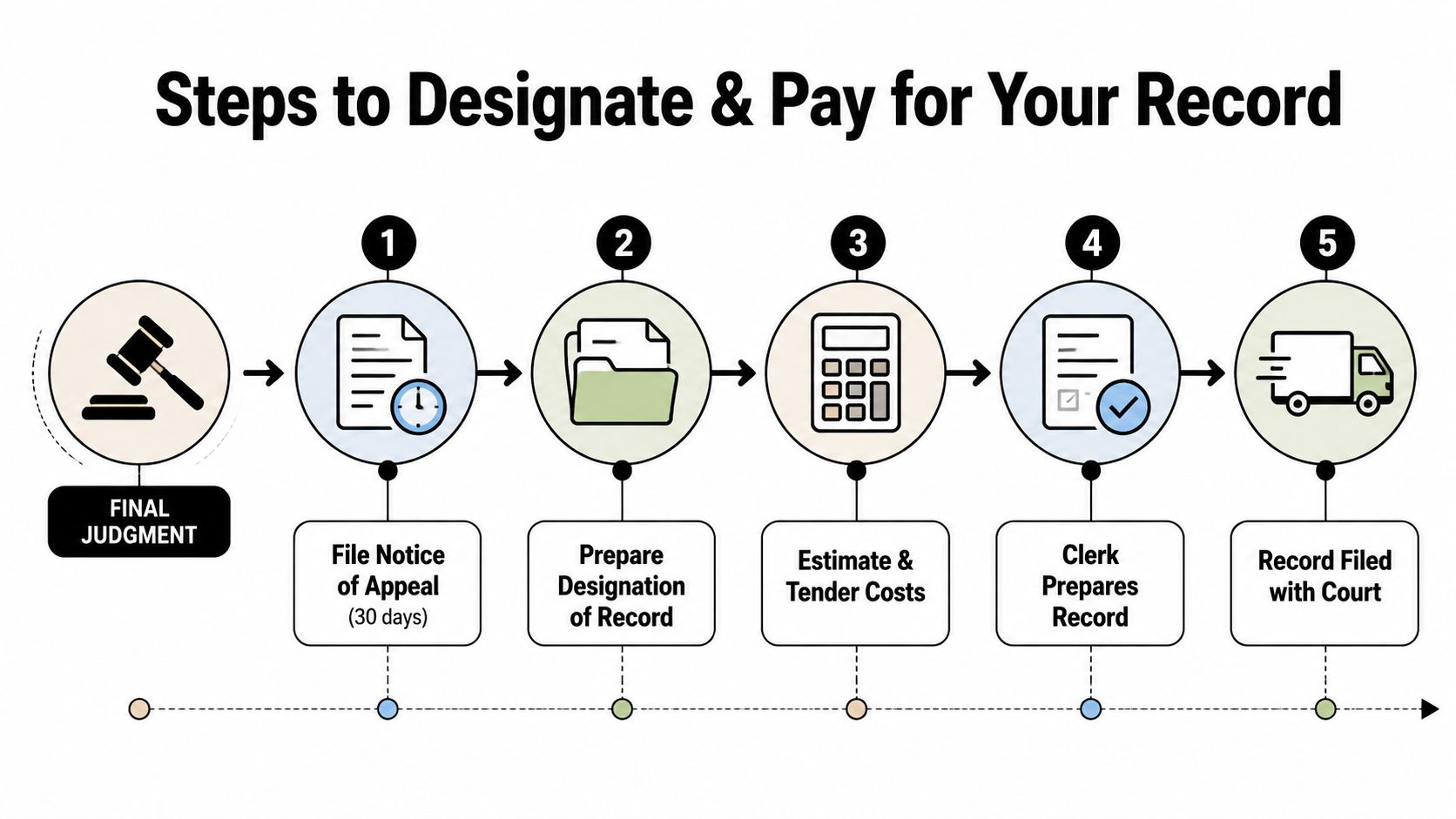
A family-law appeal starts the day the final judgment is signed, not when you feel ready to deal with it. Texas appellate deadlines leave little room for hesitation, so the first job is to identify the judgment, file the appeal, and get the record designation moving before the deadline closes. The deadline rule in The Notice of Appeal Deadline in Texas Family Cases makes the point plainly, you generally have only 30 days to begin.
Start with the Notice of Appeal. Then send the clerk's record request to the trial court clerk and the reporter's record request to the court reporter who covered the hearing or trial. If the case had more than one hearing date, do not assume one reporter handled every proceeding. Match each date to the reporter who took that portion of the record.
What to ask for and when
Be precise with the clerk's record first, then decide whether the reporter's record should be full or limited. Extra clerk's record items can be designated before the record is prepared, but treat that choice as a budget decision, not an automatic habit. If a document or exhibit helps prove your issue, include it. If it does not advance the appeal, leave it out.
Payment deserves the same discipline. For a practical look at what drives appeal costs, see How Much Does an Appeal Cost in Texas?. The record is often the largest piece of that bill, and the reporter will not move forward on goodwill alone. If the reporter is not paid or given a workable arrangement, the transcript will not get prepared on time.
Here is the workflow in plain English:
- File the Notice of Appeal and do not assume the appeal is protected without action.
- Designate the clerk's record with the clerk, and specify anything extra that matters.
- Identify every relevant court reporter for each hearing or trial date.
- Request the reporter's record in writing and state exactly which proceedings you need.
- Tender payment or arrange payment so the reporter can begin the work.
For the reporting side of the process, the Texas reporter's record guide explains how the transcript request fits into the appeal record and why timing matters. In family cases, that timing usually decides whether the appeal is built on a complete record or on guesses that will not help you in court.
Choosing Between a Full and Limited Reporter's Record
A full reporter's record is the easy answer, and it is often the expensive one. A limited reporter's record takes more judgment, but in the right case it cuts cost without weakening the appeal. Texas appellate practice does not reward waste, and family-law appeals often turn on far less than the whole case file.
The difference matters most in custody modification, property division, and contempt enforcement. A custody appeal may rise or fall on one final hearing. A property appeal may hinge on the bench trial and the testimony tied to valuation or characterization. A contempt case may turn on a few disputed exchanges about notice, ability to comply, or what the judge was told.
Ask what the issue requires
If your complaint is about one ruling on one hearing date, request that hearing, not every proceeding in the case. If your complaint is about the sufficiency of the evidence, you need enough of the testimony to support that attack. If your issue concerns a legal ruling that happened on the record, you may not need a broad transcript package just because the case was emotionally difficult.
Over-designation is easy to start and hard to undo. Texas rules let the appellate court shift unnecessary clerk's record costs back onto the party who asked for them, and the same practical lesson applies to transcripts. If the extra pages do not help prove a live appellate issue, they do not belong in the package.
Strategic rule: request the material that supports the issue you intend to brief, not the material that narrates the complete story.
For a Texas-focused walkthrough on transcript decisions, see Reporter's Record in a Texas Appeal. That guide helps when you are deciding whether to order only a final hearing, only the contested evidentiary day, or the full set of proceedings.
The right record is usually the smallest record that still preserves every issue you plan to raise. That is the cost-control move that matters.
Estimating Transcript Fees and Payment Methods in Texas
A transcript can turn a manageable appeal into an expensive one fast, especially in a family case where the hearing record is long, messy, and full of side issues that do not belong in the appellate package. That is why record designation is a budgeting decision, not a clerical chore. Decide what you need before the reporter starts preparing pages you may never use.
Pricing varies by jurisdiction and by how the record is prepared. California's appellate self-help materials show the range clearly, with a reporter's transcript requiring an initial $50 trust deposit plus approximate transcription costs of $650 per day for proceedings lasting more than three hours, $325 per day for shorter proceedings when they have not previously been transcribed, and lower rates of $160 or $80 per day-fraction when the proceedings have already been transcribed (California appellate self-help manual). The same material also lists a separate $100 clerk's transcript deposit and copying and volume fees that rise with the size of the record.
Idaho's appellate rules show the same cost pressure from a different angle. They set a per-page fee of $1.25 for paper records and $0.65 for electronic records, plus $20 for an additional CD copy (Idaho appellate rules). The federal reporting program effective October 1, 2024, prices an ordinary 30-day transcript at $4.40 per page for the original, $1.10 per page for the first copy to each party, and $0.75 per page for each additional copy to the same party.
Texas does not follow those exact schedules, but the comparison is useful because appellate record costs rise with length, copies, and format. In Texas family-law appeals, that means a long final hearing, a custody modification trial, or an enforcement hearing with several witnesses can get expensive quickly, especially if you ask for more than the issue requires. A practical overview of appeal budgeting in Texas is available in How Much Does an Appeal Cost in Texas?
What payment usually looks like
Texas court reporters often want payment arranged early, and they prefer a clean method they can track without chasing counsel later. Some accept certified funds, some accept electronic payment, and some will work through a firm account if that is their routine. Ask before the deadline gets close, because once the transcript queue is moving, your options narrow.
| Texas Reporter's Record Cost Estimates at a Glance | Approximate Rate | Typical Turnaround |
|---|---|---|
| Original transcript | Varies by reporter and record length | Ordinary or expedited, depending on request |
| First copy for a party | Varies by reporter and copying method | Usually tied to the original transcript timeline |
| Additional copy to the same party | Varies by reporter and volume | Usually tied to the original transcript timeline |
The original transcript usually sits on the appellant at the front end, even if you later have a cost-shifting argument. That is the budget reality. You may recover some costs later if the rules and the result support it, but you should plan as though you are paying for the record yourself.
The right approach is simple. Estimate the record as if the appeal belongs to your checking account today, then trim every page that does not help prove the issue you intend to brief.
What Happens If You Cannot Afford the Record
A lot of parents and spouses can't pay for transcripts out of pocket right after a divorce, custody fight, or enforcement ruling. That is not unusual, and Texas appellate rules give indigent parties a path forward. Under TRAP 20, an appellant who cannot pay may file an affidavit of inability to pay and ask the appellate system to treat the appeal accordingly.
That affidavit matters because indigence is not decided by wishful thinking, and it is not a trial-court issue. The appellate court process controls the determination, and the other side can challenge it. You still have to designate the record, even when you're claiming inability to pay, because the appeal still needs to know what the appellant is asking the court to review.
What indigence can cover
Indigence can cover the cost of starting the appeal, the clerk's record fee, the reporter's record costs, and record copies when the rules apply. It does not cover everything that comes later. Briefing costs and attorney's fees are separate issues, and you should not assume a pauper's affidavit makes the whole appeal free.
Louisiana's appellate rule is useful as a comparison point because it states that transcript costs in non-indigent cases must be paid within 20 days of notice, while also allowing a trial judge to extend the payment time after a hearing (Louisiana appellate rule overview). Texas doesn't mirror that exact setup, but the lesson is the same, payment defaults are not always fatal, and a lawyer needs to look for extensions, scope reductions, or an indigence path before the record stalls.
If money is tight, the answer is usually not to give up on the appeal. It's to narrow the record, ask for the right relief, and document the inability to pay correctly.
The hardest part is often timing. A family-law appellant may be trying to feed children, keep a home, and still preserve appellate rights. That's why this issue needs a hard look early, not after the transcript request has already gone cold.
Timeline Checklist, Common Pitfalls, and Sample Language

The safest timeline starts the day the judgment is signed and keeps moving until the record is filed. The Notice of Appeal comes first, then the designation, then the cost arrangement, and then the transcript work itself. If the appeal depends on oral testimony, waiting to sort out payment is a bad bet.
Here are the mistakes I see most often in Texas family cases:
- Missing the reporter's record designation on time, which can leave the appellate court with no testimony to review.
- Leaving out key exhibit volumes, especially when property or custody evidence was admitted at trial.
- Forgetting voir dire or a critical bench conference, when the appellate issue turns on what happened in open court.
- Missing a limited-record election deadline, then discovering the appeal needs material that was never requested.
- Assuming the clerk will include everything automatically, which almost always leads to gaps.
A few sample lines can keep the request focused:
- Clerk's record request: “Please prepare the clerk's record to include the final decree, all findings of fact and conclusions of law, the pleadings that frame the appellate issue, and the order being challenged.”
- Reporter's record request: “Please prepare the reporter's record for the hearing dates that relate to the issues on appeal, including testimony, objections, rulings, and any admitted exhibits.”
- Indigence affidavit language: “I am unable to pay the costs of the appellate record, and I request that my appeal proceed under the applicable Texas Rules of Appellate Procedure.”
If you want help evaluating whether your appeal needs a full or limited record, a Texas appellate lawyer should review the judgment, the hearing dates, and the issue list before you spend money on transcripts. The appellate team at The Law Office of Bryan Fagan, PLLC handles those reviews in family-law appeals and can help you figure out what to request, what to leave out, and how to move the case forward.
If you believe the court made a mistake in your family law case, our appellate attorneys can help you seek a fair outcome. Contact The Law Office of Bryan Fagan today for a free consultation.