You may feel like the judge heard the wrong case. Maybe the court used the wrong income number, ignored your evidence about overtime or bonuses, or signed an order without the findings you asked for. That feeling is real, but a Texas child-support appeal only works when the record shows a legal or procedural mistake, not just a bad result.
A Child-support appeals pillar case is built on precision. Appeals are not retrials, and they are not a chance to re-argue the same story with a different tone. They are a focused review of whether the trial court followed the law, used the right evidence, and explained the decision the way Texas law requires.
If you're sitting at your kitchen table after a final hearing wondering whether the court got it wrong, start here. The right move might be an appeal, but it might also be a modification or an enforcement fight. Choosing the wrong door wastes time, and in appellate work, time matters.
When a Child-Support Order Feels Wrong
A parent walks out of the final hearing thinking the court treated income like a guessing game. The judge used last year's tax return instead of current pay records, skipped over a request for a deviation, and signed the order before fully explaining why the amount made sense. That parent does not need a pep talk. They need a legal filter.
A child-support appeal is a record-bound, error-correction proceeding. The appellate court looks at whether the trial judge made a legal or procedural mistake on the papers already in the case, not whether the panel would have made the same decision in the first place. That's the core difference between being unhappy with a ruling and having a real appellate issue.
Texas parents often ask whether unfair means appealable. It can, but only if the unfairness ties back to something the court did wrong under the Texas Rules of Appellate Procedure or the Texas Family Code. That could be a misapplied support guideline, a missing finding, a refused hearing, or a record that never supported the number the court chose.
The emotional part matters, but appellate judges deal in transcripts, exhibits, and preserved objections. If the order feels wrong, the first question is simple, did the trial court commit reversible error, or do you just disagree with the outcome? Those are different problems, and they call for different remedies.
A strong appeal starts with the record, not with outrage.
In family cases, that distinction protects everyone. Parents get a structured way to challenge mistakes, and courts get a clean framework for reviewing whether the order should stand.
The Standards of Review That Decide Your Appeal
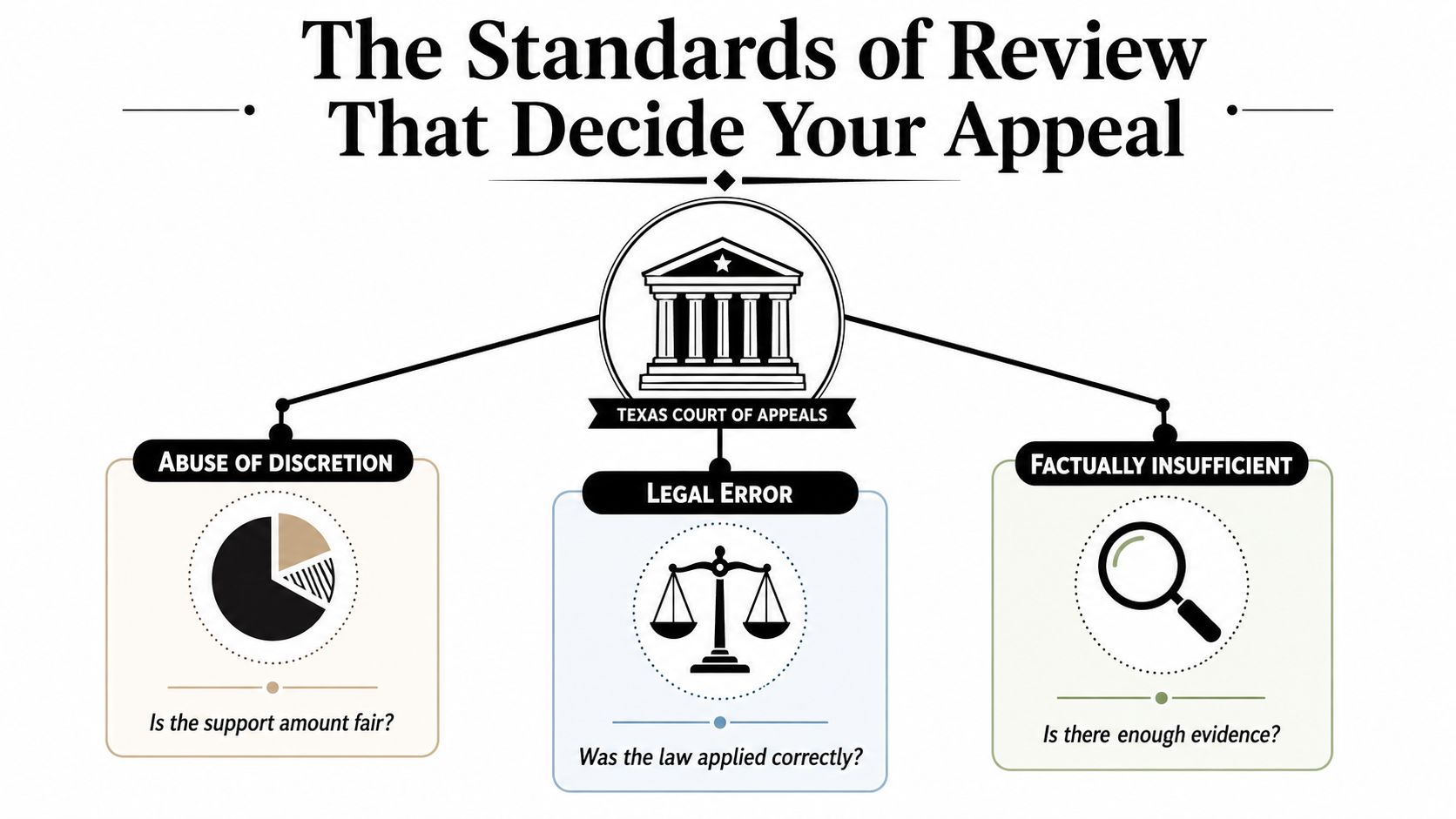
Texas appellate courts don't review child-support cases with one all-purpose lens. They apply standards of review, which is just a plain-English way of saying how much deference the court gives the trial judge. If you understand that, you understand most of the fight.
Abuse of discretion
Abuse of discretion means the trial court acted outside the legal range of choices allowed by law. In child support, that often shows up when a judge deviates from guideline support but gives no meaningful explanation in writing, or the explanation doesn't fit the evidence. If the court had options, but chose one the law doesn't support, that can be reversible error.
Legal error and de novo review
De novo review means the appellate court looks at a legal question fresh, without deferring to the trial judge. That matters when the dispute turns on interpreting a statute, a contract term, or a legal formula used in support calculations. If the court applied the wrong rule, the appellate court can step in directly.
Evidence problems and reversible error
Reversible error is a mistake serious enough to justify changing the result. A harmless typo won't do it. The error has to matter. If the judge ignored clear income evidence, cut off testimony about extraordinary expenses, or relied on a calculation that the record does not support, the problem may be reversible because it changed the support outcome.
The practical takeaway is blunt. Most child-support appeals live in the abuse-of-discretion lane, so your brief must show more than disagreement. It has to connect the judge's decision to the specific part of the record that shows the court stepped outside the law.
A brief is the document that does that work. The Appellate Brief in a Texas Family Appeal is the heart of the appeal because it ties the legal issue to the record and asks the court for a specific remedy.
Common Reversible Errors in Texas Child-Support Cases
Some mistakes show up again and again in Texas family courts. The appellate question is not whether the outcome felt rough. It's whether the judge made a mistake that affected the support order in a real way.
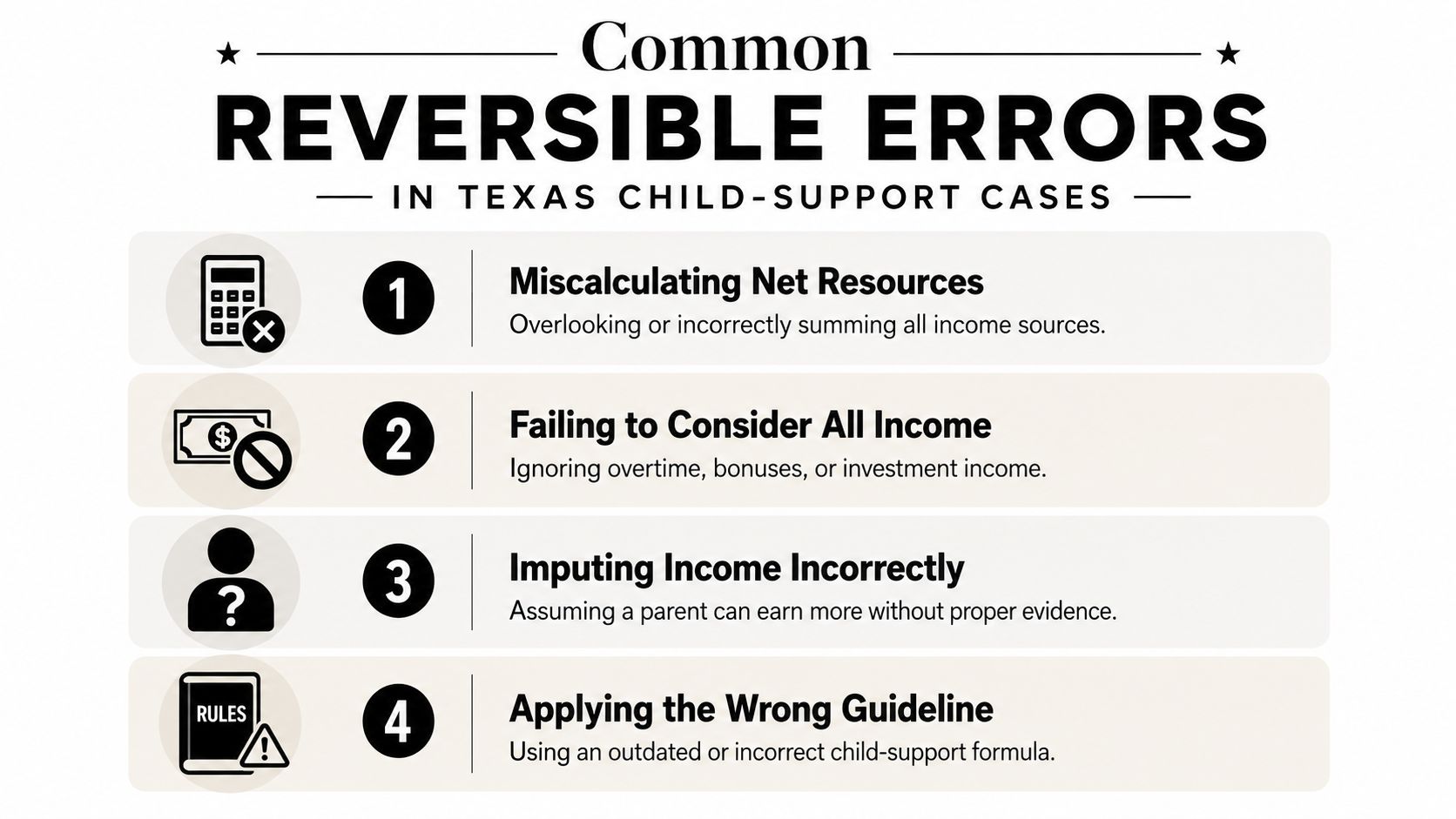
The recurring patterns
- Miscalculating net resources. A judge can get the monthly number wrong by leaving out a wage item, double-counting a deduction, or using stale earnings data. If the support amount starts from the wrong base, the rest of the calculation can collapse.
- Failing to consider all income. Overtime, bonuses, side income, and investment income can matter depending on the record. If the court ignores them without a valid reason, the order may rest on an incomplete picture.
- Imputing income incorrectly. A judge can't just assume a parent earns more because it feels fair. There has to be evidence supporting that conclusion.
- Applying the wrong guideline. If the wrong formula controls the case, the final order can be built on a legal mistake instead of a family-law finding.
Those issues show up in different ways. One parent brings detailed pay stubs and a recent job loss notice, but the court uses last year's income anyway. Another parent requests a deviation because of a child's medical needs, but the judge signs an order without writing the findings that explain the departure from guideline support.
The hard part is separating a harmful error from a harmless one. Appellate courts don't reverse just because the judge missed a detail. The error has to affect the result, or at least prevent the court from knowing whether the result was legally sound.
If you're trying to decide whether your case fits that pattern, Grounds for Appealing a Texas Family Law Ruling is a useful way to think about what kinds of mistakes can support review. For parents focused specifically on calculations, https://familylawcourtappeals.com/appealing-child-support-calculation-texas/ is the better starting point.
Building and Preserving the Record for Appeal
The record is everything. If the appellate court can't see it, it didn't happen for appeal purposes. That's why the best appellate work starts in the trial court, not after the final order is signed.
What has to be preserved
You preserve issues by objecting at the right time, asking for the right findings, and making sure excluded evidence is identified in the record. If the judge cuts off testimony about income or extraordinary expenses, counsel needs to make an offer of proof so the appellate court can see what the testimony would have been. If you wanted findings on a deviation request, ask for them in writing.
A clean record also means a complete transcript and a complete clerk's file. Missing pages, missing exhibits, or a skipped hearing can sink an issue that looked strong in the courtroom. That's why the reporter's record and clerk's record matter so much in a child-support appeal.
Here's a practical way to audit the case:
| Trial Court Action | Preserved for Appeal? | Why It Matters |
|---|---|---|
| Timely objection to excluded income evidence | Yes | Shows the judge was told about the problem |
| Written request for findings on a deviation issue | Yes | Gives the appellate court something to review |
| Offer of proof after testimony is cut off | Yes | Preserves what the missing evidence would have shown |
| No objection, no request, no offer of proof | Usually no | The issue may be treated as waived |
The deadline side matters too. After judgment, the notice of appeal starts the process, and then the record has to be designated and paid for on time. If you're trying to understand what to order and when, the internal guide on https://familylawcourtappeals.com/designating-and-paying-for-the-appellate-record-clerks-reporters/ belongs on your desk before the appeal is filed.
A preserved error is a real asset. An unpreserved error is usually just frustration on paper.
Procedural Steps and Timelines Under the Texas Rules of Appellate Procedure
The appeal clock starts running when the final order is signed. In many Texas family cases, the first deadline is the notice of appeal, and missing that deadline can end the case before the court of appeals ever sees it. Texas practice often gives you a short window, so you need to act fast and check the exact deadline in your case.
The path from order to opinion
- Final order. The trial court signs the child-support order.
- Notice of appeal. File it on time, because the appellate court needs jurisdiction.
- Reporter's record. Request the transcript immediately and make sure the court reporter knows what hearings matter.
- Briefs. The appellant's brief comes first, and it has to match the record page by page.
- Appellee's brief. The other side answers your arguments.
- Reply brief. If useful, respond to the appellee's points.
- Oral argument and decision. Argument may be set, or the court may decide the case on the briefs.
A motion to extend time can sometimes help, but you should never treat it like a plan. Deadlines are not flexible just because a parent is overwhelmed. The safer move is to organize the record early and assign the appellate brief before the transcript is even fully done.
Practical rule: order the reporter's record right away. Transcript delays are easier to manage early than after a deadline is missed.
Appeals also serve a different purpose than a modification or enforcement case. If the goal is to change support because circumstances have shifted, that's usually a modification issue, not an appeal. If the goal is to stop a child-support order from being enforced while appeal is pending, the stay question becomes important, and the discussion at https://familylawcourtappeals.com/stay-of-enforcement-pending-appeal-texas/ gives that issue the right procedural frame.
The main point is simple. Appeals are time-sensitive, record-driven, and narrow. If you miss the right step, the court may never reach the merits.
How Appeals Differ From Modifications and Enforcement Actions
Parents often lump these remedies together because they all involve child support, but they solve different problems. If you choose the wrong one, you hand the court the wrong question.
An appeal attacks the final order itself. You're saying the judge made a legal or procedural mistake when the order was signed. That means the issue is backward-looking, and the case lives on the appellate record.
A modification asks the trial court to change support because the facts have changed. New job, new medical needs, new parenting schedule, changed income, that's modification territory. The question is forward-looking, and the court is deciding what should happen now.
An enforcement or contempt action is about compliance. The order exists, and someone says it wasn't followed. That case is about payment, not the correctness of the original support formula.
How to choose the right door
- Challenge the order itself if the judge used the wrong numbers, ignored evidence, or failed to make required findings.
- Seek modification if your finances or the child's needs changed after the order.
- Respond to enforcement if the other side says you didn't pay as ordered and the issue is compliance, not the amount.
- Consider parallel remedies if both the old order is wrong and current circumstances have changed.
Texas parents also need to be clear about preserving the issue in the trial court. If you think the judge is about to make a calculation mistake, say so on the record, ask for findings, and keep the evidence tied to the exact support issue. That gives the court of appeals something concrete to review later.
The other strategic point is this. A judge-focused brief works better than a grievance memo. State the legal error, cite the record, tie the record to the remedy, and keep the argument tight. That style helps whether you're arguing in writing or preparing for oral argument.
Strategic Briefing and Oral Argument Tips
The brief has one job, make the panel see the error quickly. If the issue statement is muddy, the rest of the document won't save it. In Texas family appeals, clarity wins more often than drama.
Four questions parents usually ask
How do I frame the issue? State the legal mistake in one sentence. If the trial court used the wrong income method or failed to make the required deviation findings, say that directly.
How much fact detail belongs in the brief? Enough to show the problem in the record, but not so much that the issue gets buried. Every important fact should point back to a clerk's record or reporter's record citation.
Should I ask for oral argument? If the appeal turns on a hard legal question or a confusing record, yes, it can help. If the briefs already make the issue obvious, oral argument may be less important.
What do I do with authority? Use the Texas Family Code, the Texas Rules of Appellate Procedure, and the cases that control your issue. Don't pad the brief with weak citations.
A good appellate brief is judge-focused. It doesn't sound angry. It sounds precise. It tells the court what happened, where it happened, why the ruling was wrong, and what should happen next.
Keep your oral-argument prep simple. Know the record cold, know the remedy you want, and be ready to answer the question the panel is most likely to ask, not the one you wish they'd ask.
The Law Office of Bryan Fagan, PLLC is one option for parents who need that kind of appellate framing. The firm handles Texas family appeals, including child support, custody, property division, protective orders, and contempt orders, with a record-based approach rooted in the Texas Family Code and the Texas Rules of Appellate Procedure.
Frequently Asked Questions About Texas Child-Support Appeals
Parents usually want straight answers before they hire appellate counsel. Fair enough. The process is stressful, and nobody wants to spend money on a case that's headed in the wrong direction.
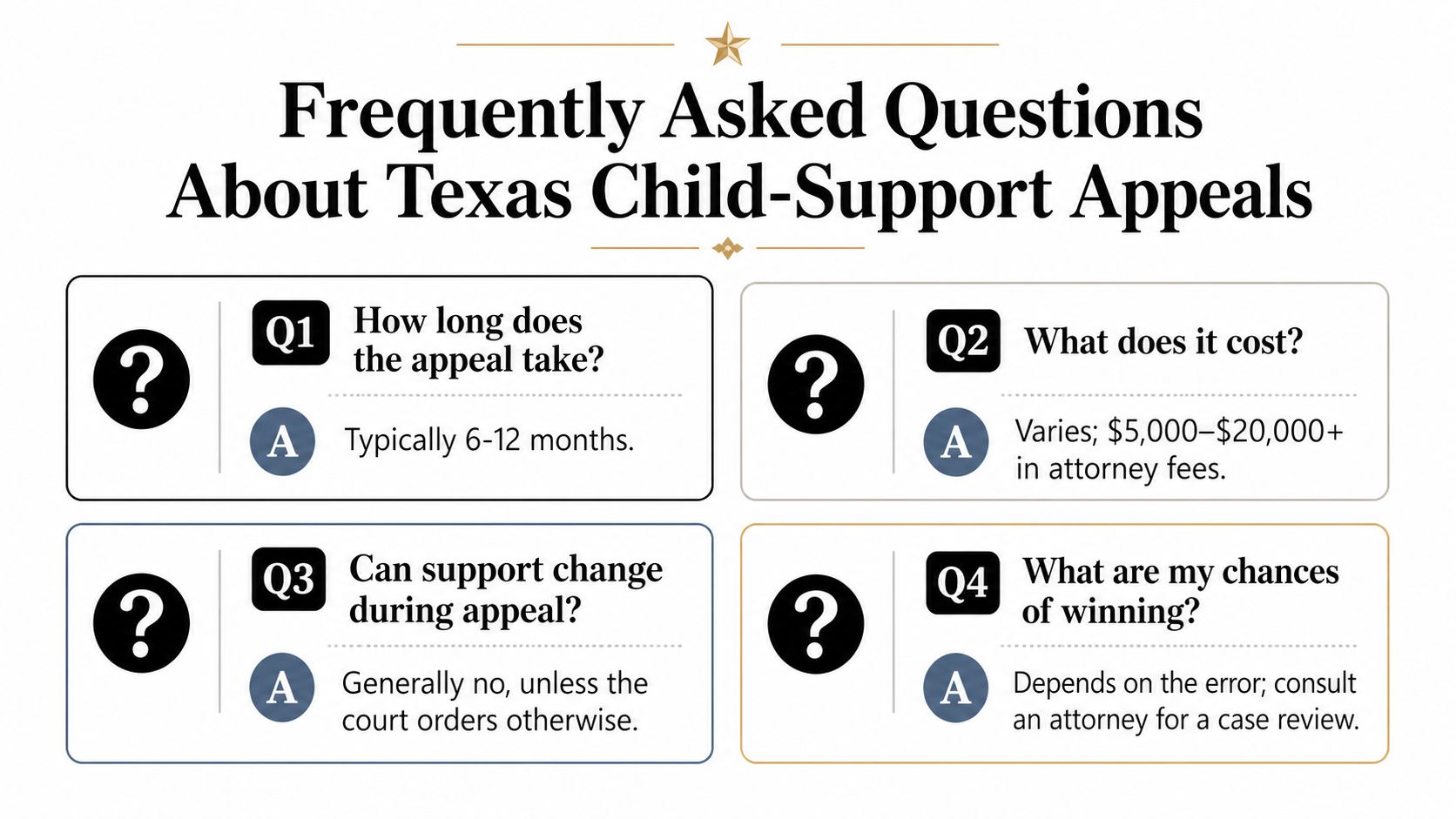
How long does an appeal take? It varies by court and by record size. A simple case moves faster than a complicated one, especially if the reporter's record takes time to prepare. The answer is that the appellate clock moves in stages, and each stage depends on the one before it.
What does it cost? It depends on the record, the number of issues, and whether the case needs oral argument. A narrow calculation issue usually costs less than a multi-issue family appeal with a long transcript. The smart move is to get a case-specific estimate after the attorney reviews the order and record.
Can support change while the appeal is pending? Sometimes, but not automatically. The trial court may have limited power to address enforcement or stay issues, and the right procedural move depends on what you're trying to protect. If your concern is keeping the order from being enforced while the appeal runs, the stay rules need immediate attention.
What happens if the appeal is lost? The underlying order usually stays in place unless a higher court changes it. Some cases may allow further review, but not every losing appeal should go to the next level. A good appellate lawyer tells you the truth about odds, cost, and whether the next step makes sense.
If you think the order is wrong, don't guess at the remedy. Get the record reviewed, get the deadlines checked, and get a plan that fits the actual problem.
If you believe the court made a mistake in your family law case, our appellate attorneys can help you seek a fair outcome. Contact The Law Office of Bryan Fagan, PLLC today for a free consultation. We'll review the order, the record, and the deadlines so you can make the next move with clear direction.