Skip to content
Yes, a default divorce in Texas can be challenged, but the path is narrow. In most cases, you're looking at a 30-day motion for new trial, a 6-month restricted appeal, or, in the hardest cases, a bill of review.
You may feel like the court signed a decree without ever really hearing your side. That's a real problem, but it doesn't mean the case is over. It means you need to move fast and choose the right remedy, because Texas treats default-divorce challenges as a timing and procedure issue first, and an argument about fairness second.
When a Default Divorce Feels Final
A default divorce can feel brutal. One day you're dealing with service papers, work, kids, or just trying to keep your life together, and the next day there's a signed decree on the table that seems to have been entered without your voice ever being heard.
That feeling is common, and it's not the same as being powerless. Texas law gives you real post-judgment remedies, but they're narrow and they depend on what happened in the record. If you're asking can you appeal a default divorce in Texas, the honest answer is yes, but not through the same route everyone expects.

The first question is not whether the decree feels unfair
The first question is which procedural door is still open. Texas appellate practice turns on deadlines, participation, and the record, not just on how upset you are about the result.
If you never answered, never appeared, and never took part in the hearing, your case usually belongs in the restricted-appeal lane or a post-judgment motion, not a standard direct appeal.
That's why the decision tree matters. A default decree can sometimes be attacked quickly in the trial court, sometimes in the court of appeals, and sometimes through an independent equitable action later. The wrong filing, or a late filing, can shut down better options.
If you want a broader look at appeal strategy in Texas family cases, the firm's appellate work on Standards of Review in Texas Family Appeals is a useful companion piece. It explains why the legal lens on appeal is so different from what happens in the trial court.
What a Default Divorce Means in Texas
A default divorce happens when one spouse files for divorce, the other spouse is properly served, and the responding spouse doesn't answer in time. Texas still allows the court to sign a final decree even if the other spouse never shows up, as long as the procedural requirements are met.
The timing rules are what make these cases tricky
In Texas, the respondent generally has 20 days plus the following Monday to file an answer after service, and the divorce cannot be finalized until the mandatory 60-day waiting period has passed. That means the shortest possible default-divorce timeline is 61 days from filing, even when the other spouse never participates. That timeline matters because a person can miss the answer deadline and still have a short window to react before the decree becomes final. Source on Texas default-divorce timing
The answer deadline and waiting period do different jobs. The answer deadline tells you when you must get into the case. The waiting period tells the court when it may finalize the divorce.
Why the posture of the case controls the remedy
A no-answer default means the respondent never answered. A post-answer default means the respondent answered but later failed to show up. Those are not the same thing, and appellate strategy changes depending on which one happened.
Texas practice also makes room for some accelerated family-law deadlines. The resource Accelerated Appeals in Texas Family Cases explains why some family orders carry a shorter 20-day appeal deadline. That shorter clock is not the rule for every divorce decree, but it's a reminder that family appellate deadlines can be unforgiving.
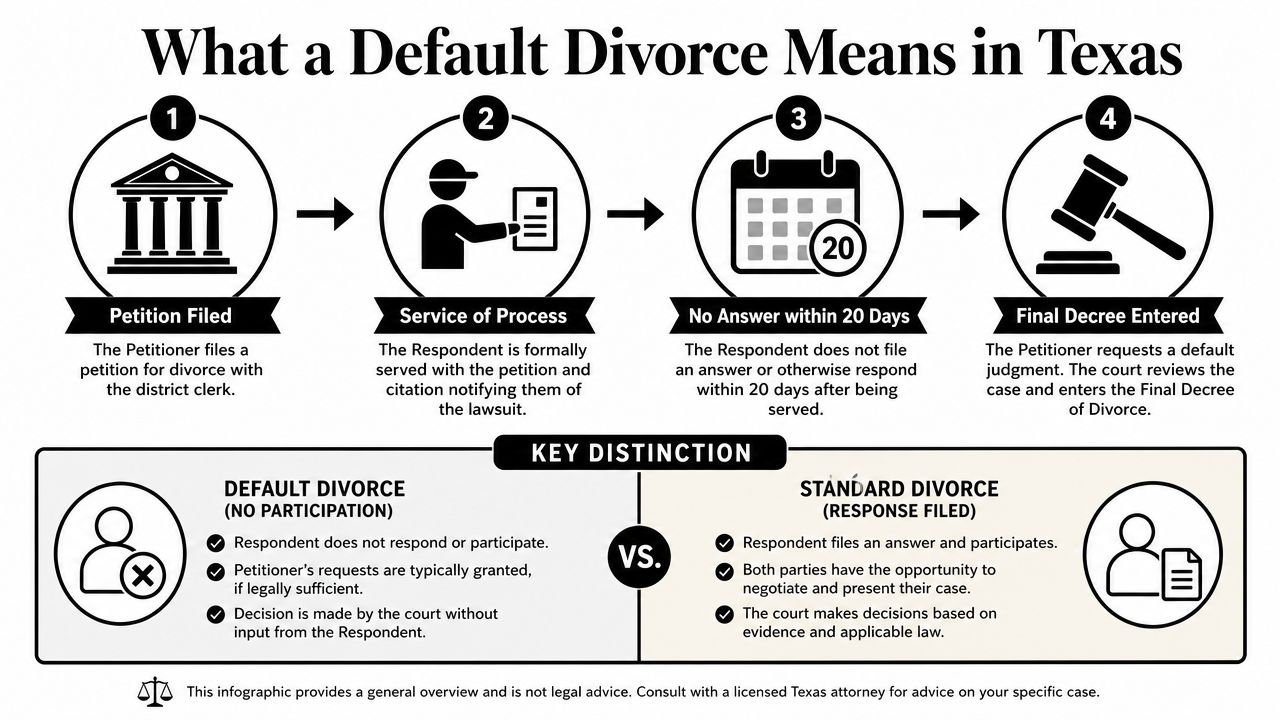
The key distinction is simple. In a default divorce, the court is making a decision with only one side fully in the room. That makes service, notice, and the record far more important than they would be in an ordinary contested divorce.
Direct Appeal Versus Restricted Appeal
Many people hear "appeal" and think there's one generic process. In Texas default-divorce cases, that's wrong. The primary choice is usually between a standard direct appeal and a restricted appeal, and the difference is decisive.
Why a direct appeal usually misses the mark
Texas appellate procedure generally requires a notice of appeal within 30 days after the judgment is signed in a divorce case, and a motion for new trial is also typically due within that same 30-day window. After that, the case moves into record-based review, where the appellate court looks at the clerk's record, reporter's record, and written briefs rather than hearing live testimony again. Source on notice-of-appeal and briefing timelines
A direct appeal works best when you preserved issues in the trial court or participated enough for the record to show the mistake. If you never showed up and never answered, that route often doesn't fit the facts. Texas courts are not going to re-try the divorce because the losing spouse missed the hearing.
Why the restricted appeal is built for default cases
Texas appellate procedure gives a nonparticipating spouse a limited 6-month window to bring a restricted appeal after a divorce judgment is signed. To win, the spouse must show they did not participate in the hearing, did not file certain post-judgment requests, and that error appears on the face of the record. Source on restricted appeal requirements and Craddock discussion
That is a different burden from a direct appeal. In a restricted appeal, you are not trying to tell the court what happened outside the record. You are pointing to what the record itself proves went wrong.
Plain-English rule: if the error is hidden outside the court file, a restricted appeal probably won't reach it. If the mistake is visible in the paperwork, the judgment, or the service record, that's where the fight starts.
If you need a deeper procedural roadmap, the firm's page on Restricted Appeal in Texas Family Court is worth reviewing. It tracks the same basic problem most default-divorce clients face, finding the right vehicle before the deadline closes.
Motion for New Trial and the Craddock Test
A motion for new trial is usually the first serious move after a default decree is signed. It asks the trial court to set aside the default and hear the case on the merits, and it can preserve issues for a later appeal if the judge refuses to reopen the case. A motion for new trial in a Texas divorce is generally due within 30 days after the decree is signed. Source on the 30-day new-trial window and appellate bridge function
How Craddock works in plain English
Texas courts use the Craddock test to decide whether to set aside certain default judgments. The moving spouse has to show three things: the failure to answer was not intentional or the result of conscious indifference, there is a meritorious defense, and a new trial won't cause undue delay or prejudice to the other side. Source on Craddock and abuse of discretion
That test is practical, not theatrical. If you ignored the lawsuit on purpose, you're in bad shape. If you missed it because of a real notice problem, and you have a real defense, the motion becomes much stronger.
Abuse of discretion means the judge crossed the line
In everyday language, abuse of discretion means the judge made a decision that was arbitrary, unreasonable, or outside the bounds of proper legal judgment. Appellate courts use that lens because they are reviewing whether the trial court handled the default correctly, not whether the appellate judges would have started from scratch.
A good example is a spouse who never received meaningful notice of the hearing, has evidence that a property issue was never properly joined, and moves quickly to set aside the decree. If the trial court refuses to reopen the case despite a strong service problem and a real defense, that refusal can become the issue on appeal.
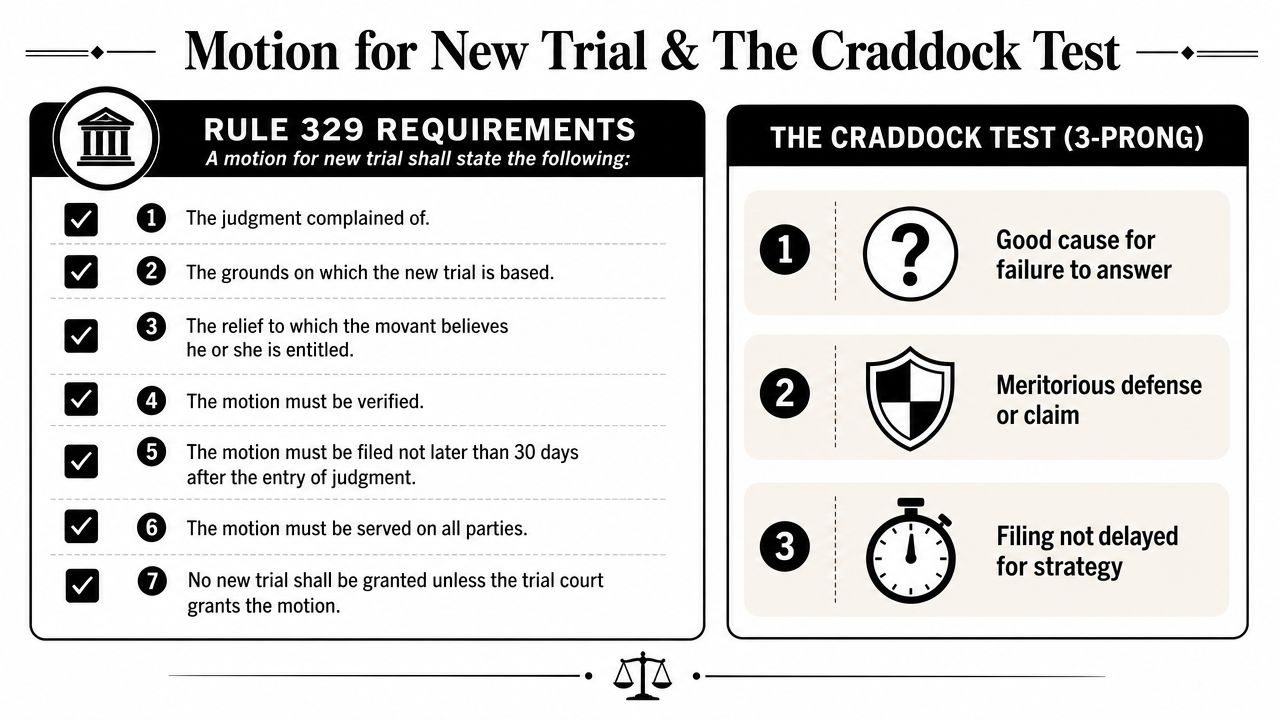
The internal link on this issue belongs here, because the motion for new trial is the first pressure point in the whole process. See Motion for New Trial in Texas Family Law for a focused discussion of that remedy.
Restricted Appeal and Bill of Review Compared
Once the 30-day motion window closes, the case narrows fast. At that point, the two main tools are a restricted appeal and a bill of review, and they are not interchangeable.
The restricted appeal is faster but narrower
A restricted appeal generally must be filed within six months of the signed judgment and requires error apparent on the face of the record. It does not require the same kind of diligence showing that a bill of review does, but it also does not let you rely on new evidence outside the record.
That makes it the better fit when the mistake is already documented. Bad service, a judgment that grants relief not supported by the pleadings, or other record-based defects are the types of issues that can work there.
The bill of review is the long road
A bill of review is an independent equitable action. It is not a normal appeal, and it usually requires proof of a meritorious defense plus strict compliance with service and diligence requirements. It is the harder route because the court expects you to explain why the judgment should be undone even though the ordinary deadlines have passed. Source on bill of review and Craddock factors in default settings
That's why choosing the wrong remedy is such a common mistake. A client who still has a clean record problem should not waste time building a bill of review. A client whose facts live outside the appellate record may need the equitable route instead.
| Remedy | Deadline | Proof focus |
|---|---|---|
| Restricted appeal | 6 months | Error on the face of the record |
| Bill of review | No fixed appellate deadline, but heavy equitable burden | Meritorious defense, service, diligence |
In practical terms, the restricted appeal is the cleaner procedural attack. The bill of review is the fallback when the record alone won't get the job done.
Reversible Errors Texas Family Courts Most Often Make
Not every bad outcome is reversible error. That's the hard truth. A reversible error is a legal mistake that matters enough for the appellate court to change the result or send the case back.
The errors that actually move a default-divorce appeal
Improper or insufficient service of process is one of the strongest issues in these cases. If the court never had proper jurisdiction over the responding spouse, the decree can fail at the foundation.
Failure to consider a meritorious defense also matters. If the trial court denied a new trial when the record showed a real, legally relevant defense, that refusal can be challenged. The same is true when the decree grants relief that doesn't line up with the pleadings or the evidence in the record.
A default judgment is not supposed to become a shortcut around due process. If the service is bad, the notice is bad, or the ruling goes beyond the pleadings, that's where appellate review gets serious.
Custody, property division, and support rulings can also create reversible issues when the record doesn't support what the court ordered. The appellate court isn't looking for a fresh emotional assessment. It is looking for legal error in the record.
Preservation still matters, even in default cases
Preservation of error means the issue was raised the right way at the right time, usually through an objection, a motion, or another step that gave the trial court a chance to correct the problem. In default-divorce cases, that often happens in the motion for new trial or through a jurisdictional complaint that shows up on the record.
If you never gave the trial court a chance to fix the problem, some issues are harder to raise later. That's why appellate work starts in the trial court, even if the end goal is the court of appeals.
Steps to Take in the First 30 Days After a Default Decree
The first 30 days are not for guessing. They're for action. If you just discovered a default divorce decree, treat the clock like it matters, because it does.
Do these things in order
- Find the signed decree immediately. You need the exact date the judge signed it, because that date controls the deadlines.
- Calculate the deadline, not the emotion. Count forward from the signing date, then decide whether you still have a motion-for-new-trial window.
- Pull the record. The clerk's record shows filed papers, and the reporter's record shows what happened in court if there was a hearing.
- Identify the defect. Service problem, wrong relief, missing notice, or unsupported ruling. Be specific.
- Call an appellate lawyer before filing anything. One bad filing can complicate the next step.
The internal resource If You Were Not Properly Served in Texas fits here because service problems often decide whether a default decree can be attacked at all.
Don't make avoidable mistakes
Don't wait to see whether the other side will “fix” the decree. Don't post about the case online. Don't sign papers that could look like you accepted the judgment if you're trying to challenge it.
If you want to challenge the decree, act like the record is being built now, because it is. The appellate court will care a lot more about the documents and deadlines than about how unfair the result feels after the fact.
Getting Strategic Help Before the Clock Runs Out
Default-divorce appeals are winnable in the right case, but only if you choose the right vehicle fast. The key job is not relitigating the divorce, it's showing that the trial court misapplied the law, lacked proper notice, or abused its discretion when it signed the decree.
A focused appellate review can tell you quickly whether you have a true reversible-error issue or just a painful result. That distinction matters, because wasted motion practice burns time you may not get back.
If you believe the court made a mistake in your family law case, our appellate attorneys can help you seek a fair outcome. Contact The Law Office of Bryan Fagan today for a free consultation.
A CTA for The Law Office of Bryan Fagan, PLLC.