Skip to content
You may feel the ruling was unfair the moment you read it. Maybe the judge ordered support that seems too high, too long, or based on facts the court seemed to miss. That reaction is understandable, but an appealing spousal support order Texas case turns on a narrower question than fairness alone, it turns on whether the trial court made a legal error that the court of appeals can fix.
That distinction matters. Texas appellate courts do not reopen the divorce and do not listen to new testimony just because the result feels wrong. They review the existing record for abuse of discretion, reversible error, and misapplication of the Texas Family Code, which means the strategy has to be precise from the start.
Understanding What an Appeal Actually Is
A spouse often calls after a support order is signed and says the same thing in different words, “The judge didn't listen.” Sometimes that means the court got the law wrong. Sometimes it means the evidence was weak, incomplete, or just lost on credibility. Those are very different appellate problems.
Appeal Is Review, Not a New Hearing
An appeal is not a second trial. The court of appeals looks at the trial record, not new documents or new testimony, and decides whether the judge made a legal mistake that changed the outcome. That is why Texas family-law appeals are built around the record, the ruling, and the standard of review, not around re-arguing every fact the way you would in the trial court. As one practical guide to the Texas family-law appeal process explains, the appellate court's job is review, not retrial, and the relevant deadline and record rules drive everything that follows, as discussed in the Texas family law appeal process guide.
Practical rule: If your argument depends on evidence the judge never saw, it usually belongs in the trial court, not on appeal.
That is why many clients are frustrated by the appellate process at first. A ruling can feel profoundly unjust, yet still be hard to reverse if the law was applied correctly and the record supports the order. Appeals are powerful, but they are not designed to give a disappointed party a fresh start.
What “Abuse of Discretion” Means
In Texas family law, abuse of discretion means the trial judge acted outside the bounds of reasonable decision-making, misapplied the governing law, or made a ruling unsupported by the record. It does not mean the appellate judges would have ruled the same way in the first place. They are not substituting their judgment for the trial court's just because they might have weighed things differently.
That matters in spousal maintenance cases because support rulings often involve legal thresholds and statutory limits, not just equity. If the trial court went beyond what the statute permits, that can create a clean appellate issue. If the court made a close call on credibility within the lawful range, the appeal is usually much harder.
A good appeal starts with the right question, not the loudest complaint. The question is whether the order was wrong as a matter of law, not whether it felt harsh in the moment.
Statutory Limits That Create Appealable Errors
Texas spousal maintenance is tightly controlled by statute, and that is where many appeals begin. The law gives appellate courts concrete benchmarks to compare against the written order, which makes it easier to identify reversible error when the trial court exceeds its authority. Under Texas Family Code § 8.055, the monthly cap is generally the lesser of $5,000 per month or 20% of the paying spouse's average monthly gross income (Texas spousal support and maintenance guide).
The Numbers That Matter
Here is the statutory framework in plain English. A trial court generally cannot order more than the monthly cap above, and it also has to stay within the allowed duration based on the length of the marriage. For marriages of 10 to 20 years, maintenance can last up to 5 years. For marriages of 20 to 30 years, the cap rises to 7 years. For marriages of 30 years or more, it can last up to 10 years (Texas spousal support and maintenance guide).
| Texas Spousal Maintenance Statutory Limits | ||
|---|---|---|
| Marriage Length | Maximum Duration | Monthly Payment Cap |
| 10 to 20 years | Up to 5 years | Lesser of $5,000 per month or 20% of gross monthly income |
| 20 to 30 years | Up to 7 years | Lesser of $5,000 per month or 20% of gross monthly income |
| 30 years or more | Up to 10 years | Lesser of $5,000 per month or 20% of gross monthly income |
Those benchmarks matter on appeal because a written order that exceeds the statute gives the appellate court a direct legal issue to review. The question is no longer whether the judge sympathized with one spouse. The question is whether the judge stayed inside the authority the Legislature gave the court.
How to Spot a Statutory Problem
Start with the decree itself. Check the monthly amount, the duration, and the marriage-length category the judge used. If any part of the order crosses the statutory line, the issue may be appealable even before you get into the evidence.
This is also where a resource like Accelerated Appeals in Texas Family Cases can matter in a limited way, because some family orders carry a shorter 20-day appeal deadline. In support cases, that makes timing just as important as substance.
A support order does not become immune from review just because it was entered in a divorce case. If the court exceeded the statute, that is the kind of error appellate judges can examine directly.
Preserving Your Right to Appeal
The strongest legal issue in the world can disappear if it was never preserved in the trial court. That is the most technical, and most unforgiving, part of Texas appellate practice. The court of appeals reviews the existing record, so your lawyer has to show that the issue was timely raised and ruled on below (family-law appeals preservation guidance).
What Preservation Looks Like in Practice
Preservation usually means more than objecting once. It can involve a timely objection to the support ruling, a request for findings of fact, an offer of proof if important evidence was excluded, and post-judgment motions that give the trial court a chance to correct itself. If the issue never made it into the record, the court of appeals may refuse to consider it even if the maintenance award looks unfair on its face.
A practical way to think about it is this. The appellate court wants to see the objection, the ruling, and the paper trail showing the trial judge had a fair chance to address the problem. Without that, the court often treats the issue as waived.
- Timely objection: Counsel must object when the court makes the contested ruling, not after the hearing is over.
- Written findings and motions: Requests for findings or post-judgment motions can help define the issues for review.
- Record audit: The appellate lawyer checks the reporter's record, the clerk's record, and any written orders before drafting the notice of appeal.
Why the Record Controls the Case
The record is the appeal. If a key argument was never raised, or if the transcript does not reflect the objection, the appellate court may not reach the merits. That is why appellate counsel reviews the entire file before deciding which points are real appellate issues and which ones are not.
Bottom line: a weak record can turn a strong complaint into a dead end.
This is also where family-law appeals differ from trial strategy. Trial lawyers build the case for the judge who hears witnesses. Appellate lawyers build the case for judges who read the paper record and expect clean legal framing. If you want to challenge an unfair maintenance order, the record has to support the argument before the brief ever gets filed.

Critical Deadlines and Filing Requirements
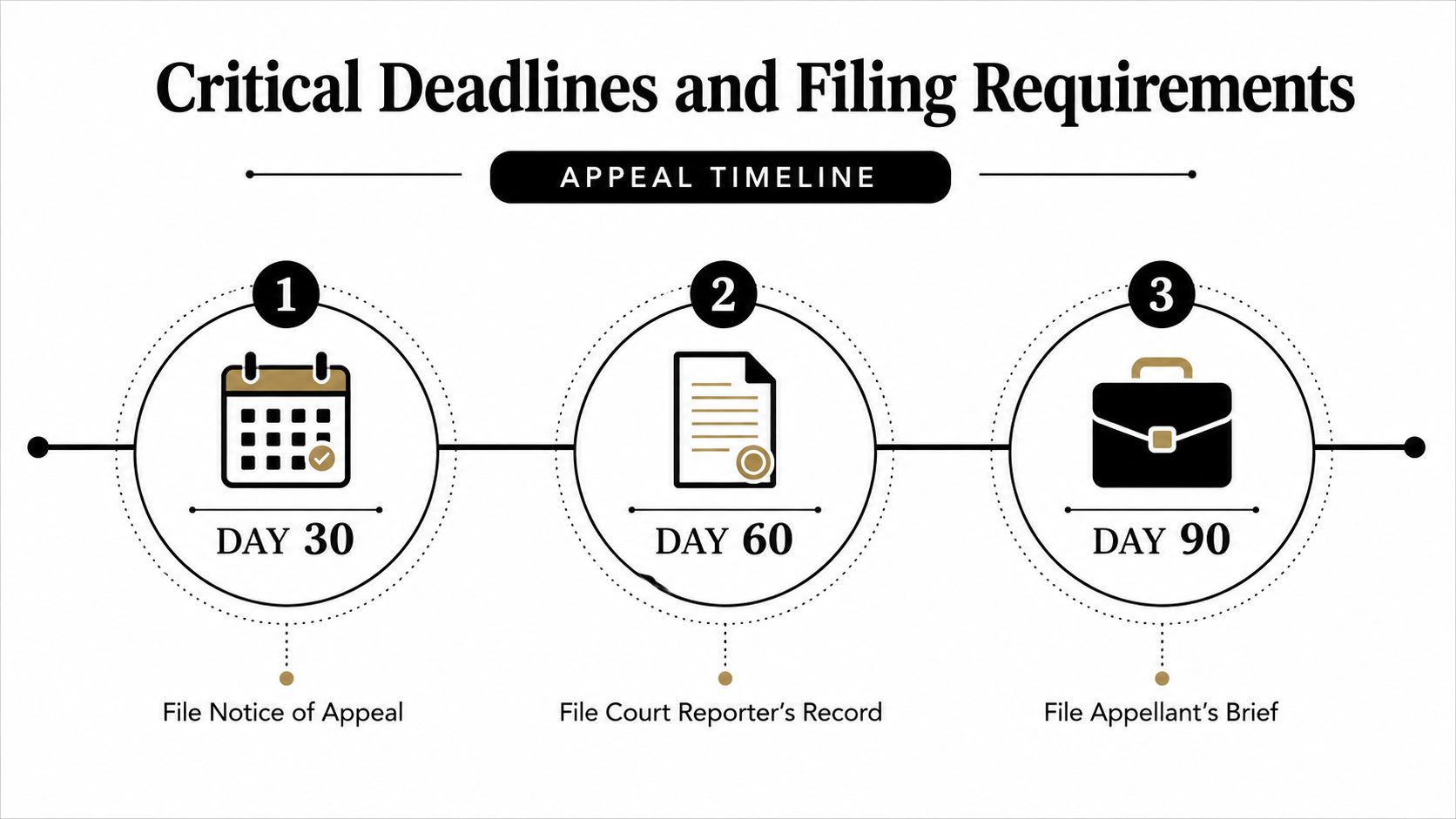
Texas appellate deadlines are strict, and waiting for a better moment can cost the appeal entirely. Under the Texas Rules of Appellate Procedure, a party generally must file a notice of appeal within 30 days after the trial court signs the final judgment or order, and that deadline can extend to 90 days if certain post-judgment motions are timely filed (Texas notice of appeal deadline guide). Texas family-law review materials also emphasize how quickly related deadlines can disappear, including the 30-day motion-for-new-trial window and the 3-business-day deadline for certain de novo review requests in master proceedings (family court appeals timing guide).
The Timeline You Have to Respect
The first step is the notice of appeal. If that filing is late, the appeal is usually over before the merits are even considered. If a timely post-judgment motion is filed, the timeline may extend, but that only helps if the motion itself is properly filed and strategically useful.
After that, the case becomes record-driven. Counsel orders the reporter's record, prepares the appellate record, and starts identifying the issues that can be won. The clock keeps running during all of that, which is why delay is one of the biggest mistakes people make after a bad ruling.
The deadline guide at what is the deadline for filing a notice of appeal in Texas is useful because it puts the filing sequence in the right order. First, secure the appellate deadline. Then, preserve the record. Then, brief the errors that matter.
Briefing Is the Real Work
Briefing means writing the appellate argument in a way that ties the facts, the record, and the law together for the court of appeals. It is not a summary of what happened in the trial court. It is a focused legal document that explains why the judge's order should be reversed or modified.
A strong briefing strategy starts early, not after the deadline is looming. The issues have to be narrowed, the record cited precisely, and the law matched to the exact kind of error the judge made. If the case only raises one clean legal issue, that is often better than forcing five weak ones into the same brief.
Before you can argue the case, you have to file it correctly.
Appeal Versus Modification
A lot of people use the word appeal when they really want a change in support because life has changed. That is understandable, but Texas treats those as different procedures. Appeal corrects an error in the original ruling. Modification addresses later changes in circumstances, and those are not the same thing.
When an Appeal Is the Right Tool
An appeal makes sense when the support order itself may be legally wrong. That includes a court exceeding the statutory cap, imposing maintenance outside the allowed duration, or making a ruling that cannot be supported by the existing record. The appellate court's job is to decide whether the original judgment should stand.
This is the path when your complaint is about the judge's legal ruling, not about what happened after the decree. If the court misapplied the Family Code, appeal is the proper vehicle. If the order was signed without required procedure or based on findings that do not match the law, the appeal targets that error directly.
When Modification Belongs in a Separate Case
Modification belongs in the trial court when the facts have changed after the order was signed. Texas practice materials explain that spousal maintenance can be addressed through modification or termination when circumstances such as remarriage, cohabitation, or a material change in financial condition come into play (Texas spousal maintenance modification guidance). That is a different question from whether the original ruling was lawful.
The practical difference is simple. Appeal asks, “Did the judge make a mistake?” Modification asks, “Have the facts changed enough to justify a new order?” If you confuse the two, you can end up fighting the wrong battle.
- Appeal: challenges the old ruling on the existing record.
- Modification: asks the court to adjust support because the facts changed later.
- Enforcement: tries to make an existing order obeyed, not rewritten.
A failed appeal does not replace a proper modification case. If the circumstances change later, the trial court still needs the new facts.
That distinction matters most when a client wants immediate relief from a support obligation that no longer fits reality. Sometimes the right answer is to appeal now. Sometimes the right answer is to return to the trial court later with new evidence and seek modification instead.
Building a Persuasive Appellate Brief
A convincing appellate brief does not sound like a trial closing argument. It sounds like a legal roadmap. The brief has to identify the error, tie it to the standard of review, and explain why the record shows the trial court crossed the line.
What Appellate Judges Need to See
The court of appeals wants controlled, record-based arguments. That means the brief should point to the exact parts of the record that support the complaint, then explain how the law applies to those facts. In a spousal support appeal, that often means focusing on whether the judge misapplied the Family Code, relied on unsupported findings, or imposed maintenance in a way the statute does not allow.
The appellate practice page on appellate brief requirements in Texas family law is useful because it reinforces what a brief has to do, not just what it should look like. The appellate court does not want a rehash of testimony. It wants a disciplined argument that makes reversal legally possible.
Why Specialized Appellate Counsel Helps
A trial lawyer is trained to persuade a judge and preserve a live case. An appellate lawyer is trained to read the record, find the reversible issue, and write for judges who were never in the courtroom. Those skills overlap, but they are not identical.
I often see people try to save a bad support ruling by arguing every perceived unfairness at once. That usually muddies the brief. A tighter approach, one that isolates the actual legal error, is often more effective because it respects the standard of review and keeps the court focused on the ruling that matters.
The publisher's appellate team, The Law Office of Bryan Fagan, PLLC, handles record review, issue spotting, and briefing in family-law appeals. That kind of focused review is what turns a vague complaint about unfairness into a real appellate argument.
Taking the Next Step Toward Justice
If a spousal support order feels wrong, start by separating emotion from appellate viability. Ask three questions, did the judge exceed the statute, was the issue preserved, and is this really an appeal issue rather than a modification issue? Those questions often decide whether a case has appellate value before the first draft of a brief is written.
Bring the final order, the hearing transcript if you have it, and any post-judgment filings to a consultation. That gives appellate counsel the materials needed to evaluate deadlines, preservation, and the likely scope of review. Once those pieces are in place, the strategy becomes much clearer.
If you believe the court made a mistake in your family law case, our appellate attorneys can help you seek a fair outcome. Contact The Law Office of Bryan Fagan today for a free consultation.
If you believe the court made a mistake in your family law case, our appellate attorneys can help you seek a fair outcome. Contact The Law Office of Bryan Fagan, PLLC today for a free consultation, and let us review the record, deadlines, and possible errors in your spousal support appeal. Visit The Law Office of Bryan Fagan, PLLC to schedule your consultation and get a clear assessment of your next step.