You may feel your case was handled unfairly, especially if the judge signed the divorce decree before you understood what happened or before you had a real chance to present important evidence. The decree may already be final, but that does not automatically mean every legal remedy has disappeared.
If you want to appeal a divorce decree that was already signed in Texas, move quickly and focus on the record. An appeal isn't a second trial, and it isn't a chance to tell the same story to a new judge. It asks a Texas appellate court to decide whether the trial court made a preserved, harmful legal or procedural error under the Texas Rules of Appellate Procedure.
What It Really Means to Appeal a Signed Divorce Decree in Texas
A signed final decree changes your case's posture. Before signing, your lawyer may ask the trial court to reconsider, correct, or clarify its ruling. After signing, the appellate court generally reviews what the trial court did through the written record, including the clerk's file and the reporter's transcript.
That means an appeal doesn't let you call witnesses again, introduce new documents, or ask the appellate judges to decide which spouse seemed more believable. The appellate court examines specific complaints tied to rulings, evidence, objections, findings, and legal standards that appear in the record.
Practical rule: A bad result isn't automatically reversible. You need a specific error, preservation in the trial court, and a record showing that the error mattered.
An appeal is different from several forms of post-judgment relief. A motion for new trial asks the trial judge to reconsider the judgment or conduct another trial. A motion to modify may ask the trial court to change a judgment when the law permits that relief. An enforcement proceeding asks the court to enforce an existing order. A petition for bill of review is a separate, limited remedy for attacking a final judgment in circumstances that don't fit an ordinary appeal.
The first question is not just, “Can I appeal?” Ask four practical questions in order:
- Should you move first or appeal first? A timely post-judgment motion may give the trial court a chance to correct an error and may extend the appellate deadline.
- What is in the record? If the evidence, objection, or ruling isn't preserved, the appellate court may be unable to consider it.
- What deadline controls? In Texas, the signing date usually controls, not the date you received a copy.
- Is the issue worth the investment? An appeal can take substantial time and legal work, so the complaint must be specific and legally viable.
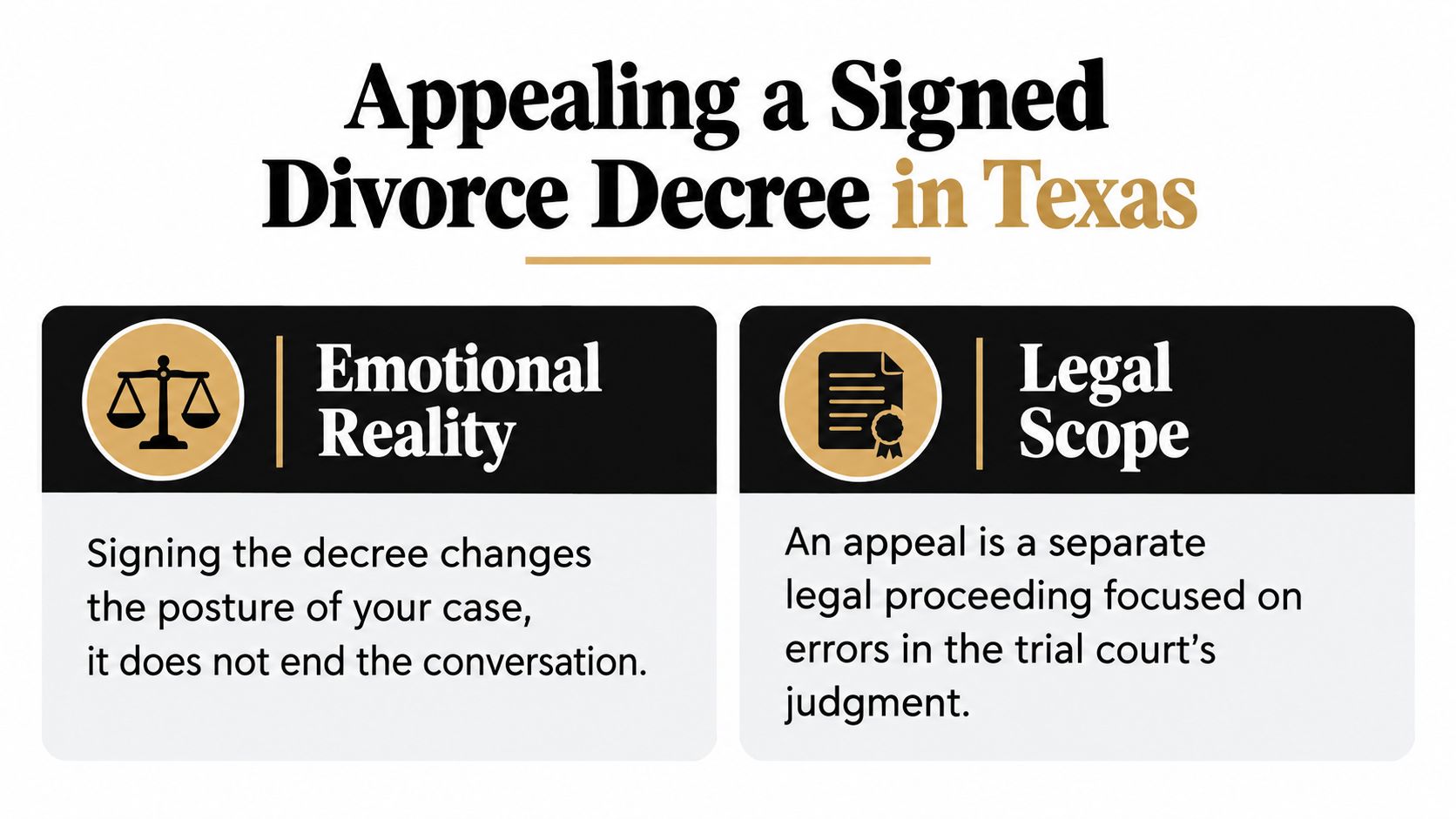
Texas appellate courts have applied the ordinary deadline rule even when a party later receives the decree or decides to challenge it. In one Texas case, the decree was signed on April 14, 2017, making May 15, 2017 the appeal deadline under the applicable calculation. See the Texas First Court of Appeals decision applying the deadline rule.
Decisions in a Texas Divorce Decree You Can Actually Appeal
The strongest appeal usually attacks a legal rule, a procedural failure, or a discretionary ruling unsupported by the evidence. A complaint that merely says, "The judge chose the wrong result," is much harder to win.
A court may have applied the wrong law to facts that weren't disputed. It may have divided property without properly addressing the community-property evidence, made custody findings without a meaningful best-interest analysis, or entered a support ruling without evidence needed to support the calculation. Procedural problems can also matter, including a denial of due process, improper handling of evidence, or a ruling made after an opportunity to be heard was unfairly restricted.
A trial judge does have broad discretion in many family-law decisions. An appellate court generally won't reverse merely because it might have divided property differently or preferred another parenting schedule. Credibility decisions are also difficult to challenge because the trial judge directly observed the witnesses.
| Type of Ruling | Examples | Likely Reversible? |
|---|---|---|
| Legal error | The court applies the wrong statute or legal rule to undisputed facts. | Potentially, especially if preserved and harmful. |
| Property-division error | The decree rests on unsupported findings or ignores material evidence concerning community or separate property. | Potentially, depending on the record and harm. |
| Custody or visitation error | The court makes a ruling without sufficient evidence or fails to apply governing best-interest principles. | Potentially, but deference is substantial. |
| Support error | The order lacks evidence supporting the required calculation or applies the wrong legal standard. | Potentially, if the issue was preserved. |
| Procedural or constitutional error | A party wasn't given a meaningful opportunity to present evidence or respond. | Potentially, if the record shows harm. |
| Credibility disagreement | The appellant believes the judge should have believed a different witness. | Usually not by itself. |
| Dissatisfaction with the result | The property division feels unequal or the schedule is inconvenient. | Usually not without a legal or evidentiary error. |
The phrase reversible error means more than a mistake. It means an error that likely affected the judgment and justifies relief from the appellate court. A lawyer should identify the exact ruling, the governing law, the preservation event, and the record citation before treating a complaint as an appealable issue.
How Post-Judgment Motions Affect Your Appeal Deadline
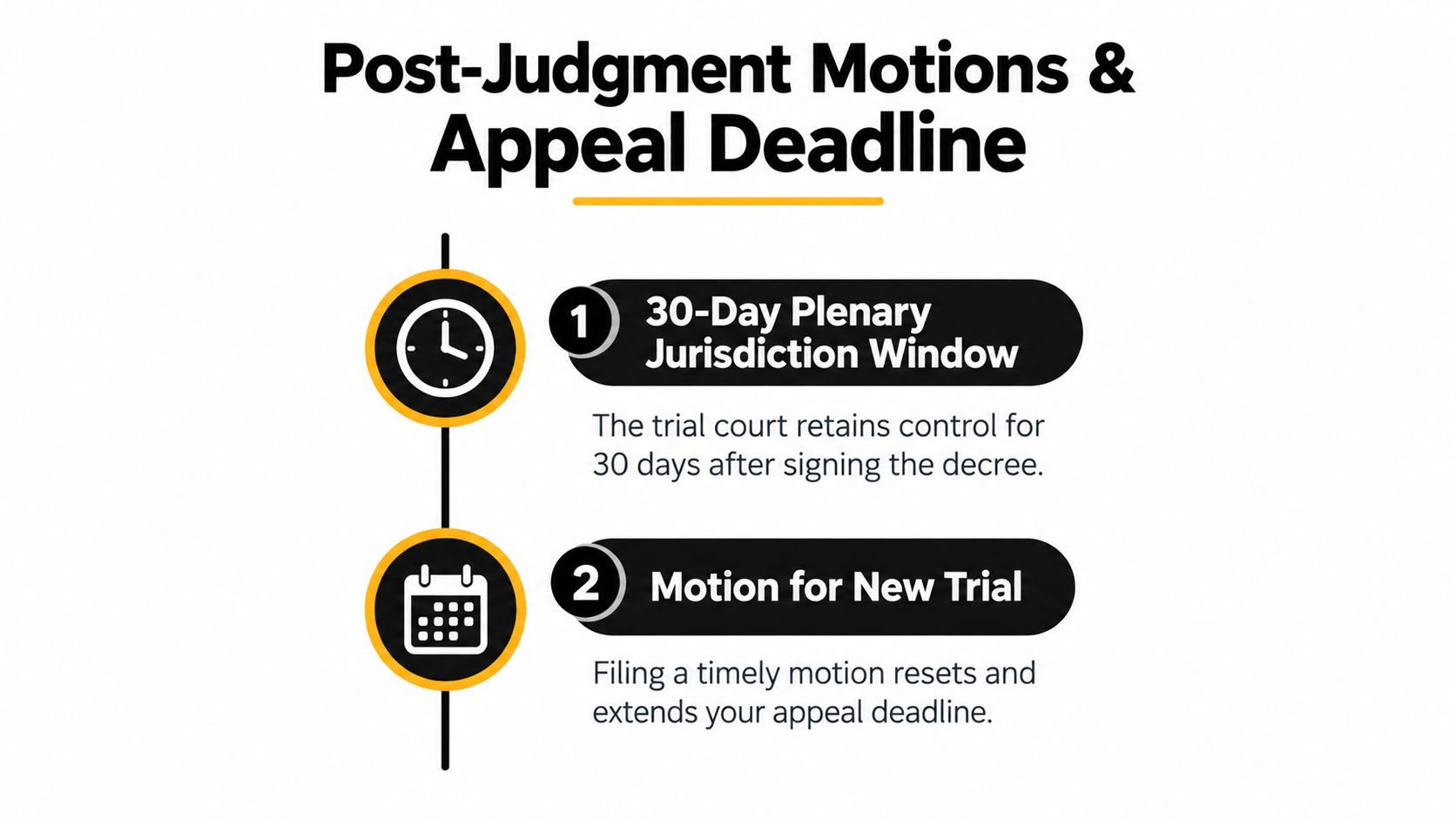
The ordinary Texas deadline to file a notice of appeal is 30 days after the final decree is signed. That deadline can extend to 90 days after signing when a party timely files a qualifying post-judgment motion, including a motion for new trial, motion to modify the judgment, motion to reinstate, or a qualifying request for findings of fact and conclusions of law. The Texas appellate rules provide the controlling framework in the current Texas Rules of Appellate Procedure.
The trial court generally retains control over its judgment during a 30-day plenary jurisdiction window. During that period, the court may have authority to modify, correct, vacate, or reconsider the decree under the applicable rules. A motion isn't a placeholder that preserves everything automatically. It should identify the error, explain the requested relief, and give the trial court a clear chance to address the problem.
Choosing the right motion
A motion for new trial may challenge the evidentiary or procedural basis for the judgment and may ask the trial court to reopen the case. A motion to modify may target a specific provision of the judgment when modification is legally available. A motion to reinstate applies in the circumstances governed by the relevant rule, such as a dismissal for want of prosecution.
A qualifying motion can extend the deadline, but filing a weak or bare motion creates risk. It may fail to preserve the issue, fail to identify the grounds needed for appellate review, or create confusion about what the trial court considered.
Deadline advice: Verify the signing date first, then determine whether a timely qualifying motion was filed. Don't calculate from the date a clerk mailed the decree.
For a focused explanation of how a motion for new trial can extend the appeal deadline, review Post-Trial Motions Before a Texas Appeal using the same deadline framework. You can also review the deadline for filing a notice of appeal in Texas before relying on a calendar estimate.
If notice of the judgment was delayed, Texas Rule of Civil Procedure 306a(4) and related appellate rules may provide a narrow timetable adjustment. That exception generally requires that the party neither received notice nor acquired actual knowledge of the signed judgment within 20 days, and the appellate timetable can't begin more than 90 days after signing. A restricted appeal has a separate six-month window, but it is available only under strict conditions.
Filing the Notice of Appeal and Perfecting Your Case
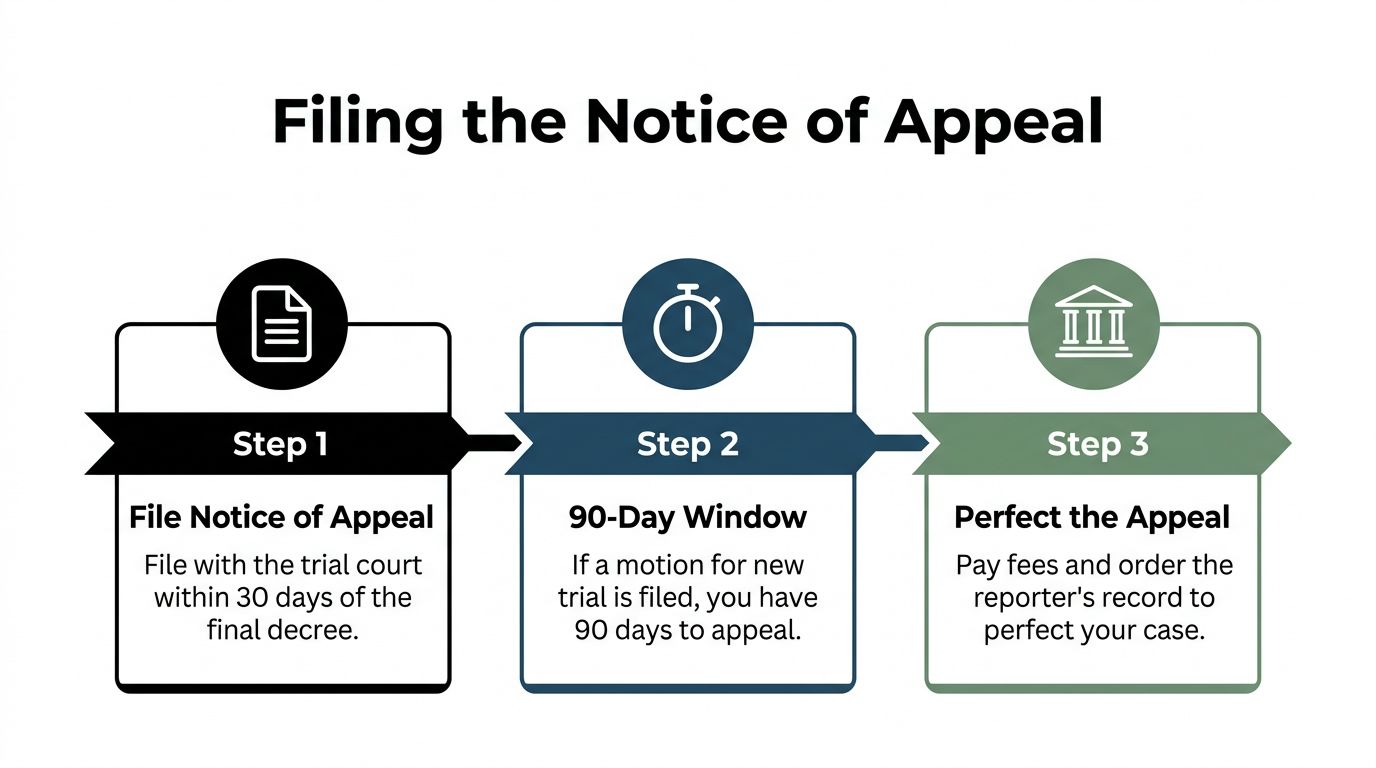
A Texas appeal starts with a written notice of appeal filed with the trial court clerk, not by sending the notice directly to the appellate court. In an ordinary divorce appeal, the notice is generally due within 30 days after the decree is signed, or within 90 days when a qualifying post-judgment filing extends the deadline under the rules.
The notice identifies the judgment being challenged and signals that the appellant seeks review. The clerk and other parties must receive the notice as required by the rules. Your appellate lawyer should confirm the correct court, cause number, parties, judgment date, and service details before filing.
The filing sequence
- Confirm the signed date. Use the date the judge signed the final decree. Do not use the date you received a copy unless a rule-based notice exception may apply.
- Check for an extending motion. Determine whether a qualifying post-judgment motion or request was timely filed.
- File the notice. File it with the trial court clerk before the controlling deadline.
- Address costs. Arrange payment of required costs, a proper cost bond or deposit when applicable, or an affidavit of inability to pay costs.
- Request the record. Designate the clerk's record and reporter's record, and coordinate with the court reporter.
- Protect the judgment. Consider whether a supersedeas bond, deposit, or other security is needed to suspend enforcement while the appeal proceeds.
The appeal is “perfected” when the required steps to invoke appellate jurisdiction are completed. The process includes timely filing, payment or qualification for costs, and proper preparation of the record. The clerk's record contains the trial-court documents, while the reporter's record contains hearing and trial transcripts.
The Texas procedure for filing a notice of appeal provides a useful procedural reference. The Notice of Appeal Deadline in Texas Family Cases also explains why the ordinary filing period is short.
A late notice can end the appeal before the court reaches the merits. A narrow restricted-appeal procedure may remain available in some cases, but it isn't a general way to revive an ordinary appeal.
Building the Appellate Record the Right Way
The appellate record is the case the appellate judges can review. It usually has two parts. The clerk's record includes pleadings, motions, orders, the signed decree, filed exhibits, and other documents from the trial-court file. The reporter's record includes the court reporter's transcription of hearings and testimony.
A strong appellate argument must connect each complaint to a record citation. If you argue that a witness admitted a fact, the transcript should show it. If you challenge an exhibit, the clerk's or reporter's record should show the exhibit, the objection, and the ruling. The appellate court generally won't consider evidence attached to a brief that never became part of the trial record.
What happens when the record is incomplete
Ask early whether the important hearings were recorded. Request the reporter's record in writing and identify the hearings, exhibits, and portions of testimony that matter. If the court reporter can't produce part of the record, the rules provide procedures for addressing the omission, but the solution depends on the reason for the gap and the issue affected.
When no reporter was present, or when a proceeding wasn't recorded, a party may need to pursue a statement of facts or another record-development procedure under the applicable appellate rules. A bill of exception is a formal method for showing what occurred outside the ordinary record, often when the trial court excluded evidence or made an evidentiary ruling off the record. Texas appellate guidance emphasizes filing a bill of exception within 30 days after the notice of appeal when that procedure applies.
Record principle: The appellate court can't review testimony that exists only in your memory.
Preservation begins before the decree is signed. Make the objection, state the ground, obtain a ruling, and ensure the event appears in the record. For practical guidance on designating and paying for the record, review designating and paying for the appellate record.
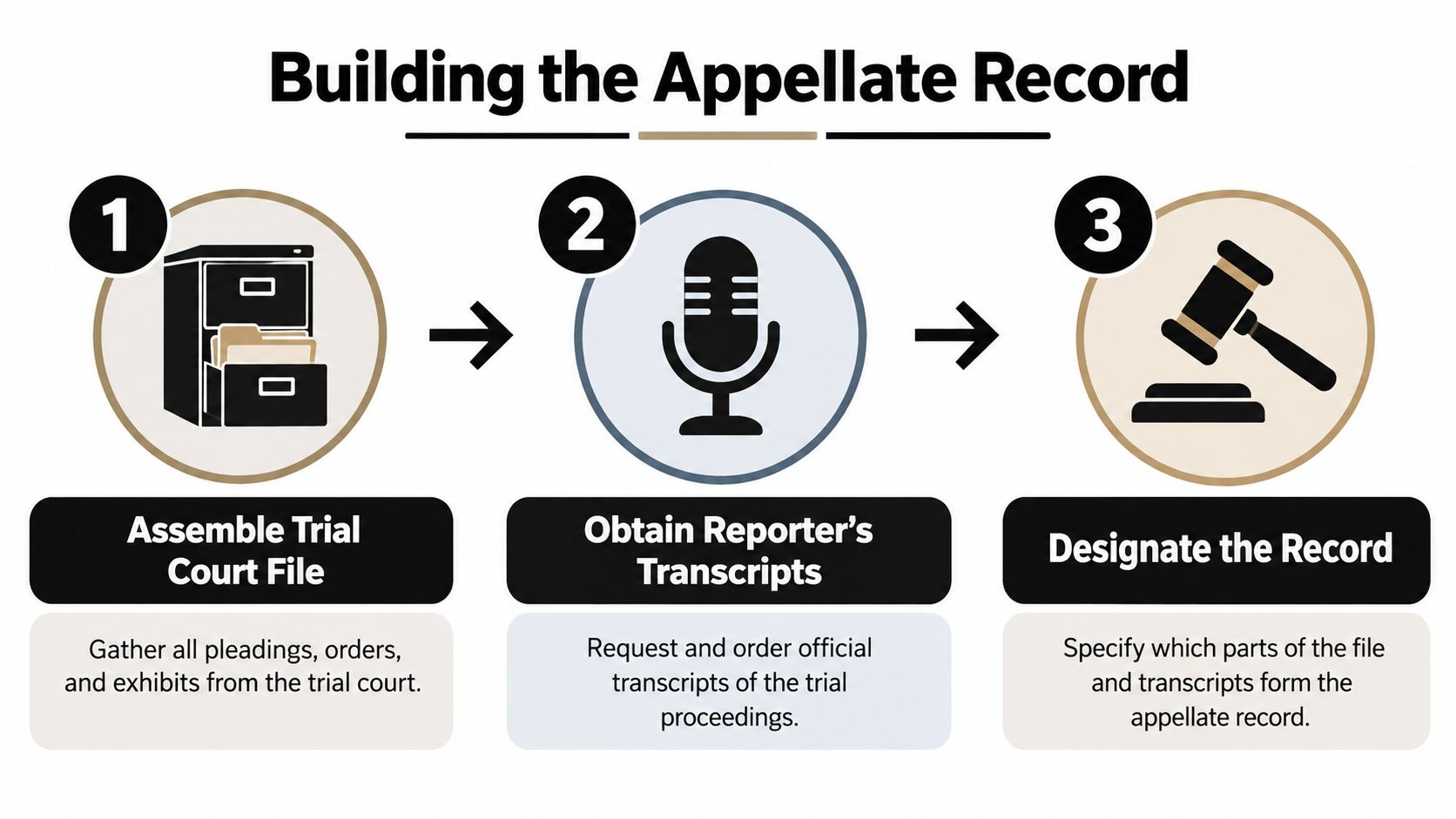
If a transcript is missing, the appeal may be limited to errors visible from the written decree and clerk's record. That limitation can defeat an otherwise plausible complaint about testimony, evidence, or a trial judge's factual reasoning.
Standards of Review and Why They Often Decide the Outcome
The standard of review is the legal lens the appellate court uses. It often matters more than how strongly a client believes the trial judge was wrong. A pure legal question receives a different review than a custody or property ruling based on disputed evidence.
Texas family courts commonly receive abuse-of-discretion review for custody, visitation, property division, and support decisions. In plain English, the appellate court asks whether the trial judge acted arbitrarily, unreasonably, or without reference to guiding rules and principles. A reasonable disagreement between judges isn't enough.
A legal question is generally reviewed de novo, meaning the appellate court decides the issue independently without deferring to the trial court's legal conclusion. Statutory interpretation and certain summary-judgment rulings generally receive this more favorable lens.
| Issue on Appeal | Standard of Review | What Appellant Must Show |
|---|---|---|
| Statutory interpretation | De novo | The trial court used the wrong legal meaning or rule. |
| Pure legal question | De novo | The legal conclusion is incorrect under governing law. |
| Custody or visitation | Abuse of discretion | The ruling was arbitrary, unreasonable, or unsupported by guiding principles, and the error caused harm. |
| Property division | Abuse of discretion | The division rests on a legally improper basis, unsupported findings, or a clear failure to exercise discretion properly. |
| Child or spousal support | Abuse of discretion, with evidence review as appropriate | The court lacked sufficient evidence or applied the wrong legal framework. |
| Evidence challenge | Preservation and harm analysis | The objection was timely, the ruling was error, and the error probably affected the judgment. |
| Unpreserved complaint | Limited review, including possible plain-error principles | The issue fits a narrow exception, which is difficult to establish. |
Briefing means presenting the legal argument to the appellate court in a written brief. Effective briefing identifies the issue, states the applicable law, explains the error, proves preservation, and cites the record. It doesn't merely repeat trial testimony or express dissatisfaction.
Texas Rule of Appellate Procedure 44 requires a harm analysis for many errors. Even if the appellate court agrees that the trial judge made a mistake, the appellant generally must show that the error probably caused an improper judgment or prevented proper presentation of the case.
Common Reversible Errors and Practical Next Steps
A property division may deserve review when the decree reflects a misapplication of the community-property rules, ignores material evidence, or relies on findings that the record doesn't support. Texas courts divide community property in a manner they consider just and right, not by an automatic equal split. The appellate issue isn't that one spouse received less. It's whether the trial judge used the correct legal framework and had evidence supporting the decision.
A custody ruling may present a stronger issue when the court overlooked important evidence or failed to analyze the child's best interests under the governing principles. The Holley factors, associated with Holley v. Adams, provide a framework for evaluating best-interest evidence. A party must still show what evidence was presented, how the court handled it, and why the ruling was harmful.
Support orders can raise legal or evidentiary issues when the court uses the wrong resources, applies the wrong guideline framework, or enters an amount without adequate supporting evidence. The remedy depends on the precise order and the record, not on a general claim that the payment is unaffordable.
| Error Category | Example of Reversible Error | Typical Appellate Result |
|---|---|---|
| Property division | The decree uses an improper legal rule or findings lack evidentiary support. | The court may reverse and remand the division for reconsideration. |
| Custody | The record shows a failure to apply governing best-interest principles to material evidence. | The court may reverse, remand, or require a new ruling. |
| Child support | The order rests on an incorrect legal calculation or insufficient evidence. | The court may modify, reverse, or remand the support ruling. |
| Spousal maintenance | The trial court applies the wrong statutory eligibility or amount standard. | The court may reverse or remand the maintenance issue. |
| Evidence preservation | The party failed to object or obtain a ruling. | The complaint may be waived. |
| Missing findings | Findings were necessary to explain the judgment but weren't properly requested or obtained. | Review may be impaired, or the issue may be remanded. |
| Summary judgment | The trial court relies on a ground that wasn't properly presented or resolved. | The judgment may be reversed or remanded. |
| Off-record evidence | A bill of exception is inadequate or absent. | The appellate court may be unable to review the complaint. |
| Deadline failure | The notice of appeal is late. | The appeal may be dismissed without merits review. |
Texas appellate survey data reported a 24% reversal rate in divorce cases, including enforcement and modification matters, and a 32% reversal rate for family cases overall. Those figures come from Evaluating Appeals by the Numbers. They aren't a promise about your case. They show why an appeal should be record-first and error-specific rather than a broad challenge to the entire decree.
Before the filing deadline runs, give an appellate attorney:
- The signed decree: Include every page, attachment, and referenced order.
- The timeline: Identify the signing date, notice date, post-judgment filings, and any hearing dates.
- The trial record: Gather pleadings, exhibits, orders, discovery responses, and transcripts.
- The suspected errors: Write down what the court did, what rule you believe applies, and what harm resulted.
- The immediate risks: Flag enforcement, possession, support, property transfers, or protective-order consequences that may require separate attention.
A lawyer should then determine whether a post-judgment motion is appropriate, whether the ordinary appeal deadline remains open, whether a restricted appeal is even available, and which complaints were preserved. The Texas restricted-appeal rules provide a six-month window after signing, but the remedy requires specific showings, including that the appellant was a party, didn't participate in the hearing that produced the judgment, didn't file a timely post-judgment motion or qualifying request, and can show error on the face of the record. That is a narrow path, not a substitute for a timely ordinary appeal.
The Law Office of Bryan Fagan, PLLC evaluates Texas appeals involving divorce decrees, child custody, property division, support, and protective orders by examining deadlines, preservation, standards of review, and the complete appellate record. If you believe the court made a mistake in your family law case, schedule a free consultation through The Law Office of Bryan Fagan, PLLC so an appellate attorney can evaluate whether a motion, ordinary appeal, restricted appeal, or another remedy fits your situation.