You may feel your Texas family-law case was handled unfairly. Perhaps the court entered a custody order you believe ignored important evidence, divided property in a way that doesn't reflect the record, or issued a protective or termination order that changed your family's future. After the hearing ends, it's natural to focus on the result. But the signed order starts a separate legal process, and that process runs on strict deadlines.
The Deadlines & notice-of-appeal pillar is the foundation of that process. Texas appeals aren't new trials. They depend on jurisdiction, preservation, the trial-court record, and a timely notice of appeal. The rules can feel technical when the stakes involve your children, home, finances, or safety. A calm review of the calendar can turn that uncertainty into a practical plan.
When the Trial Ends and the Clock Starts
The courtroom may feel quiet after the judge signs the final order. A parent leaves with a custody ruling, a spouse reviews a property division, or a party receives a protective order and realizes that the trial has ended but the legal consequences are just beginning. The date that matters for appellate planning is generally the date the judgment or appealable order is signed, not the day the hearing took place.
That distinction can change what options remain. Texas appellate procedure generally gives parties in ordinary civil and family-law appeals 30 days after the judgment is signed to file the notice of appeal. A qualifying, timely post-judgment filing can move that deadline to 90 days, while an accelerated appeal follows a shorter 20-day timetable. The correct answer depends on the type of order and the filings made after judgment, not on a single rule that fits every family case. The guide to how long after trial a Texas judgment can be appealed provides useful background, but your own signed order and docket still require individual review.
The first practical question
Start by obtaining the signed order. Then identify whether it is final, whether a statute makes the appeal accelerated, and whether a post-judgment motion could affect the ordinary deadline. A hearing date, a notice from the clerk, and the date the judge signs the order may all be different.
Practical rule: Treat the signing date as the first date on the appellate calendar, then verify every possible deadline with the Texas Rules of Appellate Procedure and the case docket.
A parent shouldn't have to decide every appellate issue immediately. The first task is preserving the ability to make that decision. Once the notice-of-appeal deadline passes, the appellate court may never reach the alleged mistake, regardless of how unfair the result feels.
What a Notice of Appeal Actually Does
A notice of appeal is the document that tells the trial court and the appellate court that a party seeks review. In Texas civil and family-law cases, filing that notice generally perfects the appeal and invokes appellate jurisdiction. In plain English, it opens the appellate case and gives the reviewing court authority to consider the appeal.
That filing doesn't explain every legal error, and it doesn't replace the appellate brief. It protects the gateway to review. The later record, briefing, and appellate arguments determine whether the court can grant relief.
The Notice of Appeal Deadline in Texas Family Cases explains why parties generally have only 30 days to begin a family-law appeal. The deadline matters because missing it usually prevents merits review unless a narrow exception applies.

An appeal isn't a second trial
At trial, the judge or jury hears testimony, considers exhibits, and decides disputed facts. On appeal, the court generally works from the existing record. It doesn't call new witnesses, re-weigh credibility, or allow a party to introduce evidence that wasn't presented below.
Texas family-law appeals may involve review for legal error, abuse of discretion, or another form of reversible error. Abuse of discretion means, in plain English, that the trial court acted arbitrarily or without reference to guiding legal principles. The standard doesn't mean the appellate judges would have made the same decision differently. It asks whether the trial court stayed within the lawful range of decision-making.
Reversible error is an error serious enough to justify relief on appeal. Examples may include applying the wrong legal rule, relying on an improper procedure, failing to consider legally significant evidence, or entering an order without adequate support in the record. Whether an error is reversible depends on the facts, the record, preservation, and the governing law.
Briefing is the written argument submitted to the appellate court. A brief identifies the issues, cites the record and legal authorities, explains the applicable standard of review, and asks for specific relief. Because appellate courts review the record rather than retry the dispute, a strong brief must connect the alleged error to what happened in the trial court.
The Texas Family Law Deadline Matrix
A divorce decree, a parental-termination order, and a protective order can each carry a different notice-of-appeal clock. No single rule governs every Texas family appeal. The deadline depends on the order type and any timely post-judgment filing.
| Appeal Type | Trigger | Deadline | Extended by Post-Judgment Motion? |
|---|---|---|---|
| Ordinary civil or family-law appeal | Judgment signed | 30 days | Yes, to 90 days, when a qualifying motion or request is timely filed |
| Accelerated appeal | Accelerated order or judgment signed | 20 days | No, ordinary post-judgment motions don't extend this clock |
| Restricted appeal | Judgment date, for a party meeting restricted-appeal requirements | Six months | Not dependent on the ordinary motion extension |
| Other parties after first notice | First notice of appeal filed | 14 days | This gives other parties a period to file their own notice |
For many ordinary Texas family-law appeals, the notice is due 30 days after the judgment is signed. This commonly includes divorce decrees, property divisions, support orders, and final custody orders. A timely motion for new trial, motion to modify, motion to reinstate, or qualifying request for findings of fact and conclusions of law can extend that ordinary deadline to 90 days.
The label on a filing does not decide whether it extends the clock. The motion or request must satisfy the applicable rule and be filed on time. The Texas notice-of-appeal deadline analysis explains the ordinary deadline in greater detail.
The shorter and longer paths
An accelerated appeal requires the notice within 20 days after the order or judgment is signed. Parental-termination and child-protection appeals fall into this category. Texas appellate courts are directed to aim for final disposition within 180 days after the notice is filed, reflecting the urgency of disputes involving a child's safety, placement, or legal relationship with a parent.
A restricted appeal can provide six months from the judgment date if the party did not participate in the trial-court proceeding and meets the other requirements. This route is not a general solution for someone who participated in the case and later missed the ordinary deadline.
The first notice can also start a separate clock for other parties. Texas rules provide a 14-day period for another party to file its own notice of appeal after the first notice is filed. That period can matter when custody, support, and property issues are connected.
Federal civil appeals generally use a 30-day baseline after entry of judgment or order, and the government generally has 30 days to appeal in federal criminal cases. Texas family appeals, however, are controlled by the Texas Rules of Appellate Procedure and applicable Texas Family Code provisions.
How Post-Judgment Motions Open and Close the 90-Day Door
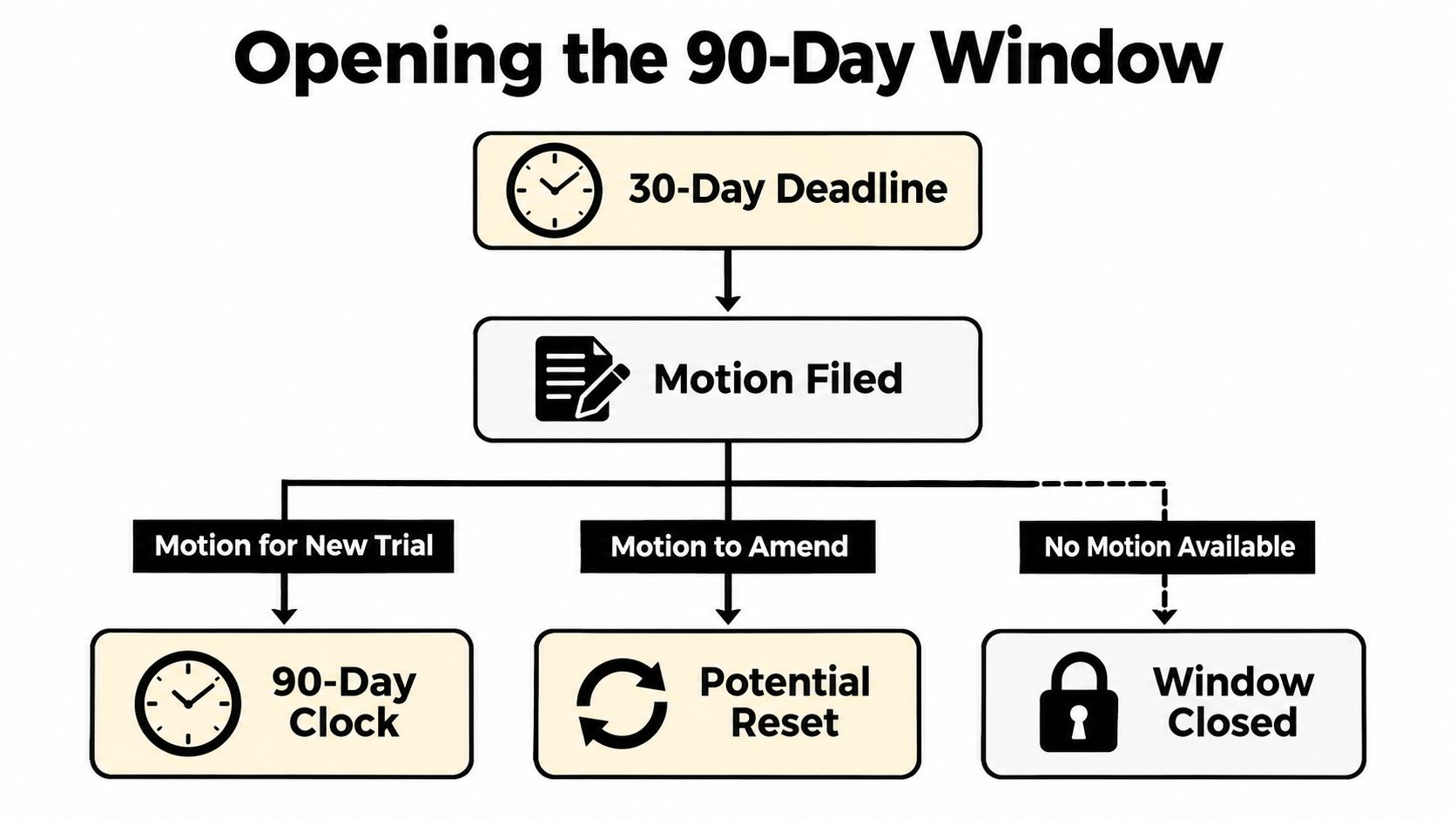
Before filing a post-judgment motion, determine whether it addresses a genuine legal problem and whether it will help build the appellate record. A timely, qualifying motion can extend the ordinary appeal deadline from 30 days to 90 days. That extension depends on the Texas Rules of Appellate Procedure and the filing date, not on the motion's title alone.
The available motion levers
A motion for new trial asks the trial court to reconsider the result after the hearing. It may address a significant legal mistake, the exclusion of important evidence, or a result that requires correction under the governing standard. A motion for new trial in Texas family law can provide background on that procedure, but the signed judgment and applicable rules control the deadline.
A motion to modify the judgment seeks a specific correction to the written order. It may identify an incorrect provision, an omission, or another defect. The motion should state the requested change clearly and explain the defect instead of merely repeating dissatisfaction with the result.
A motion to reinstate seeks restoration of a case after dismissal or a default-related problem. Its usefulness depends on the procedural history, the reason the case was removed, and why the party failed to proceed. Those facts determine whether the motion affects the appellate timetable.
In a bench trial, a qualifying request for findings of fact and conclusions of law can clarify the basis for the judgment. Findings separate factual determinations from legal conclusions and may sharpen the issues presented for appellate review. They also give counsel a clearer record to examine before deciding which complaints belong in the appeal.
The accelerated-appeal exception
Accelerated appeals follow a different clock. The notice is due within 20 days, and ordinary post-judgment motions do not extend that deadline. The Texas Supreme Court's 2005 decision in In re K.A.F. confirmed that the accelerated deadline is strict. A motion cannot safely be treated as opening the 90-day door when the appeal is accelerated.
Use one calendar for the signed-order date and every potentially deadline-extending filing. If the order may be accelerated, treat the 20-day date as controlling unless the governing statute and rules clearly provide otherwise. The full deadline matrix also includes the 90-day ordinary path, the 30-day baseline, and separate deadlines for restricted or interlocutory appeals. Correct classification comes before motion strategy.
Ordinary, Accelerated, Restricted, and Interlocutory Appeals Compared
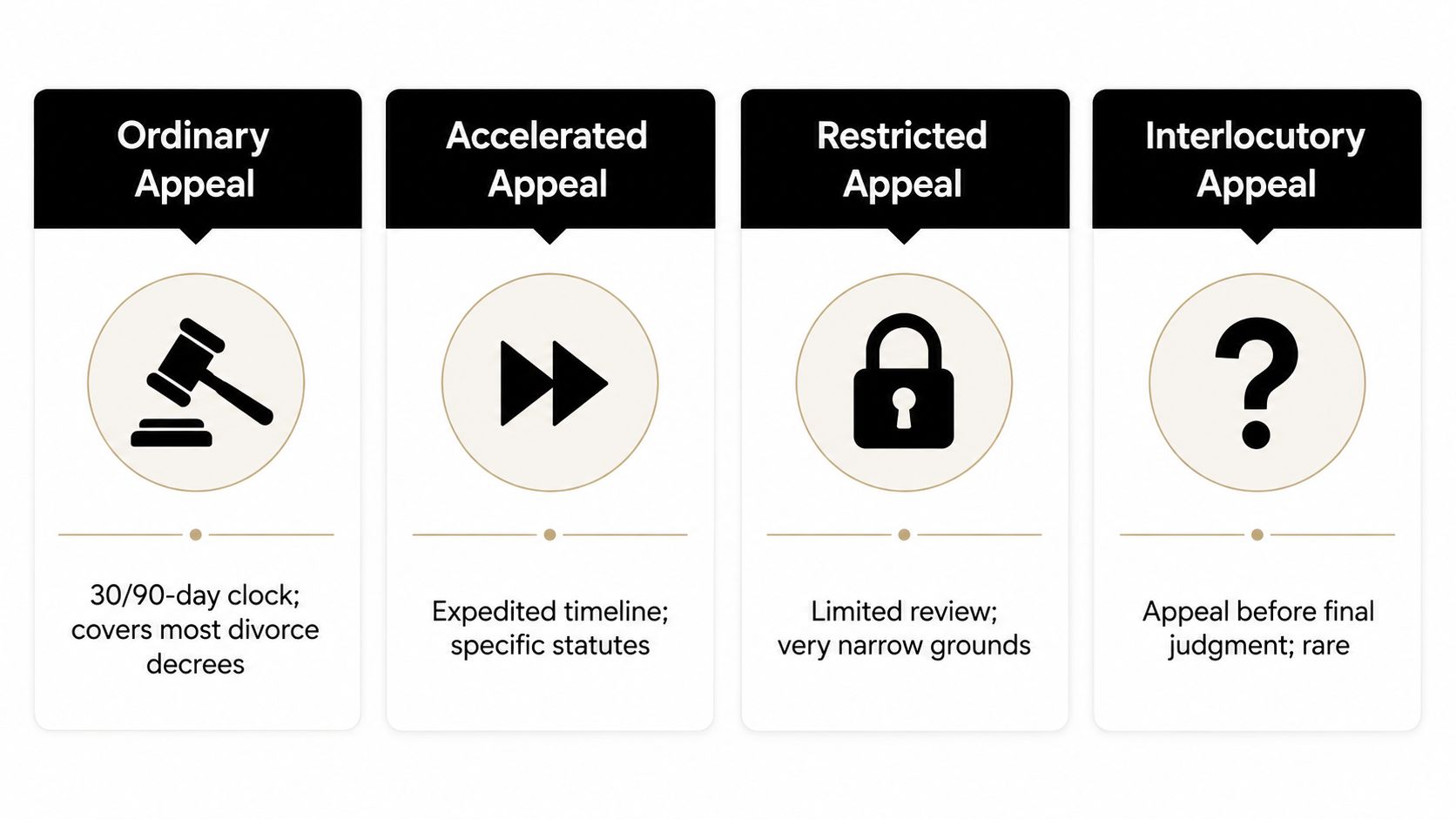
The first classification question is simple: What kind of order is this? A final divorce decree often follows the ordinary path. A termination or child-protection order may be accelerated. A party who never participated in the trial court may have a restricted-appeal route. A ruling made before final judgment may qualify for an interlocutory appeal only when a rule or statute permits it.
Ordinary appeals
Ordinary appeals cover many final family-law judgments, including divorce decrees, property divisions, support determinations, and custody orders. They generally use the 30-day deadline, or the 90-day deadline when a qualifying post-judgment motion or request is timely filed. The appellate court reviews the record and the assigned errors rather than conducting a new custody or property trial.
Accelerated appeals
Accelerated appeals move on the 20-day clock. Certain parental-termination and child-protection matters fall within this category because the child's circumstances require prompt appellate attention. A party and counsel must identify the accelerated status immediately, since ordinary motion practice won't extend the notice deadline.
Restricted appeals
A restricted appeal is limited. It can provide a six-month filing period for a party who did not participate in the trial-court proceeding and meets the other legal requirements. It isn't a fallback for every missed ordinary deadline, and the record must satisfy the restricted-appeal standards.
Interlocutory appeals
An interlocutory appeal challenges a ruling before the trial court has entered a final judgment. These appeals are available only for particular rulings authorized by statute or rule, and their timing and permission requirements differ from the ordinary matrix. A party shouldn't assume that any temporary or preliminary order can be appealed immediately.
A Family Law Scenario Where Deadlines Collide
Consider a parent whose Texas case ends with a final divorce decree addressing custody and property division. During the same week, the court also enters a related termination or child-protection order. The two rulings may feel like one family crisis, but appellate procedure can place them on different tracks.
The divorce decree generally follows the ordinary timetable. If counsel files a qualifying motion for new trial on time, the ordinary notice period may extend from 30 days to 90 days. That added time can allow counsel to examine the clerk's record, request necessary transcripts, evaluate the property findings, and prepare a focused challenge to the custody or division provisions.
The termination or protection order may be accelerated. Its notice deadline can be 20 days, and a post-judgment motion that would extend an ordinary appeal doesn't extend this accelerated timetable. If counsel waits for the ordinary deadline or assumes that the motion for new trial protects both orders, the accelerated ruling may become unavailable for merits review.
What the calendar teaches
The lesson isn't that every case requires emergency filings or that every ruling should be appealed. The lesson is that one family case can contain orders with different appellate clocks. Counsel should classify each signed order separately and identify whether one notice protects multiple rulings or whether separate notices are required.
The calendar isn't clerical work. It determines which alleged errors the appellate court is permitted to consider.
A motion strategy may preserve time for the ordinary decree while doing nothing for the accelerated order. That is why the notice date, order type, and requested relief must be reviewed together before anyone assumes that one filing solves the entire case.
Attorney and Client Checklist for Protecting the Right to Appeal
A careful post-judgment review begins with the documents, not assumptions about what happened in the courtroom. The hearing may have ended on one date, the written order may have been signed on another, and related orders may carry different classifications.
For trial attorneys
- Confirm the signing date: Use the date the judgment or appealable order was signed, not merely the hearing date.
- Identify every appealable order: Separate the divorce decree, custody ruling, support order, property judgment, protective order, enforcement ruling, or termination order when they appear in related proceedings.
- Classify the appeal: Determine whether the matter is ordinary, accelerated, restricted, or potentially interlocutory.
- Evaluate post-judgment options: Consider a motion for new trial, motion to modify, motion to reinstate, or qualifying findings request only after checking whether it fits the case and can affect the applicable deadline.
- Calendar all dates: Record the notice deadline, any motion deadline, the 14-day period for another party after the first notice, and any court-specific filing requirements.
- Verify filing mechanics: Confirm the correct court, electronic filing method, case number, parties, and required service.
For clients
Ask for the signed order in writing. Ask whether counsel plans to file a post-judgment motion, which deadline applies, and whether any order is accelerated. You should also understand that the notice of appeal protects the right to appellate review, while the later record and brief explain why the judgment should change.
A generic sample can look like this:
“Appellant [name of party] files this Notice of Appeal from the [final judgment or appealable order] signed on [date] in the [name of trial court], trial-court cause number [number], and seeks review of the rulings identified in the appellate record and relief authorized by law.”
That language is only a starting point. The actual notice must identify the correct parties, court, judgment, and relief, and local rules and court-specific forms still control.

Putting the Pillars Together and Taking the Next Step
Four principles organize Texas family appellate deadlines:
- The notice of appeal is jurisdictional. It invokes appellate jurisdiction and must be filed within the applicable period.
- The ordinary deadline is generally 30 days, but a qualifying, timely post-judgment filing can extend it to 90 days.
- An accelerated appeal uses a strict 20-day deadline that ordinary post-judgment motions don't extend.
- A restricted appeal may provide a six-month period for a party who didn't participate in the trial-court proceeding and satisfies the other requirements.
The practical work is calendar discipline, order classification, preservation, and record review. The appellate court can't correct an issue it lacks jurisdiction to hear, and it generally can't consider evidence that isn't in the trial-court record. Missing a date doesn't always mean every option has disappeared, but the available paths narrow quickly, so early advice matters.
For further reading, review the Texas family-law notice deadline resource and the grounds for appealing a Texas family-law ruling before discussing your case with counsel.
If you believe the court made a mistake in your family-law case, The Law Office of Bryan Fagan, PLLC can review the signed orders, applicable deadlines, trial record, and possible appellate issues during a focused consultation. Visit The Law Office of Bryan Fagan, PLLC to schedule a consultation and take the next step toward protecting your parental, financial, and legal rights.